
Football is a relationship, not a 90-minute product.
The match is a powerful shared moment. The opportunity is to earn a meaningful place in supporters’ lives before it, after it and between fixtures.
Christopher Roselli’s public beliefs on fan engagement, emotional connection and the opportunity to turn 90 minutes into 365 days of relevance.
The match is a powerful shared moment. The opportunity is to earn a meaningful place in supporters’ lives before it, after it and between fixtures.
A supporter has a family, a culture, routines, aspirations and responsibilities. Start with that life, rather than asking everyone to fit a club’s channels or calendar.
Purchases, clicks and attendance record activity. Explore the identity, belonging, inspiration and practical circumstances behind those actions before deciding what they mean.
A club badge can carry generations of meaning, while a player or experience can open a new connection. Treat those routes into football with curiosity rather than assuming one model of loyalty.
A young person should have opportunities to play, watch and belong. Examine scheduling, travel, accessibility and family commitments alongside awareness and price.
Men’s and women’s football can share a badge while offering distinct experiences. Sponsorship becomes more relevant when it responds to people’s motivations rather than treating visibility as the whole proposition.
Supporters move between stadiums, communities, content and everyday life. Give technology a clear role in making that experience coherent, useful and accessible.
Belonging is not permission to exploit attention or personal data. Offer a clear value exchange and respect each person’s choice about participation.
Quiet digital activity does not prove weak attachment. Build worthwhile opportunities to return and measure what people value, not simply how often they can be prompted to click.
Technology can enable an experience. People decide its purpose, take responsibility for delivery and learn whether it strengthens relationships. That is the work behind turning 90 minutes into 365 days of engagement.
THE FOOTBALL PARADOX / ARTICLE 4 OF 11
Why the next competitive advantage in world football may not come from buying another platform, but from connecting the intelligence already inside the organisation.
By Christopher Roselli · 17-minute read
Christopher Roselli’s published personal strategic perspective. Disclosed interests →
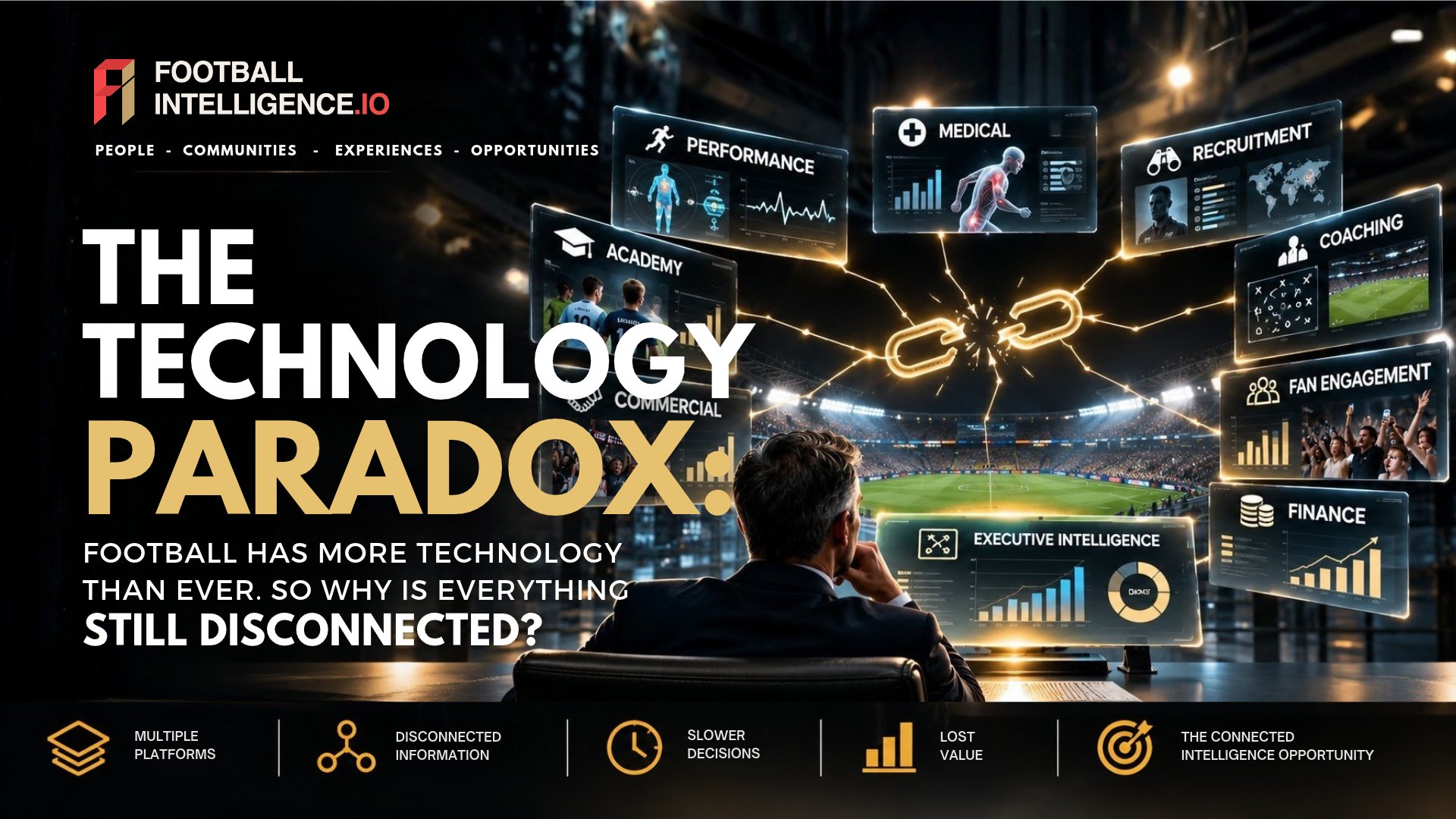
Consider a modern professional football club.
Its performance department uses sophisticated player-tracking systems.
Its medical department manages injury histories, rehabilitation programmes and player availability.
Recruitment analysts examine thousands of players through video, statistical models and scouting platforms.
Coaches use tactical analysis and match intelligence.
Academy departments monitor player development.
Commercial teams manage sponsorships, ticketing, customer relationships and fan engagement.
Finance operates its own forecasting, budgeting and reporting systems.
And executive leadership is expected to make strategic decisions across all of them.
Each department may possess exceptional technology.
Each platform may perform its intended function extremely well.
Yet here's the question I believe football needs to confront.
If every department has world-class technology, why doesn't the organisation automatically have world-class intelligence?
The answer may reveal one of the industry's most significant opportunities.
Because the problem isn't necessarily the technology.
It's what happens to information, understanding and decision-making between the technologies.
And solving that challenge may prove more valuable than purchasing the next generation of software.
We should begin by recognising how far the industry has come.
When I played professional football, much of the information available to coaches, players and executives depended on observation, experience, conversations and relatively limited performance data.
Today, the environment is dramatically different.
Tracking technologies can provide detailed information about physical activity.
Video analysis enables sophisticated tactical review.
Recruitment platforms allow organisations to evaluate players across international markets.
Medical and performance systems support more structured monitoring.
Digital platforms provide insights into supporter behaviour.
Artificial intelligence introduces new possibilities for interpreting information and supporting decisions.
And these innovations should be celebrated.
Companies across the football technology ecosystem have invested years developing specialised capabilities that can improve how clubs operate.
The issue isn't that football has invested in too much innovation.
The issue is whether organisations are capturing the full value of the innovations they've already purchased.
Because purchasing excellent technology and developing an intelligent organisation are two different things.
One involves acquiring capabilities.
The other requires connecting those capabilities to the decisions that matter.
Imagine a sporting director evaluating whether to sign a player.
The recruitment department has analysed performance statistics.
The scouting team has produced its reports.
The medical department is assessing available medical information.
The coaching staff is considering tactical compatibility.
Finance is reviewing salary structures and transfer affordability.
The academy department may have an internal player with a similar development trajectory.
Each department holds part of the picture.
But where does the complete organisational understanding exist?
And how efficiently can leadership access it?
The answer may depend on meetings.
Presentations.
Spreadsheets.
Individual conversations.
And the experience of the people responsible for bringing the information together.
That isn't necessarily a failure.
Professional judgement and human collaboration remain essential to football.
But it exposes a structural challenge.
The intelligence required for one decision may exist across five departments that were never designed to operate as one connected decision-making environment.
The same issue can arise elsewhere.
A player's return to performance involves medical, rehabilitation, physical preparation and coaching considerations.
A commercial investment may involve digital engagement, ticketing, sponsorship and finance.
An academy decision may involve recruitment, education, safeguarding, player development and first-team planning.
These decisions are inherently multidisciplinary.
Yet technology is frequently purchased and implemented around individual departmental requirements.
A departmental technology strategy does not automatically create an organisational intelligence strategy.
And that distinction matters enormously.
In 2024, researchers published a study titled Data Analytics in the Football Industry: A Survey Investigating Operational Frameworks and Practices in Professional Clubs and National Federations From Around the World.
The research examined how football organisations structure and use their analytical capabilities.
Among responding national federations, only 41% agreed that their data analysis strategy was consistent across all business units.
Only 48% agreed that the information needed to guide decision-making was readily available.
And just 42% reported that information generated from data was clearly communicated to coaching staff.
The sample was limited, and these findings should not be interpreted as representative of every club or federation.
But they illustrate the practical challenge.
Organisations can produce valuable information without consistently making it available, understandable or actionable across the people who need it.
Another important study, published in 2022, examined performance and medical practices across elite youth academies and national federations.
It found considerable variation in how information was managed and integrated.
Medical and performance data were reported as integrated within the same management system by 68% of the responding clubs, compared with 40% of responding national federations.
That is encouraging evidence of integration in some environments.
But it also highlights that the level of connection varies.
The lesson isn't that football is uniformly disconnected.
It isn't.
The lesson is that having data, sharing data and using connected intelligence to improve decisions are different levels of organisational capability.
That difference deserves much greater attention.
This is where I believe the conversation needs to move beyond traditional digital transformation.
When organisations talk about connecting technologies, they frequently begin with technical integration.
Does the system have an API?
Can data be exported?
Can the information be transferred into another platform?
Can we create a central dashboard?
These are important questions.
But technical connectivity is only the beginning.
Consider two systems exchanging player information.
One may define a particular performance metric differently from another.
One may use different collection methods.
One may update information daily.
Another may update after every training session.
One system may contain contextual observations that cannot be captured by a numerical value.
Technically, the information may be connected.
But does it mean the same thing?
Can it be compared reliably?
Can leadership understand its limitations?
And can it be used appropriately within a decision?
Connected data is not necessarily connected understanding.
This is one reason why standards matter.
FIFA has been developing a standard data format for Electronic Performance and Tracking Systems to improve the comparability of information from different sources and providers.
Its Football Data Ecosystem also uses structured frameworks and common definitions to improve consistency across data collection, processing and delivery.
These initiatives acknowledge something fundamental.
Information becomes more useful when people and systems have a shared understanding of what it represents.
But even standardised information doesn't automatically determine what an organisation should do.
That requires context.
Governance.
Interpretation.
Professional expertise.
And clarity about the decision being made.
Interoperability is an important foundation. Organisational intelligence is the broader objective.
They should.
A medical professional shouldn't be forced to operate inside a recruitment system that doesn't support medical workflows.
A coach shouldn't have to abandon specialist tactical analysis because a club wants fewer platforms.
And commercial teams shouldn't be expected to run fan engagement through software designed for player performance.
Specialisation is valuable.
The goal should not be technological uniformity.
Nor should it be replacing every platform with one enormous system that attempts to perform every function.
That approach can introduce its own limitations.
The real opportunity is to preserve specialist excellence while improving how relevant intelligence moves across the organisation.
This is an important distinction.
Because football has already made substantial investments in technology.
Those investments contain valuable capabilities, established workflows and considerable institutional knowledge.
Replacing them simply for the sake of consolidation could be expensive, disruptive and unnecessary.
Instead, leadership should ask a different question.
How can our existing technologies become more valuable when the right information, context and decisions are better connected?
That question has consequences far beyond IT procurement.
It changes how organisations think about digital strategy.
Consider a hypothetical example.
A club is preparing for an important match.
The performance department understands the physical demands placed on its players.
The medical team understands individual recovery considerations.
The coaching department understands the tactical requirements.
The fixture schedule creates additional constraints.
Each department is doing its job.
But the final selection decision requires an understanding of how these considerations interact.
The coach makes the decision.
That responsibility shouldn't disappear.
Nor should an algorithm replace the expertise of the medical and performance professionals involved.
But leadership should be able to trust that relevant information is available, current and understood.
Now extend the example across an entire season.
Player availability affects squad selection.
Squad selection influences playing opportunities.
Playing opportunities affect development.
Development influences recruitment and succession planning.
Recruitment affects financial commitments.
Financial commitments affect the club's wider strategic priorities.
These aren't isolated activities.
They're connected consequences.
The value of intelligence often emerges through the relationships between decisions, not simply through the information held within one department.
That is where the next stage of football's digital development becomes particularly interesting.
Artificial intelligence is moving rapidly into professional sport.
The possibilities are substantial.
AI can help analyse complex information, identify patterns, support operational workflows and make relevant knowledge easier to retrieve.
It may also provide new ways for specialists and decision-makers to interact with information.
But there's an important limitation.
An AI system doesn't automatically understand an entire football organisation simply because it can access large amounts of data.
If its information is incomplete, its answers may be incomplete.
If source definitions differ, its comparisons may be misleading.
If critical information is outdated, its recommendations may be unreliable.
And if the system lacks the context of why a decision was made, it may misinterpret the outcome.
Imagine asking an AI assistant:
"Which players should we prioritise for recruitment?"
A confident answer might look impressive.
But does it account for the club's actual playing philosophy?
Its academy pathway?
Current contractual commitments?
Financial position?
Medical considerations?
Regulatory restrictions?
And the strategic objectives established by leadership?
If not, the answer could be compelling while remaining operationally incomplete.
AI without trustworthy organisational context risks becoming another isolated layer of technology.
That doesn't make AI less valuable.
It makes the foundations more important.
Data quality.
Defined access permissions.
Shared terminology.
Source transparency.
Human accountability.
And decision-specific context.
Before an organisation invests in the next AI application, I believe its leadership should ask whether the foundations necessary to use that technology responsibly are already in place.
Otherwise, football risks repeating a familiar pattern.
Another impressive tool.
Another departmental deployment.
Another layer of information.
But not necessarily a better-connected organisation.
This may be the more uncomfortable question.
Technology purchasing can become a substitute for strategic clarity.
A department identifies a challenge.
A product promises a solution.
A business case is developed.
The organisation purchases the capability.
Sometimes that investment delivers exactly what was needed.
But sometimes the underlying problem was broader.
A club may believe it needs a better dashboard when its real challenge is inconsistent decision ownership.
It may believe it needs more data when the issue is an inability to interpret existing information.
It may believe it needs a new AI platform when its most important operational knowledge is fragmented or undocumented.
Or it may believe the problem is technical when it's actually organisational.
You cannot solve every leadership problem with a software licence.
And not every disconnected workflow requires a new platform.
Sometimes the most valuable innovation starts by understanding how the organisation makes decisions.
What information is required?
Who is responsible?
Where does that information originate?
What prevents it from being used?
And how would a better decision be recognised?
These questions should help shape the technology strategy.
Not simply follow it.
I believe one of football's greatest opportunities is to create more value from what organisations already possess.
This doesn't mean every existing system should be retained forever.
Some technologies will become outdated.
Some contracts may be inefficient.
Some systems may no longer meet the organisation's needs.
But wholesale replacement shouldn't be confused with transformation.
A more intelligent strategy begins by evaluating the capabilities already present.
Which systems are effective?
Which information sources are reliable?
Where are important gaps?
Which workflows genuinely require coordination?
And what needs to change for people to make better decisions?
In many cases, the opportunity may involve improving the connections between established systems, processes and people.
Rather than forcing departments into one technology environment, an organisation can focus on improving the availability and usefulness of relevant intelligence.
The objective is not one database containing everything.
It is not one dashboard for everyone.
And it is certainly not unrestricted access to sensitive information.
The objective is to ensure that the right people can access the right intelligence, in the right context, at the moment a decision needs to be made.
With appropriate safeguards.
With clear accountability.
And without undermining the specialist expertise on which football depends.
That's a much more meaningful definition of digital transformation.
There is an important qualification.
Football organisations manage highly sensitive information.
Medical records.
Player contracts.
Scouting assessments.
Personal information.
Commercial negotiations.
Youth-player information.
Financial forecasts.
These are not interchangeable data sources, and they should not be treated as freely accessible organisational assets.
In particular, health information and information relating to children require careful handling under applicable data protection rules.
Different professional roles have different responsibilities and legitimate information needs.
A connected organisation should not remove those boundaries.
It should respect them.
Organisational intelligence is not about exposing all information to everyone.
It's about establishing appropriate governance over what can be shared, how it can be used and who remains accountable.
A coach may need an appropriate availability assessment without access to an athlete's complete medical history.
A sporting director may need to understand a recruitment risk without receiving unrestricted confidential records.
Executive leadership may need an organisational overview without access to every individual's personal information.
Better connectivity must include better control.
Otherwise, an initiative intended to improve decision-making may introduce unacceptable legal, ethical and operational risks.
Here's where I believe this issue becomes particularly significant.
Football has become extremely sophisticated at developing specialised expertise.
Performance analysts.
Sports scientists.
Medical professionals.
Recruitment analysts.
Data scientists.
Commercial strategists.
Digital specialists.
All contribute to modern football.
But as the organisation becomes more complex, the challenge for executive leadership increases.
The CEO is responsible for the overall business.
The sporting director is responsible for building and sustaining a competitive sporting environment.
The finance director must understand financial commitments and risks.
The commercial director must develop revenue opportunities.
The technical and operational teams must ensure the organisation functions effectively.
These responsibilities intersect.
Yet executive reporting often remains organised around departments.
Reports explain what happened within each function.
But who is connecting the implications across the organisation?
Who identifies where one department's decision creates a consequence for another?
Who ensures that strategic priorities are reflected in operational decisions?
Who can explain whether investments in technology are creating measurable organisational value?
And who is responsible for the quality of the overall decision-making environment?
These are leadership questions.
Not simply technology questions.
The next evolution of digital maturity may be less about the sophistication of individual systems and more about the intelligence of the organisation as a whole.
1. Are we measuring technological capability or organisational outcomes?
Do we evaluate success by the platforms we've deployed, or by whether those capabilities improve decisions, efficiency, performance and commercial value?
2. Can our departments share relevant intelligence without creating unnecessary complexity?
Where do information gaps, duplicate processes and inconsistent definitions affect the organisation?
3. Are we investing in AI before establishing the foundations it requires?
Do we understand the quality, context, permissions and limitations of the information our AI applications use?
4. Can our leadership team see how decisions interact across departments?
Are we connecting sporting, operational and commercial implications where appropriate, or relying primarily on separate departmental reports?
5. Who owns organisational intelligence?
Is there clear accountability for making sure that technology investments, information governance and decision-making capabilities support the club's overall strategy?
I would encourage leadership teams to discuss these questions before approving their next significant technology investment.
Not because new technology is unnecessary.
But because the return on that investment may depend on organisational capabilities that software alone cannot provide.
I've spent approximately 15 years playing professional football and two decades working across digital innovation and strategic development.
Those experiences provide two perspectives on the same challenge.
From football, I understand the importance of specialist expertise, professional judgement, trust and the relationships that exist inside a competitive organisation.
From digital innovation, I've seen how powerful technology can become when it supports a clearly defined strategy.
But I've also seen how complexity can grow when organisations accumulate systems without a sufficiently connected view of what they are trying to achieve.
The lesson I've taken from both environments is straightforward.
Technology should serve the organisation's intelligence and decision-making needs, not determine them.
I believe football is approaching a stage where this distinction will become increasingly important.
Not simply because AI is advancing.
But because the complexity of operating professional football clubs, academies, leagues and federations continues to demand better coordination.
The opportunity isn't limited to elite men's football.
Women's football organisations face important decisions about how to build modern capabilities without automatically inheriting unnecessary technological complexity.
Academies need better connections between development pathways and long-term planning.
Federations need appropriate coordination across competitions, national teams and player development structures.
And clubs at every level need to consider whether technology investments are delivering the outcomes they were intended to achieve.
A smaller organisation with clear strategy and connected decision-making can be more effective than a larger organisation with more technology but less clarity.
That is a competitive question worth taking seriously.
This challenge connects directly with the development of the Football Intelligence Index through FOOTBALLINTELLIGENCE.io.
The Index is being developed as an independent framework for examining how football organisations approach intelligence, technology, commercial innovation and strategic execution.
The methodology includes consideration of digital maturity, ecosystem connectivity and leadership capabilities.
A central distinction will be important.
Owning technology is not the same as using it intelligently.
An organisation shouldn't automatically receive a stronger assessment simply because it has purchased more platforms.
Nor should it be penalised for using specialist systems that are appropriate for its operations.
A more meaningful evaluation considers how technology contributes to organisational outcomes.
Whether information is reliable.
Whether relevant capabilities are connected.
Whether decisions have appropriate context.
Whether information governance is effective.
And whether leadership can demonstrate that digital investments are improving how the organisation operates.
The methodology is still being developed, and this article does not constitute a ranking of any organisation or technology provider.
But it raises a question I believe should become central to the industry's understanding of digital maturity.
How should we evaluate a football organisation's intelligence, rather than simply its technology spending?
That's a distinction the industry needs to explore.
There will always be new technologies.
New data sources.
New analytical capabilities.
New AI applications.
And new vendors offering valuable improvements.
Innovation should continue.
Football should embrace the opportunities.
But we should also recognise that a growing technology ecosystem creates an increasing responsibility to manage complexity.
Because a club does not become more intelligent simply by collecting more information.
It becomes more intelligent when relevant information contributes to better understanding and better decisions.
When departments retain their expertise while collaborating effectively.
When leadership can see the implications of important decisions.
When AI is grounded in trustworthy context.
And when technology investments create measurable value.
The next competitive advantage may not belong to the football organisation with the most technology.
It may belong to the organisation that understands how to make its technology work together.
So here's the question I want to leave with football's leadership.
If your club has invested millions in technology, but your leadership team still needs five departments, three meetings and several spreadsheets to understand one strategic decision, how intelligent is your organisation?
That is the Technology Paradox.
And I believe resolving it could become one of world football's most important competitive advantages.
FIFA | Football Data Ecosystem
FIFA's approach to structured football data, common definitions, quality and delivery.
https://inside.fifa.com/innovation/innovating-the-game/football-data-ecosystem
FIFA | EPTS Standard Data Format
Research and standards supporting comparability between different tracking systems and providers.
https://inside.fifa.com/innovation/standards/epts/research-development-epts-standard-data-format
FIFA | EPTS Preferred Provider Initiative
Includes commitments to standardised data formats, APIs and interoperability.
https://quality.fifa.com/innovation/standards/epts/epts-fifa-preferred-provider-initiative
Data Analytics in the Football Industry | 2024
Data Analytics in the Football Industry: A Survey Investigating Operational Frameworks and Practices in Professional Clubs and National Federations From Around the World.
https://doi.org/10.1080/24733938.2024.2341837
Frontiers in Sports and Active Living | 2022
A Survey of Organizational Structure and Operational Practices of Elite Youth Football Academies and National Federations From Around the World: A Performance and Medical Perspective.
https://doi.org/10.3389/fspor.2022.1031721
IEEE | P3715 Proposed Standard for a Common Exchange Format for Match-Data in Football
A standards-development initiative addressing information exchange across match-data sources.
https://standards.ieee.org/ieee/3715/12303/