
Football is a relationship, not a 90-minute product.
The match is a powerful shared moment. The opportunity is to earn a meaningful place in supporters’ lives before it, after it and between fixtures.
Christopher Roselli’s public beliefs on fan engagement, emotional connection and the opportunity to turn 90 minutes into 365 days of relevance.
The match is a powerful shared moment. The opportunity is to earn a meaningful place in supporters’ lives before it, after it and between fixtures.
A supporter has a family, a culture, routines, aspirations and responsibilities. Start with that life, rather than asking everyone to fit a club’s channels or calendar.
Purchases, clicks and attendance record activity. Explore the identity, belonging, inspiration and practical circumstances behind those actions before deciding what they mean.
A club badge can carry generations of meaning, while a player or experience can open a new connection. Treat those routes into football with curiosity rather than assuming one model of loyalty.
A young person should have opportunities to play, watch and belong. Examine scheduling, travel, accessibility and family commitments alongside awareness and price.
Men’s and women’s football can share a badge while offering distinct experiences. Sponsorship becomes more relevant when it responds to people’s motivations rather than treating visibility as the whole proposition.
Supporters move between stadiums, communities, content and everyday life. Give technology a clear role in making that experience coherent, useful and accessible.
Belonging is not permission to exploit attention or personal data. Offer a clear value exchange and respect each person’s choice about participation.
Quiet digital activity does not prove weak attachment. Build worthwhile opportunities to return and measure what people value, not simply how often they can be prompted to click.
Technology can enable an experience. People decide its purpose, take responsibility for delivery and learn whether it strengthens relationships. That is the work behind turning 90 minutes into 365 days of engagement.
THE FOOTBALL PARADOX / ARTICLE 8 OF 11
Why football's next competitive advantage may not belong to the organisation with the most sophisticated AI, but to the one that understands what intelligence it actually needs.
By Christopher Roselli · 17-minute read
Christopher Roselli’s published personal strategic perspective. Disclosed interests →
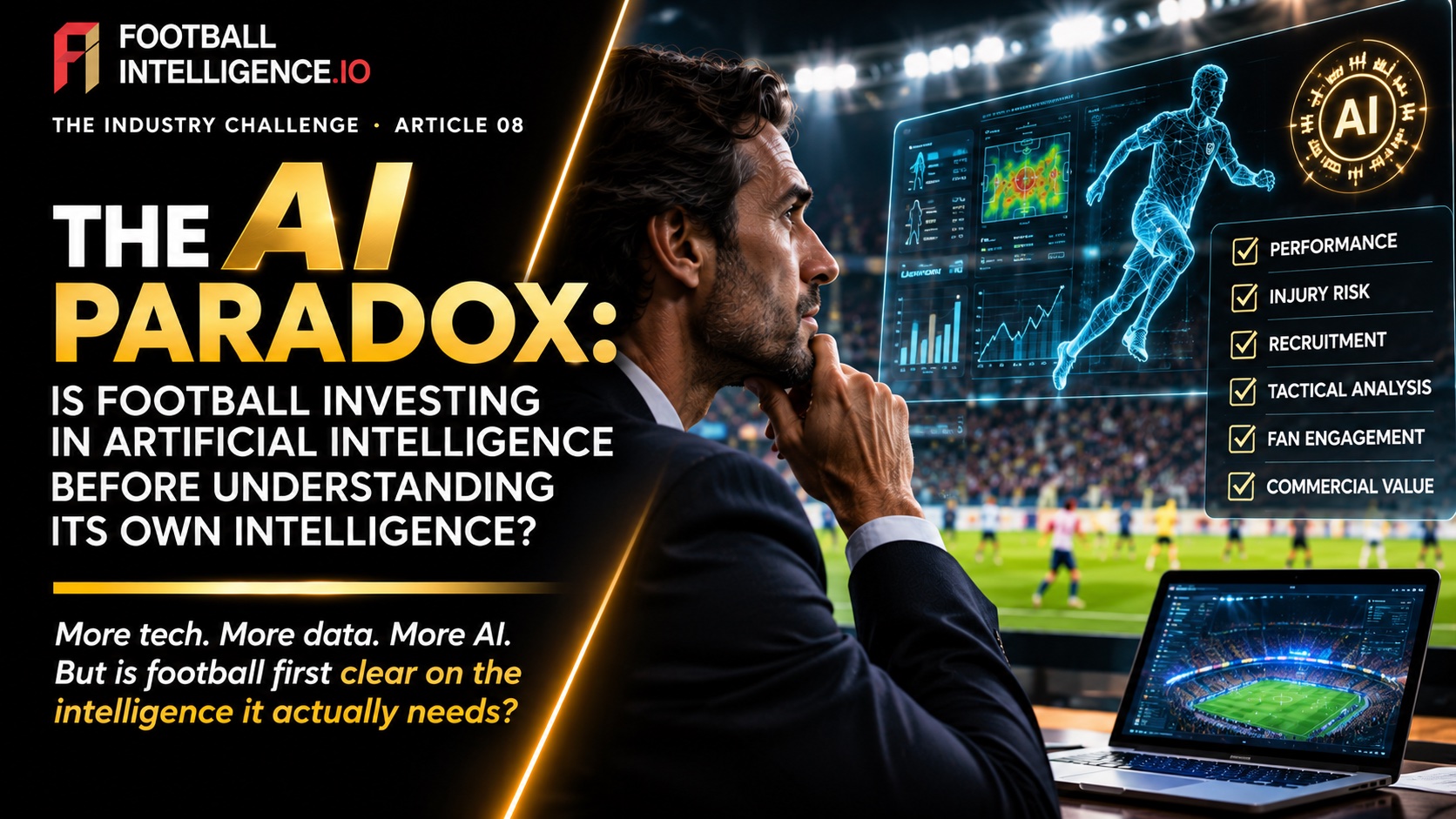
Imagine a professional football club announcing a significant investment in artificial intelligence.
The recruitment department wants AI-powered scouting.
The medical department is evaluating predictive models.
Coaching wants automated tactical intelligence.
Commercial wants personalised fan engagement.
Finance wants forecasting capabilities.
And executive leadership wants a dashboard that brings everything together.
The technology demonstrations are impressive.
The possibilities appear extraordinary.
The organisation is excited.
But before approving the investment, I would ask one question.
What does this football organisation actually need to become more intelligent about?
Not which AI platform should it purchase.
Not which vendor has the most impressive demonstration.
And not how quickly it can announce an innovation partnership.
What decisions are we trying to improve, what do we currently misunderstand, and what measurable value should greater intelligence create?
Because there is an important distinction emerging across world football.
Investing in artificial intelligence is not the same as developing an intelligent organisation.
And I believe that distinction could define the next competitive advantage in professional football.
This is not an argument against AI.
Quite the opposite.
Artificial intelligence presents extraordinary opportunities across sporting performance, operations, commercial development and supporter engagement.
And there are already meaningful examples.
At the FIFA World Cup 2026, FIFA and Lenovo introduced Football AI Pro, an analytical assistant developed to make sophisticated match intelligence more accessible to participating teams.
The technology combines structured match information, video, tracking data and specialised football terminology to help analysts and coaching staff explore tactical questions.
FIFA subsequently reported that all 48 participating teams interacted with the system, across 15 languages.
This demonstrates an important opportunity.
AI can make complex information more accessible to people who need it, including organisations without the resources to employ large specialist teams.
But there is another important lesson.
Football AI Pro is not simply a generic AI assistant connected to arbitrary information.
It has been developed around a specific purpose, structured football data, a shared analytical language and defined workflows.
The intelligence objective was established before the technology was expected to deliver it.
That distinction matters.
Because successful AI adoption isn't simply about having access to powerful models.
It's about understanding the problem, establishing the context and developing the conditions required for useful results.
In Article 04 of The Industry Challenge, I examined football's growing technology ecosystem.
Performance has its systems.
Medical has its systems.
Recruitment has its platforms.
Coaching has its analytics.
Commercial has its technology.
Finance has its reporting.
Each department may possess excellent capabilities.
But these environments are not always connected around the organisation's strategic decisions.
Now introduce artificial intelligence.
Suddenly, organisations want a system capable of understanding everything.
But here's the problem.
AI cannot automatically resolve organisational ambiguity simply because it can process information more quickly.
If departments use different definitions, the AI needs to account for those differences.
If information is incomplete, the AI's conclusions may be incomplete.
If access permissions are unclear, connecting information may introduce risks.
And if departments disagree about what constitutes success, the AI cannot independently establish the organisation's priorities.
Consider a simple example.
The recruitment department describes a player as an excellent opportunity.
The coaching department questions his tactical compatibility.
Medical identifies considerations requiring professional evaluation.
Finance raises concerns about the total financial commitment.
The academy believes an internal player deserves an opportunity.
Each perspective may be valid.
Each may be based on evidence.
But the decision is not simply a mathematical problem.
It involves organisational strategy, professional judgement, uncertainty and competing priorities.
Before AI can support a better decision, the club needs clarity about how that decision should be made.
That's not a technology problem.
It's a leadership problem.
Football generates enormous volumes of information.
Player tracking.
Video.
Physical performance.
Recruitment statistics.
Injury records.
Contracts.
Ticketing.
Merchandise.
Digital interactions.
Sponsorship reporting.
The availability of information is remarkable.
But information alone is not intelligence.
A database can contain millions of records without explaining what those records mean in context.
A model can identify patterns without proving why they exist.
An algorithm can produce predictions without determining what an organisation should do.
And an AI assistant can generate convincing language without guaranteeing that its conclusions are correct.
This connects directly to Article 03: The Fan Data Paradox.
Knowing what a supporter purchases does not necessarily explain why that purchase matters.
Knowing that a player recorded a particular performance metric does not automatically explain its tactical significance.
And knowing that commercial revenue increased does not necessarily establish whether the underlying supporter relationship became stronger.
Artificial intelligence can dramatically improve our ability to process information.
But processing information is not the same as understanding its meaning.
That is why human expertise, context and the quality of the underlying evidence remain essential.
One of the more important developments in football technology is not necessarily an AI application.
It's the effort to establish common definitions and reliable information.
FIFA's Football Data Ecosystem includes structured approaches to data collection, processing, validation and delivery.
The organisation has also developed its Football Language framework to support more consistent analysis.
This matters because even apparently straightforward football events can be defined differently.
FIFA has documented areas where its event definitions align with those used by Stats Perform, alongside areas where different collection methods and interpretations remain.
Think about what that means for AI.
If two systems use different definitions for a football event, combining their outputs without accounting for those differences can produce misleading comparisons.
If the source information is unreliable, an AI model may confidently analyse information that should not have been treated as comparable.
And if the organisation cannot explain where a conclusion came from, decision-makers may struggle to assess its reliability.
The future of intelligent football depends partly on foundations that are far less glamorous than artificial intelligence itself.
Shared terminology.
Information quality.
Appropriate governance.
Reliable access.
Clear ownership.
And professional interpretation.
These may not generate the same excitement as a new AI product announcement.
But they are essential ingredients of sustainable innovation.
Consider FC Schalke 04.
In September 2026, Microsoft published a case study detailing how the club had developed a more connected information foundation using Microsoft Fabric and Azure Databricks.
The stated challenge was not simply to acquire artificial intelligence.
The club wanted to reduce information fragmentation and improve the availability of useful insights across sporting and business operations.
Its initial work included consolidating and cleaning approximately 220,000 membership records.
According to the published case study, the club subsequently reported substantially faster initial data integration and a 60% reduction in reporting effort.
The same foundation was intended to support additional analytical capabilities, including future AI applications.
These are vendor-reported outcomes from a particular implementation, not independently verified benchmarks for the entire industry.
But the strategic sequence is instructive.
Define the organisational problem. Improve the information foundation. Establish useful workflows. Then expand the intelligence capabilities.
It's a much stronger starting point than purchasing an impressive AI product and hoping the organisation will discover how to use it.
And it raises an important question for clubs of every size.
Should the first AI investment be in another AI application, or in making existing information more useful?
The answer will depend on the organisation.
But leadership should understand the difference before committing resources.
Football operates under extraordinary pressure.
Transfer windows.
Fixture congestion.
Player availability.
Financial constraints.
Commercial deadlines.
Supporter expectations.
Leadership is frequently required to make complex decisions quickly.
AI can help.
It may reduce time spent gathering information.
Automate repetitive tasks.
Identify relevant patterns.
Support forecasting.
And allow professionals to focus on higher-value activities.
But speed alone isn't the objective.
Imagine a recruitment process that previously required several days of analysis.
AI reduces the preparation time to minutes.
That's potentially valuable.
But did the resulting decision improve?
Were relevant risks considered?
Was the analysis based on reliable information?
Did the system recognise uncertainty?
Was the recommendation consistent with the club's strategy?
And did the responsible professionals understand why it was produced?
A faster decision is not automatically a better decision.
Neither is a more visually impressive recommendation.
The real measure of AI success should be whether it improves the outcomes the organisation is trying to achieve.
That requires evaluation.
Not simply adoption.
One of the challenges with generative artificial intelligence is that convincing communication can be mistaken for reliable understanding.
A system may produce a detailed scouting report.
A comprehensive commercial forecast.
A tactical assessment.
Or a persuasive executive recommendation.
The output may look authoritative.
But that doesn't guarantee that its evidence is complete, current or correctly interpreted.
The United States National Institute of Standards and Technology has developed an AI Risk Management Framework addressing issues including validity, reliability, transparency, explainability, privacy and accountability.
Its work on generative AI also recognises the risk of people placing excessive trust in automated outputs.
This is particularly important in football.
A transfer decision can involve substantial financial commitments.
A medical decision can affect an athlete's wellbeing.
A contractual recommendation can create legal consequences.
And a commercial decision can influence relationships with supporters and partners.
The more consequential the decision, the more important it becomes to understand the limitations of the AI supporting it.
The objective should not be to remove professional accountability.
It should be to strengthen the information available to the people responsible.
AI can support expertise.
But expertise still needs to challenge AI.
AI agents are becoming an increasingly important area of technology development.
Rather than simply answering questions, some systems can assist with workflows involving multiple steps, tools and information sources.
This creates interesting opportunities across football.
An executive assistant could help prepare an organisational briefing.
A recruitment workflow could help coordinate permitted information from several sources.
A commercial workflow could support the preparation of partnership analysis.
An operational assistant could help identify scheduling conflicts or outstanding actions.
But the existence of an agent does not answer the most important governance questions.
Who authorises the task?
Which information may be accessed?
Which systems can be updated?
What happens when the sources disagree?
What actions require approval?
Who is accountable if the system makes a mistake?
And how is performance monitored over time?
These issues become especially important when AI is given the ability to take actions rather than merely produce information.
Automation without accountability is not organisational intelligence.
It is an operational risk.
The more powerful AI agents become, the more important the organisation's governance and decision-making structures will be.
There is another issue that deserves attention.
Football organisations manage highly sensitive information.
Medical records.
Physical performance information.
Contracts.
Recruitment assessments.
Personal details.
Youth-player information.
And supporter profiles.
Not every dataset should be connected.
Not every professional should have unrestricted access.
And not every use of personal information is appropriate simply because an AI system can process it.
Major League Soccer's March 2026 announcement of a league-wide privacy management and governance initiative illustrates that data protection is becoming an increasingly important part of football's digital operations.
This is not simply a compliance consideration.
It's a question of trust.
A player should have confidence that sensitive information is handled appropriately.
Supporters should understand how their personal information is used.
And organisations should establish clear boundaries around automated recommendations and decisions affecting individuals.
The purpose of intelligence should be to create value responsibly, not to maximise how much information can be extracted from people.
This connects to a principle I've raised repeatedly throughout The Industry Challenge.
Better understanding should not require the abandonment of privacy, trust or human dignity.
And better technology should not weaken the professional responsibilities that make football organisations accountable.
There is a natural assumption in professional sport that competitive advantage requires substantial investment.
Sometimes it does.
Elite tracking systems.
Advanced data infrastructure.
Specialist personnel.
Custom analytical capabilities.
These can demand considerable resources.
But not every organisation needs the same solution.
A major European club may have an established analytical department and extensive infrastructure.
A smaller professional club may operate with a handful of specialists.
A women's football organisation may be building its commercial and operational capabilities.
A federation may manage a complex network of competitions, national teams and development programmes.
The intelligence needs differ.
And so should the investments.
A smaller organisation may achieve meaningful results by improving one clearly defined workflow.
A larger organisation may need extensive changes to information governance before AI can operate reliably across departments.
The question is not how advanced the AI is.
It's whether the capability is appropriate to the problem, the resources available and the value the organisation expects to create.
Football should be wary of turning AI into another technological arms race where investment scale becomes confused with innovation maturity.
The smartest investment may be the one that solves a meaningful problem with the least unnecessary complexity.
I believe football executives would benefit from distinguishing three levels.
1. INFORMATION INTELLIGENCE: WHAT DO WE KNOW?
This includes the quality, availability, definitions and reliability of relevant information.
Without trustworthy evidence, the next level is compromised.
2. DECISION INTELLIGENCE: WHAT DOES THE INFORMATION MEAN FOR WHAT WE'RE TRYING TO ACHIEVE?
This involves context, professional interpretation, organisational priorities, uncertainty and the relationships between different sources of evidence.
It requires understanding the decision.
Not simply generating another report.
3. ORGANISATIONAL INTELLIGENCE: CAN WE ACT COHERENTLY AND LEARN FROM THE OUTCOME?
This is where leadership, departments, technology and accountability intersect.
Can relevant people collaborate?
Can decisions be evaluated?
Can the organisation recognise what worked?
And can those lessons improve future performance?
These are proposed strategic distinctions, not a claim that football has universally adopted a formal three-level model.
But they help explain why AI alone is not the destination.
Artificial intelligence can contribute across all three levels.
It cannot replace the need to define and govern them.
Much of the discussion around commercial AI focuses on personalisation.
More relevant recommendations.
Automated customer service.
Targeted offers.
Content generation.
These are legitimate use cases.
But I believe football should think more broadly.
Consider a supporter who follows a club because of an individual player.
A family who wants to attend matches but faces scheduling difficulties.
An international supporter who wants a stronger connection to the club's community.
Or a young footballer inspired by the professional game.
AI may help organisations recognise patterns, improve services and provide more relevant information.
But the underlying opportunity doesn't begin with a model.
It begins with understanding what matters to those supporters.
This is where cognitive anthropology becomes particularly relevant.
Human motivations are shaped by relationships, culture, identity and personal meaning.
AI can help organisations respond to human needs. But it should not be mistaken for an automatic understanding of those needs.
That distinction is central to my established approach to moving from 90 minutes to 365 days of engagement.
Not 365 days of automated marketing.
Not more notifications.
And not another disconnected digital platform.
But meaningful opportunities that fit into supporters' lives throughout the year.
The objective should be to use technology to improve the relationship, not simply increase the frequency of contact.
1. What specific decision or organisational outcome are we trying to improve?
If the answer is vague, the investment case probably needs more work.
2. Can we trust the information and assumptions on which the system will depend?
Are the relevant sources accurate, sufficiently current and appropriate for the intended use?
3. Do we understand how the AI will interact with existing systems and professional responsibilities?
Will it support established expertise and workflows, or create another disconnected technology layer?
4. Who is accountable for its outputs, actions and consequences?
Are there clear rules for information access, human oversight, approvals and evaluation?
5. How will we know whether the organisation has become more intelligent?
What measurable improvement should we expect in decision quality, operational efficiency, supporter experiences or sustainable commercial outcomes?
These questions shouldn't be left entirely to technology departments.
They belong in the boardroom.
Because AI strategy is ultimately about organisational priorities.
And those priorities are leadership responsibilities.
I've spent approximately 15 years playing professional football and two decades working across digital innovation, commercial strategy and connected experiences.
Those two worlds have taught me something important.
Professional football depends on expertise, judgement, preparation, trust and the ability to make decisions under pressure.
Digital innovation creates opportunities to improve those capabilities through better information, new experiences and more intelligent workflows.
But technology only creates value when it serves a meaningful objective.
I believe the greatest opportunity in football AI isn't necessarily another application.
It's developing the conditions in which the intelligence already present across an organisation can become more useful.
The expertise of its people.
The information held within existing systems.
The knowledge developed through experience.
The relationships between departments.
And the strategic priorities established by leadership.
These are already valuable organisational assets.
AI should help connect and strengthen them, not become another isolated investment competing for attention and resources.
This is where I see an opportunity for genuine executive-level innovation.
Not simply adopting the latest technology.
But asking what a more intelligent football organisation should actually look like.
And then approaching that ambition with strategic discipline.
This question connects directly to the ongoing development of the Football Intelligence Index through FOOTBALLINTELLIGENCE.io.
The Index is being developed as an independent framework examining how football organisations approach fan intelligence, digital maturity, commercial innovation, ecosystem connectivity and leadership execution.
Artificial intelligence introduces an important consideration.
Should an organisation be considered digitally mature simply because it has adopted AI?
I don't believe so.
AI adoption is evidence of technological activity.
But evaluating readiness requires a wider understanding.
Does leadership have a clear purpose?
Can the organisation establish trustworthy information foundations?
Does it maintain appropriate governance?
Can relevant capabilities operate together?
Are professional responsibilities respected?
And can the organisation demonstrate that its investments improve outcomes?
These are more meaningful questions than how many AI applications a club has purchased.
The Index methodology remains in development, and this article does not assign scores or rankings to football organisations.
But I believe one principle deserves serious consideration.
The maturity of an organisation's AI strategy should be judged by the intelligence and value it develops, not simply the technology it deploys.
That is a distinction worth making before AI becomes another standard line item in football's annual technology budget.
AI will continue evolving.
Models will become more capable.
Agents will support increasingly complex workflows.
Information will become easier to analyse.
And some of today's technological limitations will undoubtedly change.
Football should embrace that progress.
But the fundamentals of good strategy will remain.
Clarity of purpose.
Reliable information.
Professional expertise.
Human understanding.
Organisational coordination.
Accountability.
And the ability to evaluate whether decisions produce meaningful outcomes.
The organisation that invests most aggressively in AI will not automatically become the most intelligent.
Nor will the organisation that waits necessarily be better prepared.
The opportunity belongs to leadership teams that understand where AI can create genuine value and establish the conditions required to deliver it.
That may involve sophisticated technology.
It may involve better connections between existing systems.
It may involve improving information quality.
And sometimes it may involve addressing an organisational problem that technology alone cannot solve.
So here's the question I want to leave with football's executive leadership.
If your club deployed the world's most advanced artificial intelligence tomorrow, but its departments remained disconnected, its information remained inconsistent and its leadership lacked a shared strategy, how much more intelligent would the organisation actually become?
That is the AI Paradox.
And I believe answering it could help define the next era of competitive advantage across world football.
Because the future of football intelligence shouldn't begin with asking what AI can do.
It should begin with understanding what the organisation needs to become capable of doing better.
FIFA | 2026
FIFA AI Pro: Football Analysis and Decision Support
https://inside.fifa.com/innovation/innovating-the-game/fifa-ai-pro
FIFA and Lenovo | January 2026
FIFA and Lenovo Unveil Multiple AI-Powered Innovations Ahead of the FIFA World Cup 2026
https://football-technology.fifa.com/media-releases/lenovo-tech-world-ai-powered-innovations-world-cup-2026
FIFA | Football Data Ecosystem
https://inside.fifa.com/innovation/innovating-the-game/football-data-ecosystem
Microsoft | September 2026
FC Schalke 04 Turns Data Into Decisions 3x Faster With Microsoft Fabric and Azure Databricks
https://www.microsoft.com/en/customers/story/27275-fc-schalke-04-microsoft-fabric
Major League Soccer | March 2026
MLS Announces Collaboration With DataGrail to Power AI-Driven Data Privacy and Governance
https://www.mlssoccer.com/news/major-league-soccer-announces-collaboration-with-datagrail-to-power-ai-driven-data-privacy-and-governance-across-the-league-and-club-partners
NIST | AI Risk Management Framework
https://www.nist.gov/itl/ai-risk-management-framework
UK Government | Data and AI Ethics Framework
https://www.gov.uk/government/publications/data-ethics-framework/data-and-ai-ethics-framework