
Football is a relationship, not a 90-minute product.
The match is a powerful shared moment. The opportunity is to earn a meaningful place in supporters’ lives before it, after it and between fixtures.
Christopher Roselli’s public beliefs on fan engagement, emotional connection and the opportunity to turn 90 minutes into 365 days of relevance.
The match is a powerful shared moment. The opportunity is to earn a meaningful place in supporters’ lives before it, after it and between fixtures.
A supporter has a family, a culture, routines, aspirations and responsibilities. Start with that life, rather than asking everyone to fit a club’s channels or calendar.
Purchases, clicks and attendance record activity. Explore the identity, belonging, inspiration and practical circumstances behind those actions before deciding what they mean.
A club badge can carry generations of meaning, while a player or experience can open a new connection. Treat those routes into football with curiosity rather than assuming one model of loyalty.
A young person should have opportunities to play, watch and belong. Examine scheduling, travel, accessibility and family commitments alongside awareness and price.
Men’s and women’s football can share a badge while offering distinct experiences. Sponsorship becomes more relevant when it responds to people’s motivations rather than treating visibility as the whole proposition.
Supporters move between stadiums, communities, content and everyday life. Give technology a clear role in making that experience coherent, useful and accessible.
Belonging is not permission to exploit attention or personal data. Offer a clear value exchange and respect each person’s choice about participation.
Quiet digital activity does not prove weak attachment. Build worthwhile opportunities to return and measure what people value, not simply how often they can be prompted to click.
Technology can enable an experience. People decide its purpose, take responsibility for delivery and learn whether it strengthens relationships. That is the work behind turning 90 minutes into 365 days of engagement.
THE FOOTBALL PARADOX / ARTICLE 3 OF 3
Why the next competitive advantage in football may come not from collecting more data, but from understanding the human behaviour behind it.
By Christopher Roselli · 13-minute read
Christopher Roselli’s published personal strategic perspective. Original article: LinkedIn edition ↗. Disclosed interests →
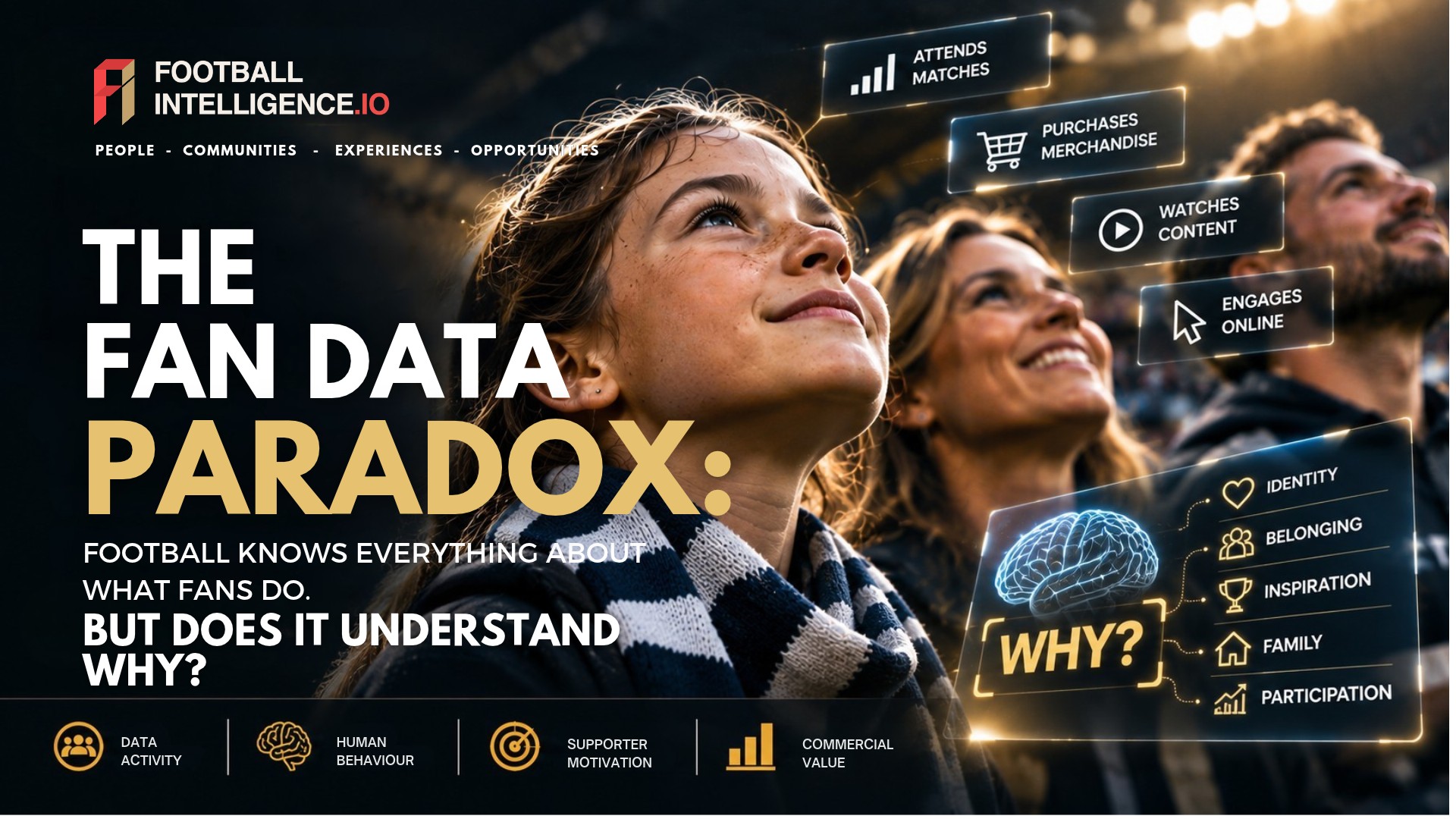
We know which matches they attend.
Which merchandise they purchase.
Which videos do they watch?
Which social media posts do they engage with?
Which emails do they open?
And increasingly, which digital experiences generate the strongest response?
We call this data.
We call it analytics.
And sometimes, we call it fan intelligence.
Are we genuinely understanding our supporters, or simply becoming more sophisticated at recording what they do?
Because there is an enormous difference.
Football doesn't necessarily have a shortage of information about its supporters. It has an opportunity to understand the human meaning behind that information much more deeply.
And until we begin treating those as two distinct capabilities, we may continue confusing measurable activity with meaningful engagement.
Imagine two supporters purchasing exactly the same football shirt.
Same club.
Same player.
Same price.
Same transaction.
From a commercial analytics perspective, those purchases may look almost identical.
But consider what could be happening beneath them.
The first supporter buys the shirt because their father supported the club, their grandfather supported the club, and wearing those colors represents a family identity passed between generations.
The second supporter buys the shirt because they recently discovered a player whose journey inspired them.
One purchase is rooted in family tradition.
The other is in personal aspiration.
The transaction may be identical.
The emotional significance is not.
Now ask yourself a question.
If those two supporters represent different motivations, why would we assume the same communication, sponsorship activation, or engagement strategy will be equally meaningful to both?
This is where the distinction between behavioral data and human understanding becomes important.
Data can tell us that a purchase occurred.
It may help us identify patterns and form hypotheses about motivation.
But the transaction alone cannot establish why the purchase mattered.
Behavior tells us what happened. Human understanding helps us explore why it happened.
And that distinction changes the commercial conversation.
Football organizations have access to an extraordinary range of digital capabilities.
Customer relationship management systems.
Ticketing platforms.
E-commerce.
Mobile applications.
Social media analytics.
Broadcasting data.
Digital memberships.
Marketing automation.
And increasingly sophisticated artificial intelligence.
These capabilities have transformed how organizations operate.
They can help clubs understand purchasing patterns, anticipate demand, improve experiences, and communicate more effectively.
They are valuable.
Consider the questions commonly found in digital reporting.
How many people opened the email?
How many clicked?
How many purchased?
How many watched?
How many returned?
These are important measures.
But what happens when we ask different questions?
Why does this supporter feel connected to the club?
What role does football play within their family?
What makes attending a match meaningful?
What prevents them from returning?
What would make a commercial partner genuinely relevant to their lives?
And what would strengthen their relationship with the club beyond matchday?
Suddenly, the conversation becomes much more interesting.
Because we are no longer discussing only what the supporter did.
We are discussing what football means to them.
This is not simply a philosophical argument.
In 1998, consumer researcher Susan Fournier published influential research examining the relationships people develop with brands.
Her work demonstrated that brand relationships can be understood through the lived experiences and personal meanings consumers attach to them.
They examined how communities form through shared identity, traditions, rituals, and relationships among people connected to brands.
Neither study was specifically about professional football.
But the underlying principles are particularly relevant to an industry where identity, belonging, and emotional attachment are central to the experience.
Think about what a football club represents.
For others, community.
For others, national identity.
Personal aspiration.
Shared memories.
Or a sense of belonging to something larger than themselves.
Football is not simply a product people consume. For many, it's part of who they are.
That should have profound implications for how the industry develops its digital and commercial strategies.
One of the disciplines that has influenced my approach to digital innovation and brand engagement is cognitive anthropology.
At its core, cognitive anthropology examines how people understand, categorize, and interpret their world within cultural and social contexts.
For football, this opens a different way of thinking about supporters.
Not simply as demographic segments.
Or customer profiles.
Or marketing audiences.
But as people whose decisions are shaped by identity, relationships, beliefs, routines, and personal meaning.
The club may record two tickets sold.
Perhaps two merchandise purchases.
Maybe an engagement with a pre-match email.
The child discovers a player they admire.
The parent and child develop a shared tradition.
A new connection with the club begins.
That relationship may influence future participation, attendance, and commercial behavior.
Or it may simply create an experience that the family values.
Both outcomes matter.
The real opportunity is not to turn every emotional experience into a commercial transaction.
It's to understand how meaningful experiences contribute to lasting relationships and how commercial value can develop responsibly around them.
This is where I believe football can begin shifting from traditional fan data towards genuine fan intelligence.
In Article 1 of this series, I questioned whether football is sometimes competing with itself.
We want young girls playing grassroots football.
But what happens when those activities are scheduled at the same time?
A marketing team may interpret that absence as low interest.
An automated campaign may respond with a discount.
The issue was never necessarily price.
Or awareness.
Or a lack of emotional connection.
It was availability.
A supporter who cannot attend is not necessarily a supporter who doesn't want to attend.
And if we fail to understand that distinction, we risk using increasingly sophisticated technology to respond to the wrong problem.
The lesson extends beyond scheduling.
Not every missed transaction indicates weak demand.
Not every abandoned purchase indicates price sensitivity.
Not every inactive digital account represents a disengaged supporter.
Behavioural data provides evidence.
But interpretation requires context.
More data does not automatically correct a misunderstanding of human behaviour.
Sometimes it can reinforce it.
In Article 2, I challenged a traditional assumption about club sponsorship.
One club.
Two teams.
Multiple audiences.
Why should we assume one sponsorship activation works equally well for everyone?
The same principle applies here.
Two supporters may engage with the same sponsor.
But for entirely different reasons.
One may value convenience.
Another may value community investment.
Another may care about access to experiences.
Another may connect with the sponsor because it supports an athlete or cause that matters to them.
A telecommunications company, for example, might create different value for families, young creators, international travellers, and business customers.
The brand remains the same.
The motivations are different.
That is why commercial relevance cannot be reduced to demographic data alone.
Age and gender may help describe an audience.
But they do not fully explain what matters to the people within it.
The next generation of sponsorship intelligence should go beyond identifying who sees the brand.
It should help organisations understand why that brand might deserve a meaningful role in the supporter's life.
Not necessarily through additional sponsorship inventory.
But through a better understanding of the relationship.
FIFA's fourth edition of Setting the Pace examines several dimensions of women's football development, including fan engagement and data and digital maturity.
Its findings highlight an important distinction between operating digital platforms and developing the capability to use information strategically.
It also observes a relationship between digital maturity and attendance, while recognising that other factors may contribute to those outcomes.
This reinforces an important point.
The issue is not simply whether organisations possess digital tools.
But I believe we can extend that question further.
Are those decisions informed by a genuine understanding of human motivation, or primarily by patterns of recorded activity?
And the distinction could become increasingly important as football invests more heavily in artificial intelligence.
Artificial intelligence is creating extraordinary opportunities across the sports industry.
It can analyse large volumes of information.
Identify patterns.
Support recommendations.
Automate communications.
And help organisations deliver more relevant digital experiences.
But we should be careful not to confuse predictive capability with an understanding of why people behave as they do.
An AI system may identify that supporters who purchase certain products are more likely to attend particular matches.
That may be commercially useful.
But correlation is not necessarily motivation.
And prediction is not necessarily explanation.
If an organisation builds its strategy around incomplete assumptions, AI may simply make those assumptions more efficient.
Artificial intelligence applied to misunderstood human behaviour can create more sophisticated mistakes.
That is not an argument against AI.
Quite the opposite.
I believe AI will become an increasingly important capability across world football.
But its value will depend partly on the quality of the questions organisations ask, the evidence available and the assumptions used to interpret it.
The objective should not simply be to generate more personalised communications.
It should be to develop a more meaningful understanding of the relationships those communications are intended to support.
And that requires more than technology.
This is where I believe the opportunity becomes particularly compelling.
Many football organisations already possess valuable capabilities.
They understand transactions.
They maintain supporter relationships.
They operate digital systems.
They collect feedback.
And they have access to increasingly advanced analytical tools.
An organisation may have excellent ticketing data without sufficient context about attendance barriers.
It may have sophisticated sponsorship reporting without understanding the personal relevance of the partnership.
It may know which content performs well without knowing what emotional or cultural needs that content fulfils.
The opportunity is to connect different forms of evidence more intelligently.
Behavioural patterns.
Direct supporter feedback.
Qualitative research.
Community understanding.
Operational context.
And measurable commercial outcomes.
Importantly, this should be done with appropriate privacy safeguards, consent where required and respect for the supporter.
Understanding people more deeply is not permission to collect every possible detail about them.
Nor should it become an attempt to manipulate emotional vulnerability.
The objective is to create value through better understanding, not exploit the relationship.
I believe many of the capabilities required to begin approaching this differently already exist.
The bigger challenge is strategic.
Knowing what information matters.
How to interpret it.
Where additional research is necessary.
And how to translate understanding into decisions that actually improve experiences.
That is where I see a practical opportunity to move from traditional fan analytics towards a more connected model of fan intelligence.
Imagine two football clubs with similar audiences.
Both have sophisticated ticketing systems.
Both operate CRM platforms.
Both invest in digital content.
Both have commercial partners.
But one club focuses primarily on tracking engagement activity.
The other also invests in understanding supporter motivations, experiences and barriers.
Which organisation is better positioned to identify meaningful opportunities?
The answer will depend on how effectively that understanding is translated into decisions.
But the second club has an additional source of insight.
It can begin distinguishing between a supporter who lacks interest and one who faces a practical obstacle.
Between a fan seeking exclusive content and one seeking community.
And between sponsorship exposure and genuine brand relevance.
These distinctions could influence ticketing, scheduling, content, partnerships and commercial strategy.
Not because every supporter needs an individual programme.
But because organisations should be able to recognise meaningful differences rather than forcing everyone into the same assumptions.
The next competitive advantage may belong to organisations that combine behavioural intelligence with genuine human understanding.
That is a much broader ambition than collecting more data.
1. Do we understand why supporters engage, or only what they do?
Are we making assumptions about motivation based on transactions, or testing those assumptions through meaningful research?
2. Are we measuring the supporters we're failing to reach?
What do we know about people who want to attend, participate or engage but face barriers?
3. Does our sponsorship strategy reflect genuine audience motivations?
Are commercial partners contributing value supporters recognise, or are we relying primarily on visibility?
4. Is artificial intelligence improving understanding or automating existing assumptions?
Can we distinguish evidence, prediction and interpretation when making commercial decisions?
5. Who is responsible for connecting supporter understanding across the organisation?
Does fan intelligence influence executive strategy, or does it remain fragmented across marketing, ticketing, digital and commercial departments?
These are not simply questions for data analysts.
Commercial directors.
Federation leadership.
League executives.
Technology partners.
And investors.
Because the value of fan intelligence depends on how it influences the decisions an organisation makes.
Fifteen years inside professional football gave me a firsthand understanding of the relationships, identities and emotional connections that make the game extraordinary.
Approximately two decades in digital innovation, connected experiences and commercial strategy introduced another perspective.
How organisations use technology.
How digital environments influence engagement.
How commercial relationships develop.
The common challenge is understanding people.
Not simply observing their activity.
But recognising why experiences matter and what makes relationships valuable.
I believe the next generation of football engagement will require these worlds to become more closely connected.
Human understanding.
Digital capability.
Commercial strategy.
And organisational execution.
I don't believe football needs to start by building another isolated platform.
I believe it needs a more intelligent approach to connecting capabilities and understanding the people those capabilities are intended to serve.
The specifics require serious consideration of research, technology, governance, partnerships and commercial viability.
But the principle is straightforward.
Before asking what more technology can tell us about supporters, we should ask what we still don't understand about them.
This argument also connects to the development of the Football Intelligence Index through FOOTBALLINTELLIGENCE.io.
The Index is being designed as an independent evaluation framework examining how football organisations approach digital maturity, commercial innovation, supporter understanding, ecosystem connectivity and strategic execution.
One proposed dimension is Fan Intelligence.
Not simply how much supporter data an organisation possesses.
But how effectively it develops, validates and uses an understanding of the people it serves.
That includes asking whether research informs decisions.
Whether organisations recognise differences in supporter motivations.
Whether they evaluate meaningful relationship outcomes.
And whether technological capabilities contribute to better experiences.
The methodology remains in development, and no independent organisational rankings are implied by this article.
But I believe the underlying question is worth exploring.
Shouldn't we evaluate football organisations not only by how effectively they capture attention, but also by how well they understand the relationships behind it?
That may be one of the more important measures of future readiness.
There is a temptation in the digital industry to assume more information will always produce better decisions.
But the goal should not be to know everything about every supporter.
The goal should be to understand enough, responsibly and accurately, to create meaningful value.
A supporter should not have to surrender their privacy to receive a relevant experience.
A club should not need to monitor every interaction to understand its community.
And a commercial partner should not need to know every personal detail to contribute something valuable.
Sometimes the most important insight comes from listening.
From asking a better question.
From understanding a community.
Or from recognising an assumption that no longer reflects how people actually live.
The future of fan engagement will not be defined simply by how much data football collects.
It will be defined by how intelligently the industry translates evidence and human understanding into meaningful experiences.
If your club knows what 100,000 supporters did last weekend, but cannot explain what football means to them, how well do you really know your fans?
That is the Fan Data Paradox.
CHRISTOPHER ROSELLI
Founder | FOOTBALLINTELLIGENCE.io Former Professional Footballer Digital Innovation | Football Strategy | Fan Engagement & Commercial Transformation
SCHEDULE A STRATEGIC CONVERSATION https://calendar.app.google/RepH2xcuBMV2eKg37
FOOTBALL INTELLIGENCE https://footballintelligence.io
FIFA | Setting the Pace: Women's Football Benchmarking Report, Fourth Edition Data and Digital https://inside.fifa.com/womens-football/fifa-benchmarking-report/data-and-digital
FIFA | Setting the Pace: Fan Engagement https://inside.fifa.com/en/womens-football/fifa-benchmarking-report/fan-engagement
Susan Fournier | Journal of Consumer Research, 1998 Consumers and Their Brands: Developing Relationship Theory in Consumer Research https://doi.org/10.1086/209515
Albert M. Muniz Jr. and Thomas C. O'Guinn | Journal of Consumer Research, 2001 Brand Community https://doi.org/10.1086/319618
THE INDUSTRY CHALLENGE
Article 01 — The Football Scheduling Paradox: Are We Making the Next Generation Choose Between Playing and Watching?
Article 02 — The Sponsorship Paradox: One Club. Two Teams. Why Are We Selling One Sponsorship Story?
Article 03 — The Fan Data Paradox: Football Knows Everything About What Fans Do. But Does It Understand Why?
COMING NEXT — ARTICLE 04
THE TECHNOLOGY PARADOX: FOOTBALL HAS MORE TECHNOLOGY THAN EVER. SO WHY IS EVERYTHING STILL DISCONNECTED?