
Football is a relationship, not a 90-minute product.
The match is a powerful shared moment. The opportunity is to earn a meaningful place in supporters’ lives before it, after it and between fixtures.
Christopher Roselli’s public beliefs on fan engagement, emotional connection and the opportunity to turn 90 minutes into 365 days of relevance.
The match is a powerful shared moment. The opportunity is to earn a meaningful place in supporters’ lives before it, after it and between fixtures.
A supporter has a family, a culture, routines, aspirations and responsibilities. Start with that life, rather than asking everyone to fit a club’s channels or calendar.
Purchases, clicks and attendance record activity. Explore the identity, belonging, inspiration and practical circumstances behind those actions before deciding what they mean.
A club badge can carry generations of meaning, while a player or experience can open a new connection. Treat those routes into football with curiosity rather than assuming one model of loyalty.
A young person should have opportunities to play, watch and belong. Examine scheduling, travel, accessibility and family commitments alongside awareness and price.
Men’s and women’s football can share a badge while offering distinct experiences. Sponsorship becomes more relevant when it responds to people’s motivations rather than treating visibility as the whole proposition.
Supporters move between stadiums, communities, content and everyday life. Give technology a clear role in making that experience coherent, useful and accessible.
Belonging is not permission to exploit attention or personal data. Offer a clear value exchange and respect each person’s choice about participation.
Quiet digital activity does not prove weak attachment. Build worthwhile opportunities to return and measure what people value, not simply how often they can be prompted to click.
Technology can enable an experience. People decide its purpose, take responsibility for delivery and learn whether it strengthens relationships. That is the work behind turning 90 minutes into 365 days of engagement.
THE FOOTBALL PARADOX / ARTICLE 2 OF 3
Why women’s football’s next commercial breakthrough may come from understanding different audiences, not simply selling more sponsorship inventory.
By Christopher Roselli · 10-minute read
Christopher Roselli’s published personal strategic perspective. Original article: LinkedIn edition ↗. Disclosed interests →
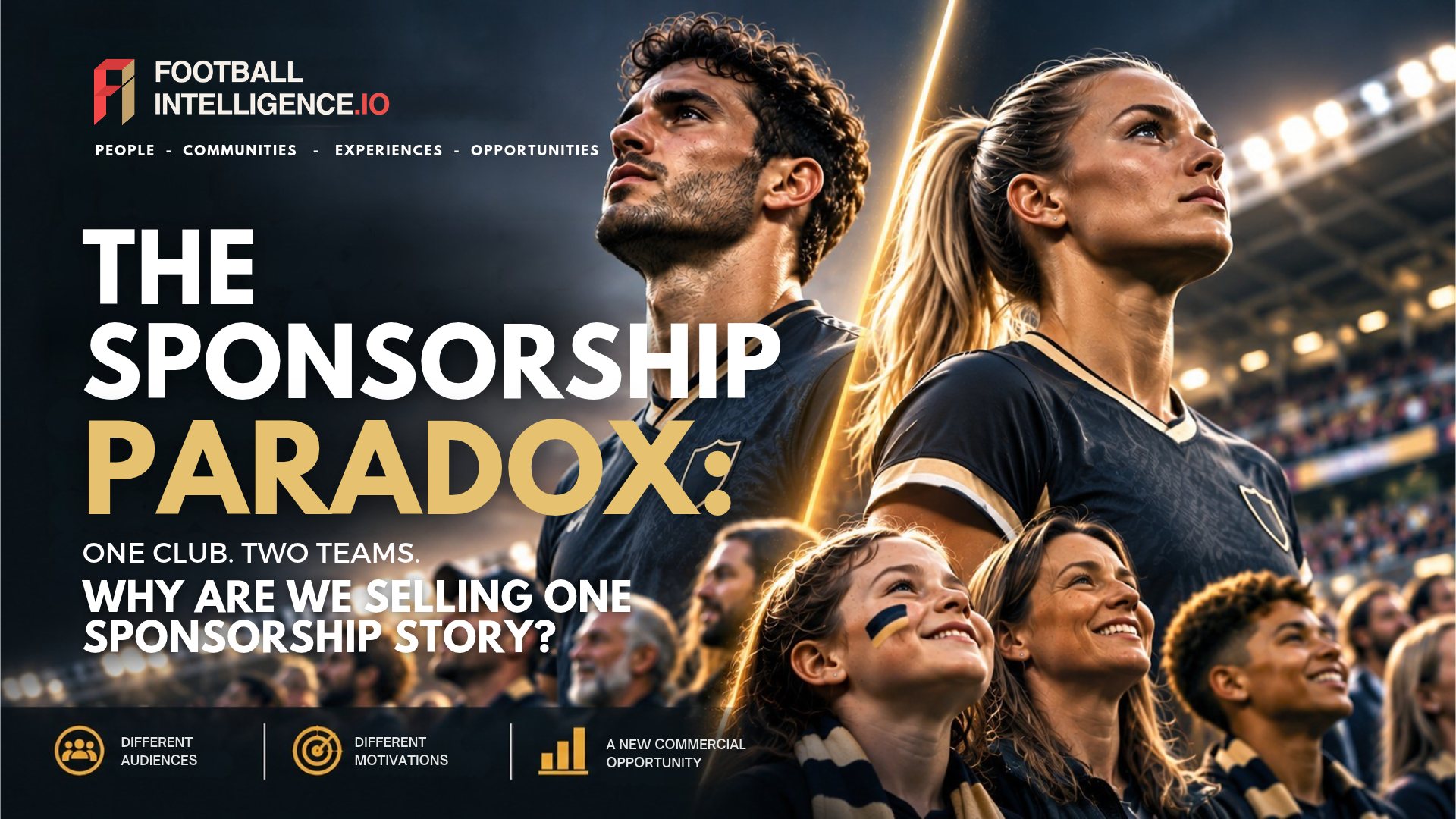
If a football club has two teams with different audience profiles, different supporter motivations and potentially different commercial opportunities, why would we automatically sell them the same sponsorship proposition?
Broadcast rights.
Shirt sponsorships.
Stadium partnerships.
Global commercial agreements.
Brand exposure.
These arrangements have helped build an extraordinary industry.
Does sharing a football club mean sharing an identical commercial strategy?
Not necessarily.
And that distinction could influence the next generation of football sponsorship.
Let me make something clear.
That would be replacing one outdated assumption with another.
Men.
Women.
Girls.
Boys.
Families.
Grassroots players.
Established football supporters.
New digital audiences.
International followers.
And people whose connection to the sport has developed through entirely different experiences.
The latest research illustrates why this matters.
Among the estimated 28.5 million engaged fans globally:
50% were female and 50% were male.
45% were aged between 18 and 34.
For comparison, the study reported that 67% of English Premier League fans were male, while 35% were aged 18–34.
But they challenge the idea that the two commercial audiences can simply be treated as interchangeable.
And half said they were more likely to trust a brand sponsoring the competition.
These are self-reported attitudes, not evidence that every sponsorship produces higher sales.
But they point towards something worth serious commercial consideration.
Women's football has an identifiable audience with distinct characteristics and positive attitudes towards relevant brand investment.
The question is whether sponsorship strategies are sufficiently sophisticated to recognize that opportunity.
Traditional sponsorship often begins with an inventory discussion.
What assets are available?
Where can the logo appear?
How many impressions can the partnership generate?
What digital content is included?
Which players can participate?
What hospitality or matchday access is provided?
These are legitimate commercial considerations.
Why should this particular audience care about this particular brand?
And perhaps even more importantly:
What meaningful value can the brand create within the lives of the supporters it wants to reach?
I believe that question should come much earlier in the conversation.
Because sponsorship is not simply a transaction between a brand and a rights holder.
At its best, it creates a relationship involving the brand, the football organization, and the people both are trying to engage.
And those relationships depend on relevance.
Not every sponsor needs a different category.
But the strategy used to engage supporters may need to be fundamentally different.
A global telecommunications company can market the same core services to dramatically different audiences.
A family may value connectivity, convenience, safety, and shared experiences.
A young digital creator may value content creation, streaming, and mobile access.
An international traveler may value reliable connectivity across countries.
A small-business owner may value communication, productivity, and flexibility.
But the reasons people engage with it differ.
Now apply that thinking to a football club.
A family participating in grassroots football may have different needs altogether.
And a digitally engaged international supporter may never enter the stadium.
Why should one brand activation be expected to create equal relevance across all these relationships?
At least not without evidence that the approach works.
The lesson is that a brand can retain one identity while developing multiple highly relevant propositions.
Football organizations should be equally capable of thinking this way.
One example is Manchester City Women.
In January 2025, Manchester City Women announced Revolut as an official global partner.
The agreement included training-kit visibility, Captain Alex Greenwood as a brand ambassador, matchday activation, and exclusive supporter experiences.
The women's team was not simply an additional asset within a pre-existing men's sponsorship. It was the initial platform for the relationship.
That is a meaningful distinction.
Another Manchester City Women partnership offers a different example.
In March 2025, the club announced Snuggs as its official period-underwear partner.
This was an audience- and athlete-relevant proposition with a clear practical purpose.
It simply identified a meaningful opportunity involving a particular audience and need.
And that is the point.
The opportunity is not to replace mainstream sponsorships with stereotypically female products.
It's to recognize that different audiences create different reasons for brands to become relevant.
That commitment represents far more than a logo on a sponsorship asset.
Here, the value of sponsorship can be examined through more than visibility alone.
Barclays has maintained relationships across both sides of the game.
The question is whether the objectives, experiences, and measures of success should differ according to the audience and property involved.
I believe they often should.
The same corporate sponsor can participate in different football environments for different commercial and social reasons.
And understanding those differences may make the overall partnership more valuable.
This is where I want to challenge both sides of the debate.
Others may argue that the strength of an established football club lies in selling its entire commercial footprint as one integrated property.
There are valid arguments for both.
A shared commercial structure can provide scale.
It can simplify partnerships.
It can leverage an established global identity.
But a fully integrated approach can also create a risk.
The distinct commercial value of the women's team may become difficult to identify, activate, or measure.
Conversely, complete separation could sacrifice the benefits of established brand recognition, infrastructure, and commercial relationships.
One club identity.
A connected commercial strategy.
But differentiated audience intelligence, activation, and rights are where they create measurable value.
Some partners may benefit from sponsoring both teams.
And some may participate in specific programmes involving grassroots football, family experiences, digital communities or individual athletes.
The right structure will depend on the club, its audience, its existing agreements and its commercial objectives.
But it is a model worth examining.
The objective shouldn't be to divide the club commercially.
It should be to understand the value of its different audiences more intelligently.
This is where my thinking moves beyond traditional sponsorship strategy.
One principle keeps returning.
People don't organise their lives around the internal objectives of organisations. Brands need to understand how to become relevant within people's existing lives.
Cognitive anthropology helps explain why.
Human behaviour is shaped by identity, relationships, culture, beliefs and the meaning people attach to experiences.
Football is an extraordinarily powerful example.
A club may represent family history.
A player may represent personal inspiration.
A team may represent community identity.
A match may become a meaningful tradition.
And a commercial partner may have an opportunity to contribute something genuinely useful to those relationships.
But only if the brand understands the context.
Putting a logo in front of an audience creates visibility.
Creating a positive contribution to an experience may create relevance.
Visibility can be purchased. Meaningful relevance has to be earned.
In the first article of this Industry Challenge series, I raised a question about fixture scheduling.
Are we making the next generation choose between playing football and watching it?
But that question also has commercial implications.
Young players.
Parents.
Coaches.
Local clubs.
Schools.
Community organisations.
These are not simply prospective ticket buyers.
They have different needs and relationships with the game.
And they may interact with the professional club in ways that extend far beyond matchday.
For the right commercial partner, that creates opportunities to support participation, improve accessibility, develop experiences and establish meaningful relationships.
But those opportunities require a different starting point from simply selling sponsorship inventory.
They require understanding the people involved.
What matters to them.
What experiences they value.
And how the brand can contribute.
The next generation of sponsorship may be less about where a brand appears and more about what role it plays.
Football organisations have commercial targets.
Sponsors want scale.
Rights holders need revenue.
And existing structures have developed over many years.
One club can contain several distinct communities.
One sponsor can serve different audiences.
One commercial relationship can support multiple objectives.
The mistake is assuming that the same creative strategy, audience proposition and commercial activation will be equally meaningful everywhere.
That is where potential value can be lost.
Not because the sponsor is wrong.
1. Do we genuinely understand the differences between our audiences?
Not simply age and gender, but motivations, behaviours, identities and the reasons people engage with each team.
2. Are we selling commercial exposure or meaningful access to distinct communities?
These are related propositions, but they are not interchangeable.
3. Could the same sponsor create greater value through different activations?
A shared sponsor does not require a shared message.
4. Are we allowing women's football to develop its own commercial identity?
5. Are we measuring long-term relationships alongside immediate sponsorship performance?
Impressions matter.
Revenue matters.
But so do relevance, supporter trust, participation, engagement quality and commercial outcomes that develop over time.
These are not simply questions for sponsorship sales teams.
Because commercial rights structures, brand strategy, audience intelligence and investment priorities are ultimately organisational decisions.
The emotional and cultural significance of football.
And the commercial and technological systems organisations use to develop relationships around it.
Supporter understanding.
Commercial partnerships.
Digital engagement.
Community participation.
Brand strategy.
And the long-term relationship between a football organisation and the people it serves.
The interesting opportunity is not necessarily another sponsorship category or another digital platform.
I believe much of the capability needed to explore this already exists.
What matters is how it is structured, how the right partners participate and how value is created and measured.
That is where commercial strategy moves beyond selling rights and begins creating a more intelligent engagement ecosystem.
Investment is increasing.
Global interest is expanding.
Commercial partnerships are evolving.
But the next commercial breakthrough may not come simply from attracting more sponsors.
It may come from understanding how to make existing and future sponsorship relationships more meaningful.
To the people.
To the brands.
To the clubs.
And to the wider football ecosystem.
Nor am I suggesting that existing club partnerships are failing.
Some organisations are already demonstrating what differentiated, relevant activation can look like.
But I believe the underlying question deserves broader attention.
If the audience is not one-size-fits-all, why should the sponsorship strategy be?
It should be defined by how much meaningful value we can create.
CHRISTOPHER ROSELLI
Founder | FOOTBALLINTELLIGENCE.io Former Professional Footballer Digital Innovation | Football Strategy | Fan Engagement & Commercial Transformation
SCHEDULE A STRATEGIC CONVERSATION https://calendar.app.google/RepH2xcuBMV2eKg37
FOOTBALL INTELLIGENCE https://footballintelligence.io
WSL Football and YouGov, January 2026 WSL Football and YouGov Release New Research About the Women's Football Fanbase https://www.wslfootball.com/news/wsl-football-and-yougov-release-new-research-about-the-women-sfootball-fanbase
Hayday, Read and Heria, Sport Management Review, January 2026 Balancing Recognition and Novelty: Exploring the Brand Architecture of Integrated Football Clubs in the English Women's Super League https://doi.org/10.1080/14413523.2026.2620217
Manchester City FC, January 2025 Manchester City Women Announces Revolut as an Official Global Partner https://www.mancity.com/news/womens/manchester-city-women-announce-revolut-as-official-global-partner-63872534
Manchester City FC, 2026 City Announce Revolut as Official Back of Shirt Partner https://beta.mancity.com/news/club/revolut-back-of-shirt-partner-63906575
Manchester City FC, March 2025 Manchester City Women Announces snuggs as Official Period Underwear Partner https://www.mancity.com/news/womens/man-city-women-snuggs-official-period-underwear-partner-63877883
BBC Sport, September 2024 WSL Agrees New £45m Sponsorship Deal With Barclays https://www.bbc.co.uk/sport/football/articles/c79n83l0wd8o
THE INDUSTRY CHALLENGE
Article 01 — The Football Scheduling Paradox: Are We Making the Next Generation Choose Between Playing and Watching?
Article 02 — The Sponsorship Paradox: One Club. Two Teams. Why Are We Selling One Sponsorship Story?
COMING NEXT — ARTICLE 03
THE FAN DATA PARADOX: FOOTBALL KNOWS EVERYTHING ABOUT WHAT FANS DO. BUT DOES IT UNDERSTAND WHY?
#WomensFootball #FootballSponsorship #FootballIntelligence #SportsBusiness #FanEngagement #CommercialStrategy #FootballInnovation #WorldFootballSummitFOOTBALLINTELLIGENCE.io,