
Football is a relationship, not a 90-minute product.
The match is a powerful shared moment. The opportunity is to earn a meaningful place in supporters’ lives before it, after it and between fixtures.
Christopher Roselli’s public beliefs on fan engagement, emotional connection and the opportunity to turn 90 minutes into 365 days of relevance.
The match is a powerful shared moment. The opportunity is to earn a meaningful place in supporters’ lives before it, after it and between fixtures.
A supporter has a family, a culture, routines, aspirations and responsibilities. Start with that life, rather than asking everyone to fit a club’s channels or calendar.
Purchases, clicks and attendance record activity. Explore the identity, belonging, inspiration and practical circumstances behind those actions before deciding what they mean.
A club badge can carry generations of meaning, while a player or experience can open a new connection. Treat those routes into football with curiosity rather than assuming one model of loyalty.
A young person should have opportunities to play, watch and belong. Examine scheduling, travel, accessibility and family commitments alongside awareness and price.
Men’s and women’s football can share a badge while offering distinct experiences. Sponsorship becomes more relevant when it responds to people’s motivations rather than treating visibility as the whole proposition.
Supporters move between stadiums, communities, content and everyday life. Give technology a clear role in making that experience coherent, useful and accessible.
Belonging is not permission to exploit attention or personal data. Offer a clear value exchange and respect each person’s choice about participation.
Quiet digital activity does not prove weak attachment. Build worthwhile opportunities to return and measure what people value, not simply how often they can be prompted to click.
Technology can enable an experience. People decide its purpose, take responsibility for delivery and learn whether it strengthens relationships. That is the work behind turning 90 minutes into 365 days of engagement.
THE FOOTBALL PARADOX / ARTICLE 5 OF 11
Why football's next commercial breakthrough may depend less on how many people it reaches and more on how many meaningful relationships it builds.
By Christopher Roselli · 17-minute read
Christopher Roselli’s published personal strategic perspective. Disclosed interests →
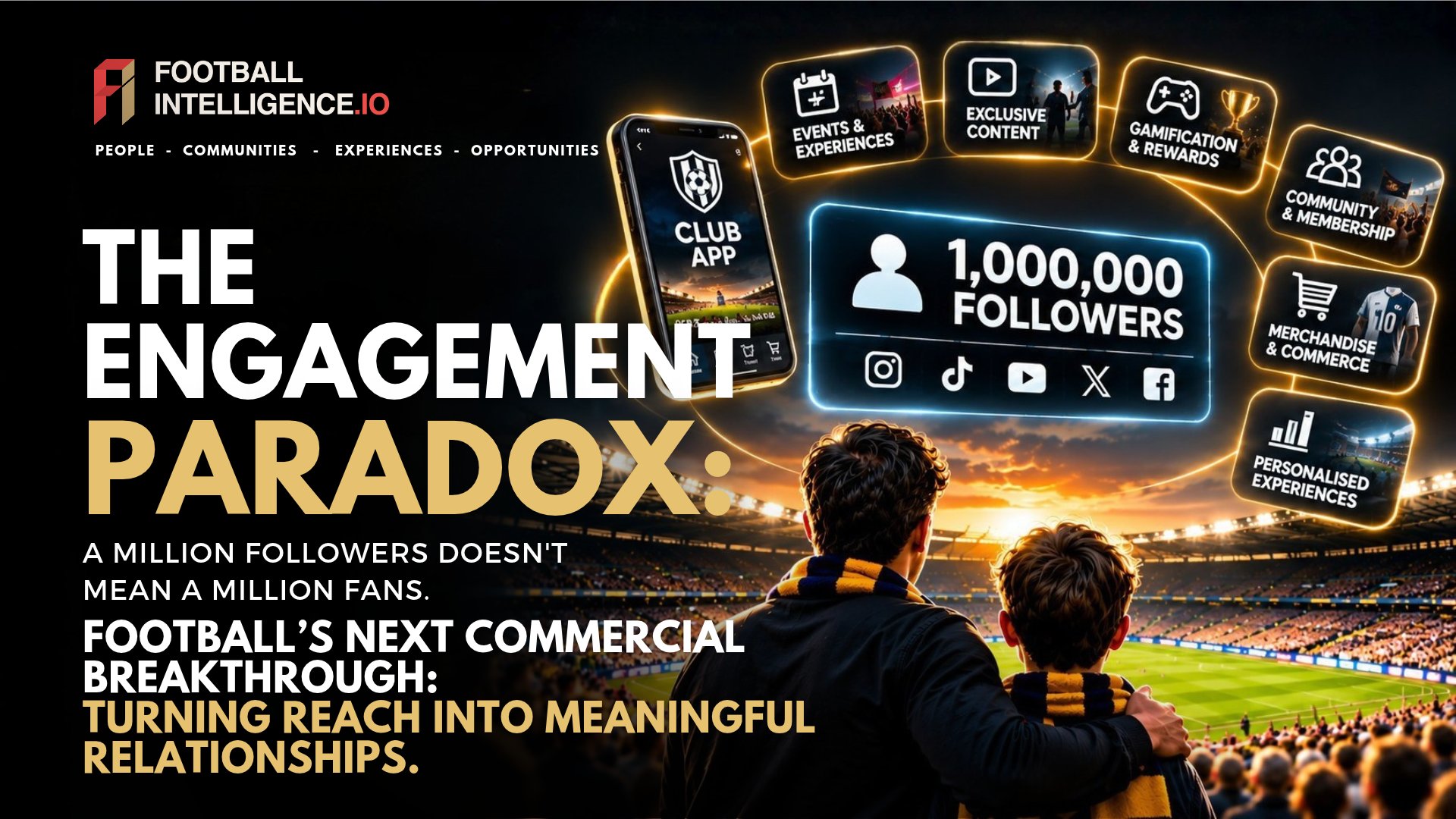
Imagine a football club celebrating a major digital milestone.
One million social media followers.
The announcement goes out.
The marketing team celebrates.
The commercial department presents the audience growth to sponsors.
The board receives another positive digital performance update.
And rightly so.
Building an audience of that scale can represent a significant achievement.
But here's the question I believe football's leadership should be asking.
What does having one million followers actually mean for the relationship between the club and those people?
How many genuinely identify with the club?
How many follow because of an individual player?
How many discovered the club through one viral moment?
How many live thousands of miles away?
How many would participate in something meaningful beyond watching another video?
And how many relationships will remain when the next algorithm, player transfer or cultural trend changes where people direct their attention?
These are not arguments against social media.
Social platforms have created extraordinary opportunities for football to reach people across the world.
But I believe we need to distinguish between three very different things.
Attention. Engagement. Relationship.
They are connected.
But they are not interchangeable.
And the difference could become one of the most important commercial questions facing world football.
In May 2026, the CIES Football Observatory published its analysis of social media audiences across professional football.
Real Madrid led the global ranking with approximately 488 million followers across five major platforms.
Barcelona followed with approximately 442 million.
Manchester United recorded approximately 239 million.
Paris Saint-Germain exceeded 208 million.
Collectively, the ten most-followed clubs accounted for approximately 2.36 billion follower accounts across the platforms examined.
These numbers demonstrate the extraordinary global visibility football has achieved.
But we should be careful about how we interpret them.
A combined follower count is not a count of unique individuals.
One person may follow the same club across several platforms.
An account may follow multiple clubs.
Some people follow individual players, entertainment or football news rather than expressing deep allegiance to the organisation.
And following an account does not automatically mean someone sees every piece of content it publishes.
A follower count is an indicator of digital audience scale. It is not a complete measurement of supporter loyalty, relationship depth or commercial value.
That distinction matters.
Especially when these figures influence sponsorship propositions, commercial forecasts and strategic investment decisions.
The question shouldn't simply be whether a club has a large audience.
It should be whether the organisation understands what that audience represents, how people engage and what kinds of relationships can realistically be developed.
Let me challenge the headline of this article for a moment.
A million followers doesn't mean a million fans.
But it also doesn't mean those followers have no value.
Quite the opposite.
Someone who follows a football club because of a particular player may be at the beginning of a meaningful relationship.
A person who watches a viral highlight may discover a competition they had never previously followed.
A young supporter who first encounters women's football through short-form video may go on to develop a lifelong connection with the game.
Digital discovery matters.
In its 2025–26 Generational Fan Study, WSC Sports reported that 62% of surveyed sports fans had discovered a new team, player or league through short-form video.
That is an important illustration of how modern sporting relationships can begin.
But discovery is only the beginning.
It doesn't automatically establish allegiance.
Or continued engagement.
Or commercial participation.
The strategic opportunity isn't simply to convert every follower into a paying customer.
It's to understand which relationships are developing, what makes them meaningful and how the club can provide value that encourages them to continue.
Some will remain casual observers.
Some will engage through entertainment.
Some will become dedicated supporters.
Others may follow an athlete rather than the club itself.
All are legitimate forms of interaction.
But they should not automatically be measured as though they represent the same relationship.
Consider what happens when a globally recognised player joins a new football club.
Social media interest accelerates.
New markets become aware of the team.
Merchandise demand may increase.
Commercial partnerships gain visibility.
And the club reaches audiences that may previously have had little reason to engage.
Lionel Messi's move to Inter Miami provided a striking example of how an individual player can reshape a club's international visibility and commercial profile.
But it also raises a question with implications far beyond one player or club.
When supporters arrive because of an athlete, are they developing a relationship with the club, or simply following the athlete's journey?
Research from YouGov in 2025 provides useful context.
Across its international sports-fan survey, team allegiance remained a stronger driver of following a sport than individual athlete allegiance.
In football specifically, 54% of respondents leaned towards teams, 14% towards athletes and 32% said they supported both equally.
The research also found that some supporters would begin following a new team if their favourite athlete transferred.
This doesn't mean football loyalty has disappeared.
Nor does it mean the traditional club-supporter relationship is becoming irrelevant.
It means there are multiple pathways into football fandom.
And the commercial opportunity depends partly on understanding those pathways.
A club may successfully attract attention through a player.
But retaining a meaningful connection to that audience may require offering something beyond access to the player's content.
Community.
Experiences.
Shared identity.
Participation.
Knowledge.
Entertainment.
Or a reason to care about the club's future.
The player can open the door. But the organisation still needs to develop a relationship worth maintaining.
A supporter watches a match highlight.
The platform records a view.
Another supporter shares the clip.
The platform records an interaction.
A third supporter comments.
Another engagement metric increases.
All useful.
But consider what the same metrics may conceal.
One person watches because they love the club.
Another watches because the goal was extraordinary.
Another watches because their favourite player scored.
Another watches because the clip appeared in an algorithmically recommended feed.
Similar digital activity.
Very different motivations.
This connects directly to Article 03 of The Industry Challenge: The Fan Data Paradox.
Football increasingly understands what people do online.
But understanding why they do it requires additional context.
And that context matters commercially.
Because one million people who encounter a piece of content may represent a very different proposition from a smaller community of supporters who actively value, participate in and sustain a relationship with the club.
That doesn't mean the smaller audience is always commercially superior.
Reach and relationship depth each have value.
But they create different forms of value.
A million impressions can demonstrate exposure. They cannot, by themselves, demonstrate emotional commitment.
And an engagement strategy should be capable of recognising the difference.
Imagine two hypothetical football clubs.
Club A has five million social media followers.
Club B has one million.
At first glance, Club A appears to possess the stronger digital audience.
But now consider additional questions.
How many people return regularly?
How many choose to participate in club experiences?
How many engage across different parts of the organisation?
How many maintain a relationship beyond periods of sporting success?
How well does the club understand the different motivations of its supporters?
How many supporters say the club provides experiences they genuinely value?
And how effectively are commercial partners contributing to those experiences?
Suddenly, the comparison becomes more complicated.
Club A may still have the stronger commercial proposition.
But it cannot be determined from follower numbers alone.
Nor can we conclude that Club B is more valuable without evidence.
The point is that audience scale and relationship strength need to be evaluated separately before we can understand how they contribute to value.
This should influence how clubs approach their commercial reporting.
Not by abandoning impressions, views or follower growth.
But by complementing them with measures of continued engagement, supporter experience, trust, participation and meaningful outcomes.
A club should know how many people it reaches.
It should also seek to understand what happens after that first interaction.
An October 2026 Ipsos study commissioned by England's Independent Football Regulator provides a useful reminder of the wider meaning of football engagement.
Among surveyed supporters of men's clubs in the top five divisions of English football, social media was the most commonly reported way of engaging with a club, cited by 40%.
But the same research found that supporters placed substantial importance on club heritage, local identity, matchday traditions and community.
Eighty-eight percent agreed that football was important to national culture and identity.
Eighty-four percent said it mattered to community identity in towns and cities.
And 64% said football was important to their personal identity.
These findings were specific to the surveyed population and should not automatically be generalised to all football audiences worldwide.
But they reinforce something fundamental.
Football relationships exist across far more than digital channels.
A grandfather introducing his grandson to the club.
A young girl attending her first professional women's match.
Friends following a team from another continent.
A family travelling together on matchday.
A local business supporting grassroots football.
These experiences may generate social content.
But their value isn't limited to the content.
Social media can help maintain and amplify a relationship. It shouldn't be confused with the entirety of that relationship.
And that is where football's engagement strategy needs to expand.
A football match creates an extraordinary concentration of attention.
For 90 minutes, thousands or millions of people may share the same emotional experience.
Anticipation.
Joy.
Frustration.
Belonging.
Disappointment.
Celebration.
Football understands how to create these moments better than almost any other industry.
But here's the question.
What is the club's relationship with those people during the other 364 days of the year?
Not simply how many times they can be encouraged to open an application.
Or how many additional notifications they receive.
But what ongoing value can the football organisation contribute to their lives?
For a young player, that might involve meaningful opportunities to learn and develop.
For a family, it might involve accessible experiences that fit around everyday life.
For an international supporter, it might mean feeling connected to a community despite geographical distance.
For a supporter interested in the club's culture and heritage, it might involve access to stories, people and traditions.
For others, the relationship may be primarily entertainment-driven.
There is no requirement that every supporter engages daily.
In fact, assuming that they should would repeat the very mistake we're trying to challenge.
365-day engagement does not mean demanding 365 days of attention.
It means creating the possibility of a meaningful relationship throughout the year, whenever and however it fits into people's lives.
That's a very different proposition.
And I believe it represents a much larger commercial opportunity than simply publishing more content.
This also connects with Article 02: The Sponsorship Paradox.
Traditionally, sponsorship is frequently evaluated through reach, visibility, media value, brand awareness and associated commercial outcomes.
These measures have legitimate uses.
But what happens when sponsors begin evaluating not only how many people see a brand, but how meaningfully it participates in their experiences?
A telecommunications sponsor could help connect families to international football experiences.
A financial services partner could support relevant education or practical services.
A technology brand could help improve accessibility or participation.
A travel partner could contribute to supporter journeys.
These are illustrative possibilities, not endorsements or claims about existing partnerships.
The principle is that commercial partners can have different reasons to matter to different supporters.
That requires understanding audience motivations.
It also requires a willingness to design experiences around value rather than visibility alone.
A brand shouldn't automatically be considered successful simply because its logo appeared in front of millions of people.
Nor should the commercial contribution of awareness be dismissed.
The strategic question is whether the partnership is achieving the objectives it was designed to deliver.
Are we helping brands become visible to supporters, or valuable to them?
The strongest partnerships may do both.
And as football's audiences continue to diversify, that distinction could become increasingly important.
Football clubs have increasingly sophisticated digital communication capabilities.
Mobile applications.
Personalised content.
Membership programmes.
Email marketing.
Push notifications.
Artificial intelligence.
Connected media experiences.
Each creates opportunities to reach people.
But more communication doesn't automatically mean more engagement.
And more personalisation doesn't necessarily mean a better experience.
Imagine a supporter receiving multiple notifications from a club.
A merchandise promotion.
A ticket offer.
A sponsor campaign.
A subscription upgrade.
A new piece of content.
Every message may be relevant to an internal commercial objective.
But how many are genuinely relevant to that supporter's circumstances?
Sometimes the most valuable experience may involve providing something useful at the right moment.
At other times, the intelligent decision may be not to interrupt the supporter at all.
Engagement should be evaluated by the value created for people, not simply by the frequency with which an organisation contacts them.
That requires different thinking.
What does the person need?
What are they trying to achieve?
How does football fit into their existing routines?
And is the organisation making that relationship easier, more enjoyable or more meaningful?
These questions connect directly to cognitive anthropology and the importance of understanding the cultural and human context behind behaviour.
Technology can help support that understanding.
But technology doesn't replace the need to develop it.
I believe a useful executive conversation begins by separating four dimensions that are frequently grouped under the same word.
1. REACH: WHO CAN WE POTENTIALLY CONNECT WITH?
This includes followers, impressions, discoverability and audience exposure.
Reach is valuable because relationships cannot develop without opportunities for discovery.
But reach alone does not establish the depth of a relationship.
2. INTERACTION: WHAT DO PEOPLE ACTUALLY DO?
This includes viewing, clicking, commenting, sharing, attending and participating.
These behaviours provide useful evidence about how people respond.
But they don't always explain motivation or long-term commitment.
3. RELATIONSHIP: WHY DO PEOPLE CONTINUE TO ENGAGE?
This includes trust, identity, satisfaction, belonging and the perceived relevance of the organisation.
These dimensions may require direct research and qualitative understanding rather than relying solely on platform metrics.
4. VALUE: WHAT MEANINGFUL OUTCOMES DOES THE RELATIONSHIP CREATE?
For supporters, that may mean better experiences, accessibility or stronger connections to the game.
For clubs, it may involve sustainable revenue, participation, retention or commercial development.
For sponsors, it may involve measurable business outcomes and relevant brand relationships.
And for the wider football ecosystem, it may contribute to community and participation.
These four dimensions are not a formal industry standard.
They are a proposed strategic lens for evaluating engagement more comprehensively.
And they should be considered together.
Because reach without interaction can remain passive.
Interaction without relationship may be temporary.
And relationships that create no meaningful value may struggle to develop their full potential.
1. Are we measuring the size of our audience or the strength of our relationships?
Do our reports distinguish between followers, active audiences, committed supporters and participants?
2. Do we understand why people engage with our organisation?
Can we distinguish between people following the club, individual players, entertainment and wider football culture?
3. Are we creating value between matches?
What experiences or services give supporters meaningful reasons to remain connected throughout the year?
4. Can we demonstrate commercial outcomes beyond impressions?
Do we evaluate sponsorship and engagement investments through appropriate measures of relevance, participation, trust and business results?
5. Are our digital strategies designed around people's lives or our internal publishing calendars?
Are we genuinely understanding the supporter, or simply finding more opportunities to demand their attention?
These questions matter to club CEOs, commercial directors, digital leaders, league executives, sponsors and investors.
Because fan engagement is not simply a marketing activity.
It's a strategic capability that can influence the long-term development of the entire football organisation.
After 15 years playing professional football and approximately 20 years working across digital innovation, commercial strategy and connected experiences, I've come to recognise an important distinction.
The ability to attract an audience is not the same as the ability to develop a relationship.
And the ability to develop a relationship is not the same as understanding how that relationship creates meaningful value.
Football is exceptionally good at the first.
Many organisations have also built powerful capabilities around the second.
But I believe there is an opportunity to approach the entire relationship more strategically.
This doesn't necessarily require another platform.
Or another application.
Or a new collection of isolated engagement tools.
Much of the underlying capability already exists across football's digital and commercial ecosystem.
The opportunity is to understand the human relationships, identify the most relevant experiences and connect the available capabilities around a coherent strategy.
The next competitive advantage may not be the club that generates the most attention.
It may be the club that understands how to turn attention into meaningful relationships and those relationships into sustainable value.
That is the strategic opportunity I believe world football should be exploring.
This question connects directly with the ongoing development of the Football Intelligence Index through FOOTBALLINTELLIGENCE.io.
The Index is being developed as an independent research framework examining how football organisations approach intelligence, commercial innovation, digital maturity, organisational connectivity and leadership execution.
Fan engagement is an important part of that evaluation.
But the ability to attract followers shouldn't automatically be treated as evidence of superior engagement maturity.
A large international club will naturally possess opportunities for reach that smaller clubs cannot easily replicate.
That does not necessarily mean every aspect of its relationship strategy is more sophisticated.
A smaller club may demonstrate exceptional local participation, community relevance or supporter understanding.
A women's football organisation may be developing innovative relationships within an emerging audience.
A federation may have opportunities to connect professional football, grassroots participation and national identity.
These organisations operate in different contexts.
Any meaningful assessment should account for those differences.
The Index's methodology is still being developed. This article does not assign scores or rankings to organisations.
But I believe one principle should guide the research.
We should evaluate how intelligently football organisations develop relationships, not simply how many people follow them.
That could become an important distinction in how the industry understands long-term engagement maturity.
Football's digital growth deserves recognition.
Social media has taken the game into homes, communities and countries that clubs may never have reached through traditional channels.
It has connected supporters to athletes.
Expanded the visibility of women's football.
Created opportunities for brands.
And helped introduce new generations to the sport.
None of that should be underestimated.
But I believe the industry's next challenge is more demanding than simply growing the audience.
It's understanding what the audience actually represents.
Recognising the different motivations behind engagement.
Creating experiences that matter beyond matchday.
And ensuring commercial strategies deliver measurable value to the organisation and the people it serves.
Not every follower needs to become a season-ticket holder.
Not every international supporter needs to purchase merchandise.
Not every relationship needs to produce an immediate transaction.
But every football organisation should understand the difference between attracting attention and developing enduring value.
Because a million followers may demonstrate how far your club can reach.
It doesn't automatically tell you how deeply your club matters.
And perhaps that is the question football should be asking more often.
If your club gained another million followers tomorrow, but nothing changed in the quality of its supporter relationships, how much more intelligent would its engagement strategy really be?
That is the Engagement Paradox.
And I believe addressing it could redefine how world football approaches fan engagement, sponsorship and commercial growth.
The next challenge isn't simply turning followers into customers.
It's turning 90 minutes of football into 365 days of meaningful opportunity.
CIES Football Observatory | May 2026
Weekly Post No. 548: Most Popular Clubs on Social Media
https://football-observatory.com/IMG/sites/b5wp/2025/wp548/en/
Ipsos | October 2026
New Ipsos Research Released as Part of the Independent Football Regulator's State of the Game Report
https://www.ipsos.com/en-uk/new-ipsos-research-released-part-independent-football-regulators-state-game-report
WSC Sports | December 2025
The 2025–2026 Generational Fan Study
https://wsc-sports.com/blog/industry-insights/the-2025-2026-generational-fan-study/
YouGov | 2025
Athlete or Team Allegiance: What Drives Sports Fandom in 2025?
https://d3nkl3psvxxpe9.cloudfront.net/documents/Multi_country_star_power_report_Global_Report_English_YouGov.pdf
Nielsen | 2025
Global Sports Report: Key Factors Transforming Sports and Sponsorship Strategy
https://www.nielsen.com/insights/2025/global-sports-report-2025/
Deloitte | 2026
Football Money League 2026
https://www.deloitte.com/uk/en/services/consulting-financial/analysis/deloitte-football-money-league.html