
Football is a relationship, not a 90-minute product.
The match is a powerful shared moment. The opportunity is to earn a meaningful place in supporters’ lives before it, after it and between fixtures.
Christopher Roselli’s public beliefs on fan engagement, emotional connection and the opportunity to turn 90 minutes into 365 days of relevance.
The match is a powerful shared moment. The opportunity is to earn a meaningful place in supporters’ lives before it, after it and between fixtures.
A supporter has a family, a culture, routines, aspirations and responsibilities. Start with that life, rather than asking everyone to fit a club’s channels or calendar.
Purchases, clicks and attendance record activity. Explore the identity, belonging, inspiration and practical circumstances behind those actions before deciding what they mean.
A club badge can carry generations of meaning, while a player or experience can open a new connection. Treat those routes into football with curiosity rather than assuming one model of loyalty.
A young person should have opportunities to play, watch and belong. Examine scheduling, travel, accessibility and family commitments alongside awareness and price.
Men’s and women’s football can share a badge while offering distinct experiences. Sponsorship becomes more relevant when it responds to people’s motivations rather than treating visibility as the whole proposition.
Supporters move between stadiums, communities, content and everyday life. Give technology a clear role in making that experience coherent, useful and accessible.
Belonging is not permission to exploit attention or personal data. Offer a clear value exchange and respect each person’s choice about participation.
Quiet digital activity does not prove weak attachment. Build worthwhile opportunities to return and measure what people value, not simply how often they can be prompted to click.
Technology can enable an experience. People decide its purpose, take responsibility for delivery and learn whether it strengthens relationships. That is the work behind turning 90 minutes into 365 days of engagement.
THE FOOTBALL PARADOX / ARTICLE 11 OF 11
Why football's next competitive advantage may depend less on individual departments becoming better and more on the organisation becoming more intelligent as a whole.
By Christopher Roselli · 17-minute read
Christopher Roselli’s published personal strategic perspective. Disclosed interests →
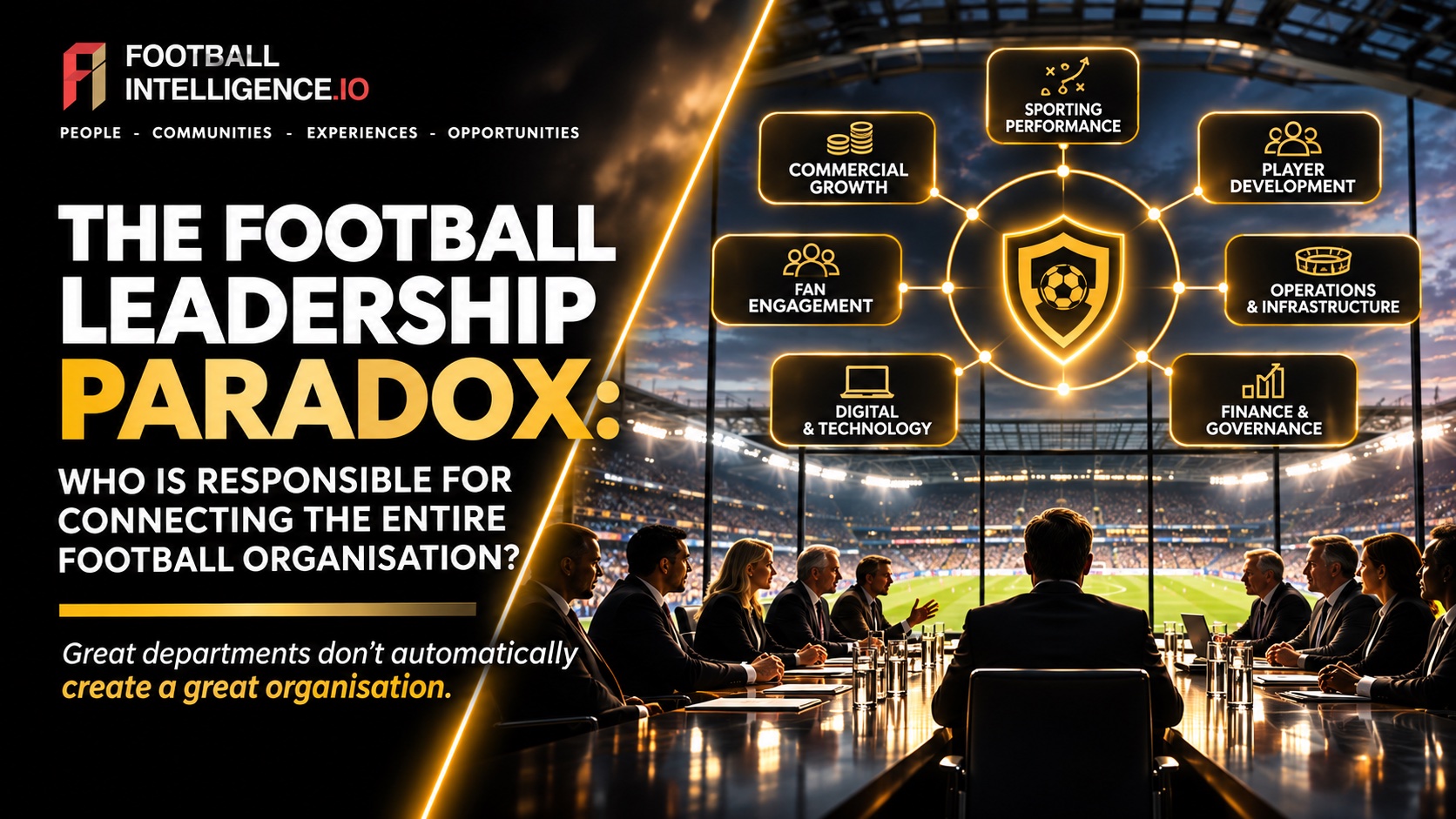
Imagine walking into the executive offices of a major professional football club.
The sporting director is focused on recruitment, squad development and competitive performance.
The head coach is preparing the team for its next fixture.
The performance department is monitoring player workloads.
Medical is managing availability and rehabilitation.
Finance is evaluating financial commitments.
Commercial is negotiating sponsorship agreements.
Marketing is developing international audiences.
Digital is introducing new technologies.
And supporter engagement is working to strengthen relationships with fans.
Every department has talented people.
Every department has objectives.
Every department has its own reporting systems.
And each may be performing exceptionally well.
But here's the question I would ask the club's executive leadership.
Who is responsible for making sure all these capabilities are working together to achieve the organisation's wider ambitions?
Not simply reporting into the same CEO.
Not attending the same leadership meetings.
And not sharing a dashboard.
Actually connecting the decisions, relationships and opportunities that exist between departments.
Because there is an important distinction.
A football club can have excellent leadership within every department and still lack effective leadership across the organisation.
That is the Football Leadership Paradox.
And I believe it deserves considerably more attention.
Professional football has undergone an extraordinary commercial and operational transformation.
Deloitte's 2026 Annual Review of Football Finance reported that the European football market generated €40.2 billion in revenue during the 2024/25 season.
The five largest European leagues collectively generated €21.6 billion.
Clubs are operating increasingly complex businesses.
Sporting performance remains central.
But the surrounding organisation now encompasses international commerce, media, technology, entertainment, infrastructure, financial management and global supporter relationships.
Consider how much responsibility has accumulated around a modern football club.
Player development.
Transfers.
Contract management.
Sports science.
Medical services.
Academy operations.
Women's football.
Stadium experiences.
Ticketing.
Sponsorship.
Broadcasting.
Digital engagement.
International development.
Commercial partnerships.
Data governance.
And emerging artificial intelligence capabilities.
Specialisation is necessary.
No single executive can possess deep expertise in every discipline.
But increasing specialisation creates a new leadership challenge.
Who is responsible for the opportunities and decisions that exist between those disciplines?
That question becomes more important as organisations grow.
Because organisational complexity does not automatically produce organisational intelligence.
Sometimes, it produces the opposite.
Consider a hypothetical football club.
The commercial department achieves its sponsorship revenue target.
Marketing delivers strong social media growth.
The ticketing team meets its sales objectives.
Digital launches a successful application.
And the sporting department delivers an excellent season.
On paper, there is a great deal to celebrate.
But imagine the following.
Marketing attracts a new international audience through a globally recognised player.
The digital department records increased engagement.
Commercial identifies attractive sponsorship opportunities.
Ticketing develops new supporter packages.
And the club's community programmes could offer valuable experiences for younger supporters.
Yet these activities are planned independently.
Nobody is responsible for understanding how they could contribute to a coherent long-term supporter relationship.
Each department has delivered.
But the club may have missed a larger opportunity.
The problem isn't necessarily poor departmental performance.
It's that departmental success and organisational success are not always the same thing.
This is a hypothetical scenario, not evidence that all football clubs operate this way.
Some organisations coordinate these functions very effectively.
But the leadership question remains relevant.
Are we measuring the performance of individual departments?
Or are we also evaluating how effectively they contribute to outcomes that no single department can deliver alone?
The typical organisational chart is designed around reporting relationships.
Who reports to whom?
Who controls a budget?
Who approves decisions?
Who is accountable for a particular function?
These are important structures.
But an organisational chart doesn't necessarily reveal how value is created across the business.
Consider the journey of a young supporter.
They discover a player through YouTube.
Begin following the club on social media.
Watch a match.
Become interested in attending.
Purchase their first ticket.
Visit the stadium with a parent.
Join a community programme.
And develop a relationship with the club that continues into adulthood.
Potentially, that journey involves marketing, digital, ticketing, commercial, operations, community engagement and football personnel.
Yet the supporter doesn't experience seven different departments.
They experience one football club.
That's the important distinction.
Organisations are structured around internal responsibilities.
But supporters experience the combined result.
The same principle applies elsewhere.
A recruitment decision can involve sporting strategy, medical assessment, financial commitments, contract management and player development.
An academy decision can influence sporting performance, long-term financial planning and community relationships.
A stadium investment can affect revenue, accessibility, matchday operations and supporter loyalty.
Football's most important opportunities frequently exist across organisational boundaries.
And those boundaries need intentional leadership.
This connects directly to Article 04, The Technology Paradox, and Article 08, The AI Paradox.
Football organisations have access to an extraordinary range of technology.
Player tracking.
Recruitment analytics.
Medical systems.
Customer relationship management.
Ticketing.
Content platforms.
Commercial reporting.
Artificial intelligence.
Each capability may offer genuine value.
But who is responsible for ensuring that relevant information and workflows connect appropriately?
The sporting department may select technology based on its requirements.
Commercial may choose a platform for sponsorship reporting.
Digital may evaluate customer engagement systems.
Finance may procure different analytical capabilities.
Each decision may be rational.
But the combined technology environment can become difficult to coordinate.
This is not an argument that every system should be combined into one enormous platform.
Different functions require different capabilities.
Privacy, access rights and professional responsibilities must also be respected.
The objective isn't to centralise everything.
It's to ensure that the organisation can connect what matters, when it matters, for a clearly defined purpose.
That requires leadership capable of looking beyond individual departmental requirements.
Technology interoperability is partly a technical challenge.
But deciding why information should be connected, who can use it and what outcome it should improve is an organisational challenge.
And that responsibility cannot simply be delegated to a software vendor.
A natural response to this challenge is straightforward.
Isn't this the CEO's responsibility?
Ultimately, yes.
Executive leadership is responsible for organisational strategy, priorities and accountability.
But recognising that responsibility isn't the same as establishing an effective operating model.
A football CEO may be managing relationships with ownership, the board, investors, leagues, regulators, sponsors and senior personnel.
The role can involve significant financial, sporting and reputational pressure.
Expecting one individual to personally coordinate every cross-functional opportunity is unrealistic.
The objective should not be to create a dependency where every meaningful decision needs the CEO's direct intervention.
It should be to establish leadership structures through which the organisation can make connected decisions effectively.
That distinction matters.
A CEO can establish a shared strategy.
Assign clear accountability.
Create appropriate decision-making forums.
Ensure that incentives support collaboration.
And evaluate outcomes that cross departmental boundaries.
But the operating model must enable other leaders to execute.
Otherwise, the organisation risks becoming either fragmented or excessively centralised.
Neither is particularly attractive.
The question isn't whether the CEO is ultimately responsible.
It's whether the organisation has been designed to deliver that responsibility in practice.
The football industry is increasingly recognising the importance of governance and financial sustainability.
In England, the Football Governance Act 2025 established the legislative framework for the Independent Football Regulator.
The Act includes provisions addressing financial soundness, corporate governance and effective supporter engagement.
UEFA's club licensing framework also provides requirements intended to support the professional management and sustainability of clubs participating in its competitions.
These developments reflect the importance of accountable leadership.
But governance and organisational innovation are not identical.
A club can satisfy relevant compliance requirements while still having opportunities to improve strategic coordination.
And an organisation can adopt sophisticated technology without having sufficiently clear governance around its use.
We need both.
Financial discipline.
Clear responsibilities.
Appropriate oversight.
Effective supporter engagement.
And the ability to coordinate capabilities towards meaningful outcomes.
Compliance helps establish essential boundaries and responsibilities.
Organisational intelligence concerns how effectively the club makes decisions and creates value within them.
The distinction isn't an excuse to weaken governance.
It's an argument for building on strong governance rather than treating it as the endpoint of leadership development.
In many businesses, commercial strategy can be developed with relatively predictable assumptions about the underlying product.
Professional football is different.
The sporting product is inherently uncertain.
Clubs compete.
Players become unavailable.
Managers change.
Results fluctuate.
League positions carry financial consequences.
And the emotional experience of supporters can change dramatically over the course of a season.
Consider a commercial partnership built around a star player.
Sporting leadership may view that player primarily through performance, squad planning and contractual considerations.
Commercial leadership may see an international audience and valuable partnership opportunities.
Digital may recognise increased engagement.
Finance may evaluate the costs and financial benefits.
These perspectives are not contradictory.
They're different dimensions of the same organisational decision.
A player should not be retained solely because of social media popularity.
Nor should a transfer decision ignore legitimate commercial implications where those considerations are relevant and appropriately assessed.
Good leadership doesn't mean every department gets to dictate the decision.
It means the organisation can understand the relevant consequences before an accountable decision is made.
That is a fundamental difference.
The purpose of connectivity is not to eliminate professional judgement.
It is to make that judgement better informed.
My career has taken me through professional football and, subsequently, nearly two decades of digital innovation and commercial strategy.
Those experiences have provided very different perspectives on how organisations operate.
As a professional player, the immediate focus was performance.
Training.
Preparation.
Competition.
Recovery.
Results.
The football environment is built around these priorities for good reason.
Later, working across digital businesses and connected commercial experiences, I became increasingly interested in another dimension.
How do different capabilities work together to create value?
Not simply how a product performs.
But how technology, people, content, relationships and commercial opportunities become part of a connected experience.
I've worked on digital concepts designed to bring audiences, content, transactions and engagement capabilities into a more interoperable environment.
And over the years, I've found myself asking a recurring question.
Why do organisations invest so heavily in improving individual capabilities without always giving the same attention to how those capabilities work together?
Football is particularly interesting because its emotional and commercial potential extends far beyond the match.
The performance on the pitch creates extraordinary moments.
But those moments influence supporters, brands, communities, commercial partnerships and future generations.
The opportunity is not to interfere with sporting expertise.
It's to ensure that the wider organisation is capable of recognising and developing the value created around the sport.
That's where I believe a different kind of executive leadership becomes increasingly important.
Not leadership defined by controlling more departments.
Leadership defined by helping the entire organisation become more connected, accountable and effective.
Football executives frequently describe supporters as the heart of the organisation.
And for many clubs, that reflects a genuine understanding of their importance.
But consider what supporter experience actually involves.
The timing of fixtures.
Access to tickets.
Stadium facilities.
Digital content.
Broadcasting.
Membership.
Merchandise.
Community involvement.
Family experiences.
Accessibility.
And communication with the club.
Different departments influence different parts of that experience.
Some factors, such as competition scheduling or broadcasting arrangements, may also involve organisations beyond the club's direct control.
But from the supporter's perspective, these elements contribute to one overall relationship.
So who is accountable for understanding that relationship across its different dimensions?
Marketing may measure reach.
Digital may measure engagement.
Ticketing may measure sales.
Commercial may measure revenue.
And community departments may measure participation.
All useful indicators.
But does someone evaluate whether the combined experience is becoming more meaningful?
A supporter doesn't measure their relationship with a club according to departmental KPIs.
They judge the experiences they actually have.
This is why I believe football's next commercial opportunity requires leadership capable of moving beyond individual transactions.
From 90 minutes to 365 days of engagement.
Not as a slogan.
As an organisational ambition.
Because meaningful year-round engagement cannot be delivered by marketing alone.
It requires coordination across the club and, where appropriate, its partners.
Whenever organisational complexity increases, there's a temptation to introduce another leadership position.
Chief Digital Officer.
Chief Innovation Officer.
Chief Data Officer.
Chief Transformation Officer.
Chief Fan Officer.
Each role may be entirely justified.
But adding another title doesn't automatically solve a coordination problem.
An organisation can create a new executive role and still leave the underlying responsibilities unclear.
The more useful starting point is to identify which outcomes require cross-functional leadership.
Then establish who is accountable.
Who contributes expertise?
Who has decision-making authority?
Who resolves competing priorities?
How is information shared appropriately?
And how will success be evaluated?
Different football organisations may require different answers.
A global club with multiple teams, international operations and complex commercial structures may need dedicated cross-functional executive capabilities.
A smaller club may achieve the same principles through a focused leadership team and well-defined processes.
A national federation may require coordination across competitions, development programmes and external stakeholders.
The operating model should reflect the organisation's complexity, not simply imitate the executive structure of a larger club.
This is not about creating unnecessary bureaucracy.
It's about removing unnecessary fragmentation.
I would distinguish three important dimensions.
This involves the capabilities, expertise and accountability required within sporting, commercial, financial, digital and operational functions.
Specialisation matters.
Professional standards matter.
Strong departmental performance remains essential.
This is where the organisational challenge becomes more interesting.
Can different departments contribute relevant expertise without losing accountability?
Are shared priorities established?
Can disagreements be resolved?
Do information and decisions move appropriately across boundaries?
And can the organisation identify opportunities that no individual department would recognise alone?
This involves ownership, the board and executive leadership.
What is the organisation trying to become?
Which capabilities will it need?
Where should it invest?
What relationships should it develop?
How should risk be managed?
And what evidence demonstrates progress?
These are proposed strategic distinctions, not a formally established industry classification.
But they offer a useful way to examine whether football leadership is operating across the entire organisation.
Functional excellence creates capability.
Connected leadership creates coordination.
Strategic leadership gives both a meaningful direction.
An intelligent football organisation needs all three.
Modern football has become exceptionally sophisticated in evaluating players.
Clubs analyse technical performance.
Physical capacity.
Tactical behaviour.
Recruitment suitability.
Medical information.
Contractual considerations.
And development potential.
Much of this work is impressive.
But consider another question.
Do football organisations apply comparable strategic discipline to evaluating their own decision-making capabilities?
How effectively does the board understand information from across the business?
How clearly are cross-functional decisions governed?
How well do departments collaborate?
Where do competing priorities create unnecessary friction?
Which decisions take too long?
Where is information repeatedly collected or analysed?
And how does the organisation learn from major decisions after they have been made?
These are questions of organisational intelligence.
They don't imply that the sporting department should disclose sensitive medical information to commercial personnel.
Nor do they suggest that all decisions should be evaluated through a single financial metric.
Quite the opposite.
Intelligent leadership recognises that different information has different purposes, access requirements and risks.
The objective is to create the conditions for better decisions.
Football has become increasingly sophisticated at understanding the people performing on the pitch.
Perhaps it's time to become equally sophisticated at understanding the organisation surrounding them.
1. Which of our most important outcomes depend on multiple departments working together?
Can we identify these outcomes clearly, or do we evaluate almost everything through individual departmental targets?
2. Who is accountable for the opportunities that exist between departments?
Are decision-making responsibilities explicit, particularly when sporting, commercial, financial and digital priorities overlap?
3. Are our technology and information investments supporting a shared organisational strategy?
Or are different departments making individually rational decisions that create unnecessary complexity when combined?
4. Can we evaluate the quality of our supporter relationships across the entire organisation?
Do we understand how different activities contribute to engagement, accessibility, trust and sustainable commercial value?
5. What evidence demonstrates that our organisation is becoming more intelligent?
Are we improving decision quality, coordination, accountability and outcomes?
Or simply adding more reports, systems and management layers?
These questions belong in boardroom discussions.
Not because functional leaders are failing.
But because the organisation's wider success depends on how their capabilities work together.
This discussion sits at the heart of the Football Intelligence Index being developed through FOOTBALLINTELLIGENCE.io.
The Index is an independent framework examining how football organisations approach intelligence across multiple organisational dimensions.
Its purpose is not simply to identify which clubs have the largest budgets, most technology or highest revenues.
Nor is it intended to replace existing financial, regulatory or sporting assessments.
The broader ambition is to examine how intelligently organisations use their capabilities to achieve meaningful outcomes.
Leadership and governance are essential to that question.
Because technology can exist without integration.
Commercial growth can occur without strong supporter relationships.
Data can accumulate without improving decisions.
And organisational activity can increase without creating greater strategic clarity.
This raises an important consideration for the Index.
Should leadership maturity be evaluated partly through an organisation's ability to connect its capabilities across departments?
I believe it should.
Not through assumptions about organisational charts.
And not by rewarding one executive structure over another.
But through evidence of clear responsibilities, appropriate governance, connected decisions and measurable organisational outcomes.
The Index methodology remains in development, and this article does not assign scores or rankings to individual clubs.
But one principle is increasingly important.
An intelligent football organisation should be assessed not only by the strength of its departments, but by how effectively those departments contribute to its shared ambitions.
I'm not suggesting that the football industry has failed to develop excellent executives.
It has.
Nor am I arguing that every professional football organisation operates in disconnected silos.
Some clubs have developed sophisticated leadership structures and effective cross-functional practices.
The question is whether the broader industry is giving organisational connectivity the strategic attention it deserves.
As football continues expanding commercially and technologically, the complexity of its operations will increase.
More information.
More specialised personnel.
More digital capabilities.
More commercial opportunities.
More regulatory expectations.
And more relationships extending beyond the stadium.
The response cannot simply be to create additional departments and assume everything will eventually connect.
Nor should organisations abandon specialised expertise in pursuit of centralisation.
The challenge is to preserve the strength of individual disciplines while enabling the entire organisation to operate with greater clarity and intelligence.
That requires leadership.
Not just technology.
Not just another executive title.
And not just a dashboard showing everyone else's performance.
It requires an explicit understanding of what the organisation is trying to achieve, how decisions connect and who is responsible for delivering the outcomes.
So here's the question I want to leave with football's executive leadership.
If every department in your football club achieved its individual targets this season, would that guarantee the organisation had achieved everything it was capable of?
If the answer is no, then perhaps we've been asking the wrong leadership question.
Not simply:
Who is responsible for each department?
But:
Who is responsible for ensuring the entire football organisation works together?
That is the Football Leadership Paradox.
And I believe answering it could define the next generation of competitive advantage across world football.
Because the future of football leadership shouldn't simply be about managing more capabilities.
It should be about connecting the capabilities we already have to create greater value.
Deloitte | 2026
Annual Review of Football Finance 2026
https://www.deloitte.com/uk/en/services/consulting/research/annual-review-of-football-finance-europe.html
UEFA | 2026
The European Club Finance and Investment Landscape
https://ecfil.uefa.com/
UEFA | 2026
Club Licensing and Financial Sustainability Regulations
https://www.uefa.com/running-competitions/integrity/club-licensing/
UK Parliament | 2025
Football Governance Act 2025
https://www.legislation.gov.uk/ukpga/2025/21/enacted
UK Government | July 2025
Football Governance Act Becomes Law
https://www.gov.uk/government/news/football-governance-act-becomes-law-in-historic-moment-for-english-football