
Football is a relationship, not a 90-minute product.
The match is a powerful shared moment. The opportunity is to earn a meaningful place in supporters’ lives before it, after it and between fixtures.
Christopher Roselli’s public beliefs on fan engagement, emotional connection and the opportunity to turn 90 minutes into 365 days of relevance.
The match is a powerful shared moment. The opportunity is to earn a meaningful place in supporters’ lives before it, after it and between fixtures.
A supporter has a family, a culture, routines, aspirations and responsibilities. Start with that life, rather than asking everyone to fit a club’s channels or calendar.
Purchases, clicks and attendance record activity. Explore the identity, belonging, inspiration and practical circumstances behind those actions before deciding what they mean.
A club badge can carry generations of meaning, while a player or experience can open a new connection. Treat those routes into football with curiosity rather than assuming one model of loyalty.
A young person should have opportunities to play, watch and belong. Examine scheduling, travel, accessibility and family commitments alongside awareness and price.
Men’s and women’s football can share a badge while offering distinct experiences. Sponsorship becomes more relevant when it responds to people’s motivations rather than treating visibility as the whole proposition.
Supporters move between stadiums, communities, content and everyday life. Give technology a clear role in making that experience coherent, useful and accessible.
Belonging is not permission to exploit attention or personal data. Offer a clear value exchange and respect each person’s choice about participation.
Quiet digital activity does not prove weak attachment. Build worthwhile opportunities to return and measure what people value, not simply how often they can be prompted to click.
Technology can enable an experience. People decide its purpose, take responsibility for delivery and learn whether it strengthens relationships. That is the work behind turning 90 minutes into 365 days of engagement.
THE FOOTBALL PARADOX / ARTICLE 10 OF 11
Why football's next commercial advantage may depend on turning player-driven global attention into meaningful relationships that outlast transfers, tournaments and individual careers.
By Christopher Roselli · 18-minute read
Christopher Roselli’s published personal strategic perspective. Disclosed interests →
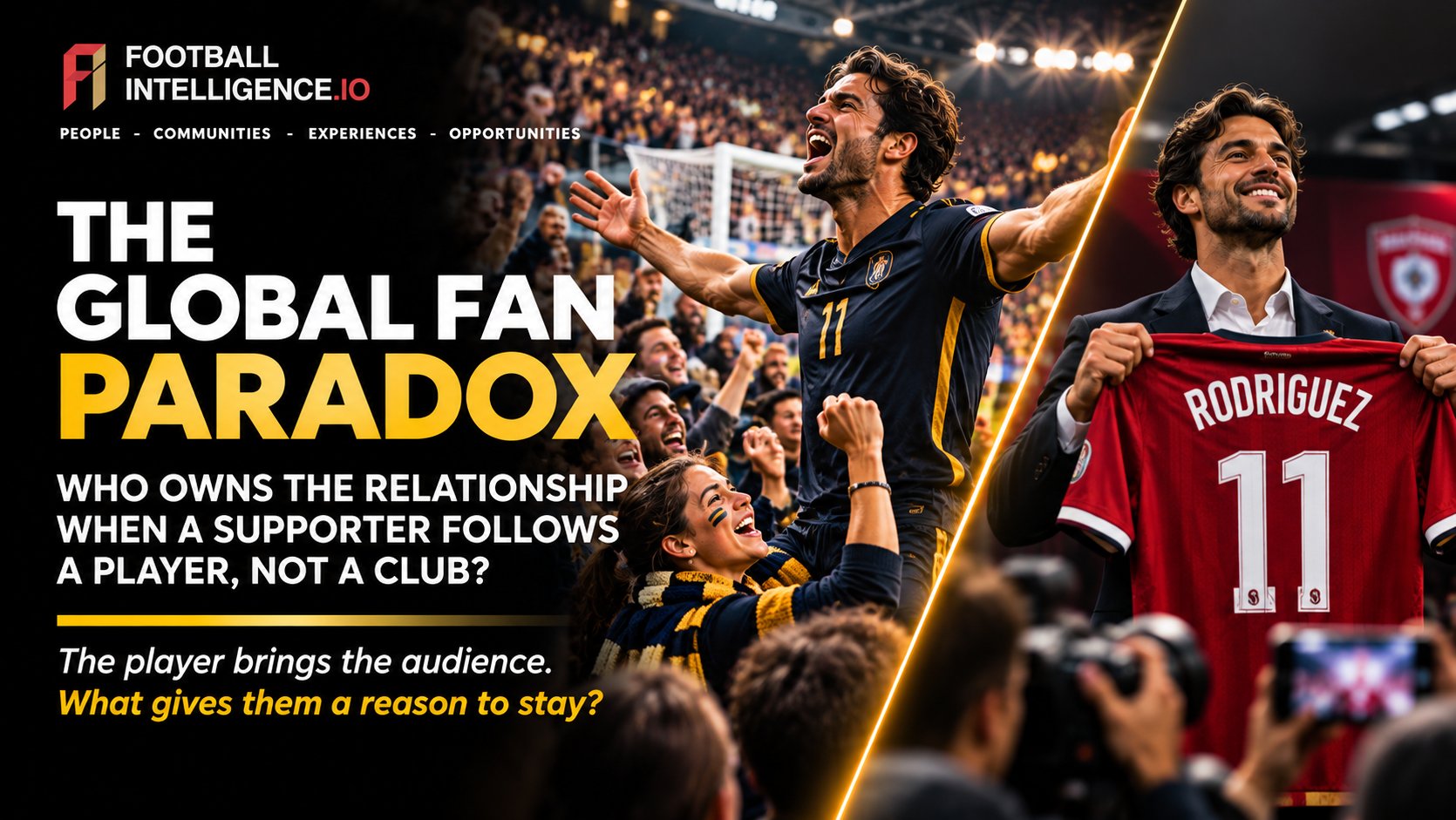
Imagine a football club announcing the signing of a globally recognised player.
Within hours, the announcement travels around the world.
Social media activity accelerates.
New international audiences discover the club.
Merchandise sales receive a boost.
Sponsors recognise an opportunity.
Broadcasters see additional interest.
And the club celebrates an extraordinary moment of global attention.
From a commercial perspective, it's an exciting development.
But here's the question I believe football's executive leadership should be asking.
How many of those people are now supporters of the club, and how many are simply following the player?
It's a distinction that matters enormously.
Because the player may have created the introduction.
But the organisation still needs to develop a relationship.
And if that distinction is misunderstood, football clubs risk confusing temporary attention with long-term commercial value.
The most important question may not be how many followers a player brings to a club.
It may be how many meaningful relationships the club creates while that player is there.
That is the Global Fan Paradox.
And I believe it represents one of the most significant opportunities in modern football's commercial development.
There is a popular narrative that younger supporters are abandoning traditional club loyalty and following individual players instead.
The reality is more nuanced.
In 2025, YouGov examined the importance of athlete and team allegiance across 15 international markets.
Among sports fans surveyed, 40% identified following a team as an influential reason for following a sport.
Nineteen percent identified following an athlete.
Team allegiance remained the stronger factor overall.
But the generational differences were revealing.
Among sports fans aged 18–34, 25% cited following athletes as an influential factor.
Among supporters aged 55 and over, that figure was 12%.
The study also found that team allegiance remained important across age groups.
These results don't demonstrate that player loyalty is replacing club loyalty.
Nor do they mean every younger supporter follows individuals rather than teams.
They indicate that athletes are particularly important routes into sports fandom for younger audiences.
That creates an important commercial opportunity.
A supporter may discover football through a player.
But that doesn't prevent them from subsequently developing an attachment to a club, competition or wider community.
The relationship can evolve.
The player may be the beginning of the journey without necessarily being its destination.
And that is precisely where club strategy becomes important.
Consider the global attention surrounding Lionel Messi's arrival at Inter Miami in 2023.
The signing transformed the club's international visibility.
Audiences across multiple markets became interested in a Major League Soccer organisation they may not previously have followed.
Merchandise, sponsorship visibility, media attention and commercial opportunities all benefited from the extraordinary profile of one footballer.
By August 2026, reporting from AS indicated that Inter Miami's Instagram account had grown to more than 18 million followers.
The report also highlighted how the attention surrounding Messi helped introduce audiences to opposing MLS teams and the league itself.
This is a fascinating aspect of player-driven fandom.
A globally recognised athlete can create value beyond their own club.
Other teams gain visibility.
The competition gains attention.
Commercial partners reach new audiences.
And previously unfamiliar football properties become part of international conversations.
But this creates another question.
When one player attracts an enormous global audience, how much of that relationship belongs to the club, the league, the player or the platform through which the supporter discovered them?
The answer isn't straightforward.
And it cannot be established from follower numbers alone.
A follower may become deeply attached to Inter Miami.
Another may remain interested primarily in Messi.
Another may begin following MLS more broadly.
Another may engage only when the player appears.
These relationships have different characteristics.
And they may develop in very different ways over time.
The commercial opportunity isn't simply the size of the audience a player attracts.
It's understanding what kind of relationship that attention creates.
This is where the title of the article becomes deliberately provocative.
Who owns the relationship?
In a literal sense, nobody owns a supporter.
Clubs may hold legitimately collected customer information.
Players may have relationships with followers through their personal channels.
Leagues may operate digital platforms.
And social media companies control significant parts of the technology through which those interactions take place.
Each operates within its own rights, contracts and privacy obligations.
But none owns the person's loyalty.
Supporter loyalty isn't a transferable commercial asset simply because someone follows an account or purchases a shirt.
It's a relationship that develops through experience, identity, trust and meaning.
And it can change.
A supporter may begin by following an athlete.
Become interested in the club.
Develop relationships with other supporters.
Attend a match.
Become connected to the club's history.
And eventually maintain that relationship long after the original player has departed.
Or they may never develop that deeper attachment.
Both possibilities are legitimate.
The important point is that the outcome isn't automatic.
Clubs cannot assume that player-driven attention will become lasting club loyalty simply because the player is wearing their shirt.
They need to understand what makes that relationship worth continuing.
Traditional football culture often treats supporter loyalty as a singular relationship.
You support a club.
You follow its results.
You identify with its colours.
And that allegiance may last a lifetime.
For many supporters, that remains true.
But modern football also allows people to develop several overlapping relationships.
A supporter might follow a local club because of family history.
A major European club because of its playing style.
A national team because of cultural identity.
A women's team because of an inspiring player.
And an international league because of its entertainment and accessibility.
These interests are not necessarily contradictory.
People can maintain different relationships for different reasons.
And those motivations may evolve.
This is where cognitive anthropology becomes particularly relevant.
Human identity is shaped by culture, relationships, shared experiences and personal meaning.
Football is one of the most powerful expressions of those forces.
But the meaning attached to a club may be different from the meaning attached to an individual athlete.
For some supporters, the club represents belonging.
For others, the player represents aspiration.
For others, the league represents entertainment.
And for some, these relationships become interconnected.
Modern fandom doesn't always follow the organisational boundaries football uses to sell its commercial rights.
That's a challenge worth examining.
Because football's commercial structures are largely organised around clubs, leagues, federations and competitions.
But supporters don't necessarily experience the game through those same divisions.
Women's football is developing global audiences during a period when individual athletes can establish powerful personal identities through digital media.
A young supporter may discover a player through a World Cup.
Follow their career.
Learn about their personal journey.
And become interested in the club where they play.
Another supporter may connect with an athlete because of the values, experiences or aspirations they represent.
The initial relationship may be deeply personal.
That is not something clubs should attempt to replace.
It's something they should recognise and respect.
The player has earned their relationship with their audience.
And the club has an opportunity to create additional value around the wider football experience.
Imagine a young girl discovering an international player she admires.
She begins watching highlights.
Learns about the team.
Attends her first match.
Starts following other players.
And eventually becomes connected to the club itself.
The original player may later transfer.
But the relationship with football may continue.
This is an illustrative journey, not evidence that every supporter follows that path.
Still, the opportunity is significant.
The objective shouldn't be to transfer a player's audience into the club's database.
It should be to create experiences that allow a supporter to develop a genuine connection with the organisation on their own terms.
That distinction matters both commercially and ethically.
Football clubs frequently celebrate international audience growth.
And rightly so.
Global visibility can generate commercial value through broadcasting, sponsorship, merchandise, licensing and digital services.
But geographic reach doesn't automatically translate into purchasing behaviour.
Consider three supporters.
One lives close to the stadium.
One lives in another country.
One lives on another continent.
All three may follow the same football club.
But their opportunities to engage differ.
The local supporter may attend matches regularly.
The international supporter may rely on broadcasting and digital content.
The distant supporter may follow an individual player and have limited interest in the club's other activities.
Their needs are not identical.
Their motivations are not identical.
And their commercial value cannot be understood solely through a common follower metric.
A global audience is not one uniform market.
It's a collection of people with different relationships, expectations and opportunities.
That matters when clubs develop international strategies.
Because a campaign designed around matchday attendance may be irrelevant to an overseas supporter.
A merchandise promotion may appeal to one segment but not another.
And a digital membership may have limited value unless it addresses a need the supporter actually has.
The opportunity is to develop more intelligent audience understanding.
Not simply more international reach.
There is another important dimension.
Social media has transformed how supporters discover clubs and athletes.
But it has also introduced an additional layer between football organisations and their audiences.
The platform.
A club may have millions of followers.
But it cannot assume that every follower will see its content.
Distribution is influenced by recommendation systems, platform policies, content formats and individual behaviour.
The club may control its content.
But it doesn't control every aspect of how that content reaches people.
Players face similar constraints.
Their personal followings can be commercially powerful.
But those audiences often exist within third-party environments.
This creates a strategic distinction between digital visibility and a direct supporter relationship.
An official club app, membership programme or other authorised direct channel may give an organisation greater control over the experiences it offers.
But simply persuading supporters to download another application isn't a complete solution.
A direct channel is only valuable if people have a meaningful reason to use it.
And maintaining that relationship requires appropriate privacy, transparency and consent.
The objective shouldn't be to capture every possible interaction.
It should be to reduce unnecessary friction while providing genuine value.
Because a supporter who trusts an organisation and chooses to remain engaged is more meaningful than one who has simply been added to another database.
This is the question that makes the issue commercially significant.
Players transfer.
Contracts expire.
Careers end.
International tournaments finish.
And sporting narratives change.
These are normal characteristics of professional football.
But they can affect commercial relationships.
A club may experience a surge in international attention following a major signing.
Commercial partnerships may expand.
Merchandise demand may increase.
And digital engagement may reach new markets.
But leadership should consider what happens after the initial excitement.
What portion of that audience remains interested in the club?
What experiences encourage continued engagement?
What other players, stories or communities have become meaningful to those supporters?
And what value persists after the original player has departed?
These questions shouldn't be interpreted as a demand to convert every player follower into a permanent club supporter.
That's unrealistic.
Some audiences will always be primarily athlete-driven.
Others will develop broader football interests.
The strategic challenge is understanding the difference.
A major signing may create an extraordinary commercial opportunity.
But the strength of the underlying relationship is tested when the original reason for attention changes.
That's where temporary exposure and lasting engagement begin to separate.
There's a reason this particular subject interests me.
Nearly a decade ago, I created a digital platform around a challenge I believed would become increasingly important for football clubs and global sports brands.
How do you turn audiences into meaningful, lasting relationships rather than simply accumulating followers?
The platform was designed to connect digital content, audience experiences, commercial transactions and engagement opportunities within one interoperable environment.
But the technology was only part of the thinking.
What interested me most was understanding people.
Where they spent their time digitally.
Why they followed certain players.
How younger generations consumed football differently.
And how their relationships with clubs, athletes and communities were evolving.
A supporter might grow up attending matches at a particular stadium without necessarily developing lifelong loyalty to that club.
Another might spend hours on YouTube watching one player, following their career from club to club.
Same sport. Completely different relationships.
And that distinction has significant commercial implications.
A few years later, I had an opportunity to present this thinking to a club with one of the largest global audiences in football.
The timing was particularly interesting.
They were preparing to welcome back a legendary player.
A five-time Ballon d'Or winner with one of the largest social media followings in the world.
I'll leave the names out of it.
Although I suspect most football supporters won't need VAR to work this one out.
During the conversation, I explained the opportunity to connect the club's digital ecosystem, audience relationships, content and commercial experiences in a way that could create value beyond any individual player.
Then I asked a question.
"What happens when this player eventually leaves and a significant part of his global audience follows him to the next club?"
And perhaps more importantly:
"Wouldn't it make sense to establish those relationships before that day comes?"
There was a moment of consideration.
The response was something along the lines of:
"Interesting. We'll get back to you."
Well, I'm still waiting.
Actually, I'm not. I had other things to get on with.
But the conversation stayed with me.
Not because I expected the club to adopt my particular platform.
And certainly not because I claim to have predicted the details of a player's career.
It was because the commercial question was bigger than the technology I had created.
A globally recognised player can deliver extraordinary attention to a club.
But attention doesn't automatically become loyalty.
And the audience that arrives with a player doesn't necessarily remain when that player leaves.
That's not a criticism of the club, the player or the supporters.
It's simply the reality of how relationships develop.
Today, football has more digital platforms, more data, more content and more sophisticated technology than ever before.
Yet I continue asking essentially the same question.
Are clubs using the extraordinary attention generated by their players to develop meaningful relationships that can exist beyond those players?
Because attracting an audience is one achievement.
Creating something valuable enough that people choose to stay is an entirely different one.
There is also an important consideration for the players themselves.
Modern footballers are increasingly influential personal brands.
Their identities can extend beyond the clubs they represent.
They may have commercial partners.
Personal ventures.
Community initiatives.
And direct relationships with audiences across the world.
Those relationships have independent value.
Clubs should not assume that signing a player automatically grants unrestricted commercial access to everything associated with their personal identity.
Image rights, contractual obligations, commercial agreements and applicable regulations all matter.
So does professional respect.
The more interesting opportunity is collaboration.
How can the club, player and relevant partners create experiences that benefit supporters while respecting everyone's rights and interests?
That might involve appropriately agreed content.
Community participation.
Education.
Player-led storytelling.
Or experiences that connect supporters to a wider football community.
These are illustrative possibilities.
The underlying principle is straightforward.
Player-driven fandom should be developed through mutually valuable partnerships, not treated simply as commercial inventory.
That's a more sustainable approach.
And potentially a more powerful one.
A globally recognised player can create enormous attention during a match.
A spectacular goal travels across social media.
A performance reaches international audiences.
A personal story connects with supporters.
And the club becomes visible to people who may never have previously encountered it.
But what happens next?
The interaction might last ten seconds.
The match lasts 90 minutes.
The player's contract may last several years.
Yet the relationship with football could continue for a lifetime.
The real opportunity is to connect the moment of discovery with meaningful experiences beyond it.
Not 365 days of marketing.
Not endless notifications.
Not another disconnected platform.
But experiences that reflect why people became interested in the first place.
For a young player, that may involve inspiration and development.
For a family, shared experiences.
For an international supporter, community and access.
For a fan of a particular athlete, meaningful opportunities to follow the player's journey.
And for someone developing an attachment to a club, a broader sense of belonging.
This is central to my approach to turning 90 minutes into 365 days of engagement.
The objective isn't to demand more attention from people.
It's to create more meaningful reasons for football to remain part of their lives.
And those reasons can create commercial value when developed responsibly.
Football is generating extraordinary commercial revenues.
Deloitte's 2026 Football Money League reported that the world's 20 highest-revenue clubs generated €12.4 billion during the 2024/25 season.
Commercial revenue reached €5.3 billion, representing 43% of the total.
The industry is increasingly developing commercial models that extend beyond traditional matchday activity.
But audience growth and commercial sophistication should not be confused.
A club may have a globally recognised brand.
It may attract enormous social media audiences.
And it may generate substantial sponsorship income.
Yet the organisation still needs to understand how its relationships are developing.
Which audiences engage because of individual players?
Which identify with the club?
Which become interested in the wider competition?
Which relationships persist?
And what meaningful value can be created across those different groups?
These distinctions could influence sponsorship strategy, international partnerships, digital services and long-term commercial planning.
The next generation of global football strategy may be less about accumulating followers and more about understanding the relationships behind them.
That is a significantly different commercial ambition.
1. Why are people following our club?
Do we distinguish between loyalty to the organisation, interest in individual players, entertainment and broader football culture?
2. What happens to our audience when a major player leaves?
Can we evaluate whether relationships continue, change or decline without making unsupported assumptions from follower counts?
3. Are we creating genuine value for international supporters?
Do our engagement strategies reflect geographic differences, cultural motivations and the practical ways people can participate?
4. Are we developing meaningful partnerships with players?
Do commercial programmes respect individual rights while creating appropriate opportunities for supporters, clubs and athletes?
5. Are we measuring global reach or lasting relationship value?
Can we explain how international visibility contributes to meaningful engagement, sustainable revenue and the wider football community?
These are not simply questions for marketing departments.
They're questions for club CEOs.
Commercial directors.
Sporting directors.
Leagues.
Federations.
Player representatives.
And international investors.
Because global fandom increasingly crosses traditional organisational boundaries.
And understanding those relationships may become one of football's most important executive capabilities.
This discussion connects directly to the development of the Football Intelligence Index through FOOTBALLINTELLIGENCE.io.
The Index is being developed as an independent framework for examining how football organisations approach intelligence, commercial innovation, digital maturity, ecosystem connectivity and strategic execution.
Global fan engagement raises an important evaluation question.
Should an organisation receive greater recognition simply because it has a larger international following?
Audience scale has value.
But scale alone cannot demonstrate how effectively an organisation understands and develops relationships.
An organisation with fewer followers may possess sophisticated capabilities for supporter understanding, relevant engagement and meaningful community development.
A global club may demonstrate extraordinary reach while still facing opportunities to improve its understanding of why different audiences follow it.
A national federation may maintain powerful tournament-driven relationships that require a different approach from a professional club.
These contexts should not be assessed as identical.
The Index methodology remains in development, and this article does not rank any organisation.
But I believe the following distinction deserves attention.
Global fan intelligence should examine not only how many people an organisation reaches, but why they connect, how those relationships develop and what value they create.
That is a more meaningful measure of engagement maturity.
The emotional relationship people have with football is one of the industry's greatest assets.
But those relationships are not all created in the same way.
Some begin with family.
Some with community.
Some with a club.
Some with an extraordinary match.
And others with a player who inspires someone to take an interest in the game.
These different beginnings should not be treated as weaknesses.
They're opportunities.
The question is whether football organisations understand them well enough to create meaningful experiences that allow relationships to develop.
That may require better research.
More connected commercial strategies.
Thoughtful digital experiences.
Appropriate partnerships.
And greater coordination between the people and organisations that shape the supporter journey.
It does not necessarily require another platform.
Nor does it require clubs to control every interaction.
The goal should not be ownership of the supporter.
It should be earning a meaningful relationship with them.
So here's the question I want to leave with football's executive leadership.
If your club signs a global superstar and gains ten million new followers, but loses their attention when that player leaves, how much lasting value did you actually create?
That is the Global Fan Paradox.
And I believe answering it could shape the next generation of football's international commercial strategy.
Because the player may bring the audience.
But the club still has to give people a reason to stay.
YouGov | June 2025
Star Power: The Role of Individual Athletes on Sports Fandom
https://yougov.com/en-gb/reports/52280-star-power-in-sports-uk-report-2025
YouGov | 2025 Global Research
Athlete or Team Allegiance: What Drives Sports Fandom in 2025?
https://d3nkl3psvxxpe9.cloudfront.net/documents/Multi_country_star_power_report_Global_Report_English_YouGov.pdf
AS | August 2026
Los datos económicos del adiós de Messi a Argentina
https://as.com/futbol/internacional/los-datos-economicos-del-adios-de-messi-a-argentina-f202608-n/
Deloitte | January 2026
Football Money League 2026: Driving Home Advantage
https://www.deloitte.com/uk/en/services/financial-advisory/analysis/deloitte-football-money-league.html
Infobip | October 2025
Global Sports Fans Demand Always-On Engagement From Their Favourite Teams
https://www.infobip.com/news/sport-fan-engagement-study