
Football is a relationship, not a 90-minute product.
The match is a powerful shared moment. The opportunity is to earn a meaningful place in supporters’ lives before it, after it and between fixtures.
Christopher Roselli’s public beliefs on fan engagement, emotional connection and the opportunity to turn 90 minutes into 365 days of relevance.
The match is a powerful shared moment. The opportunity is to earn a meaningful place in supporters’ lives before it, after it and between fixtures.
A supporter has a family, a culture, routines, aspirations and responsibilities. Start with that life, rather than asking everyone to fit a club’s channels or calendar.
Purchases, clicks and attendance record activity. Explore the identity, belonging, inspiration and practical circumstances behind those actions before deciding what they mean.
A club badge can carry generations of meaning, while a player or experience can open a new connection. Treat those routes into football with curiosity rather than assuming one model of loyalty.
A young person should have opportunities to play, watch and belong. Examine scheduling, travel, accessibility and family commitments alongside awareness and price.
Men’s and women’s football can share a badge while offering distinct experiences. Sponsorship becomes more relevant when it responds to people’s motivations rather than treating visibility as the whole proposition.
Supporters move between stadiums, communities, content and everyday life. Give technology a clear role in making that experience coherent, useful and accessible.
Belonging is not permission to exploit attention or personal data. Offer a clear value exchange and respect each person’s choice about participation.
Quiet digital activity does not prove weak attachment. Build worthwhile opportunities to return and measure what people value, not simply how often they can be prompted to click.
Technology can enable an experience. People decide its purpose, take responsibility for delivery and learn whether it strengthens relationships. That is the work behind turning 90 minutes into 365 days of engagement.
THE FOOTBALL PARADOX / ARTICLE 6 OF 11
Why football's next commercial breakthrough may depend on making broadcasting, live attendance and year-round supporter engagement work together.
By Christopher Roselli · 14-minute read
Christopher Roselli’s published personal strategic perspective. Disclosed interests →
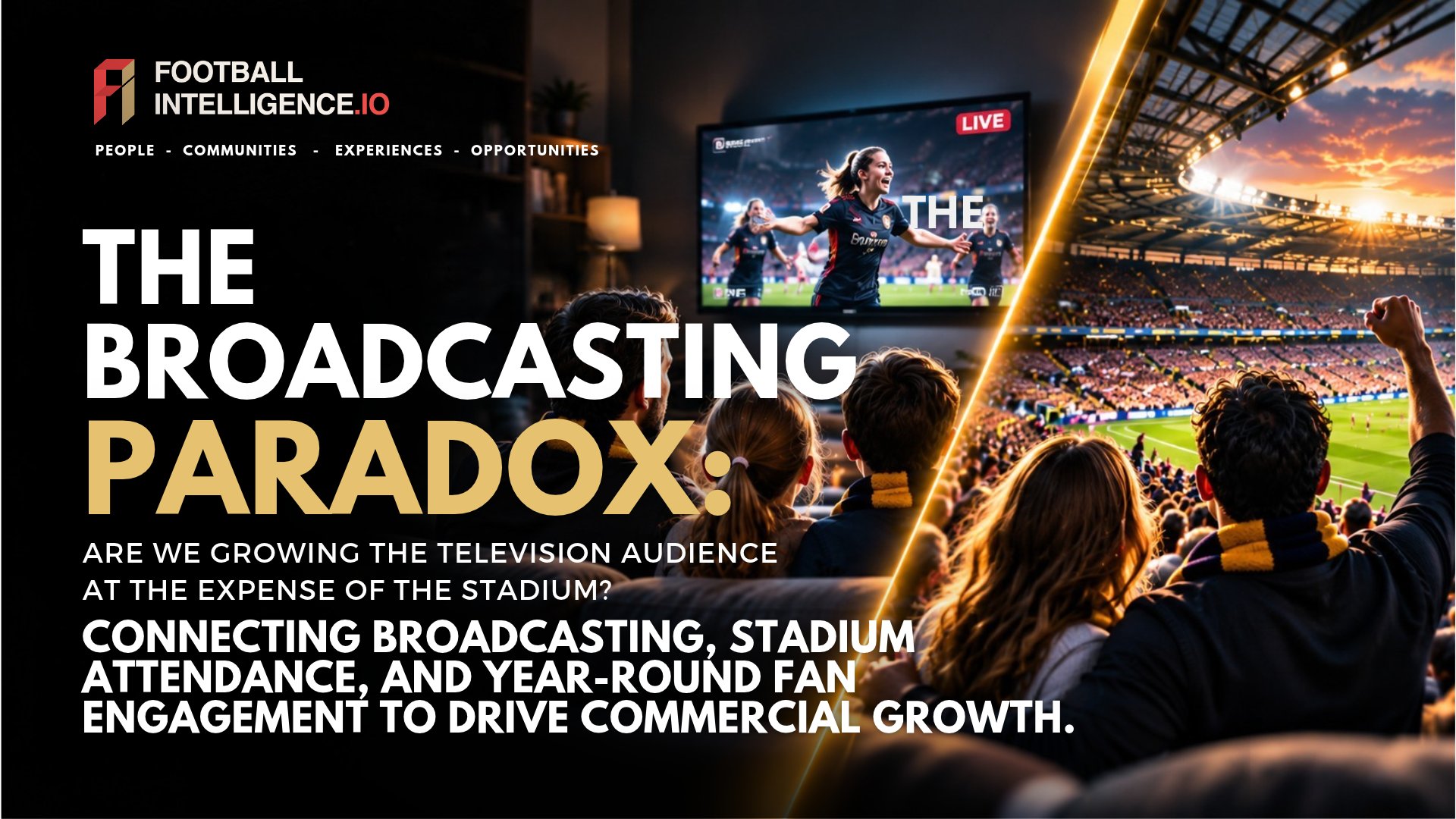
Imagine two supporters watching the same football match.
One is sitting inside the stadium.
They've travelled to the ground, perhaps brought their family, purchased refreshments and become part of an experience that extends beyond the 90 minutes.
The other is watching from home.
They may be thousands of miles away.
They may have discovered the team through an individual player, a recent tournament or a piece of digital content.
Both supporters matter.
Both represent opportunities for football to build meaningful relationships.
And both can contribute to the industry's commercial future.
But here's the question I believe football needs to examine more carefully.
Are we developing these audiences as part of one connected growth strategy, or measuring them through separate commercial models that occasionally compete with one another?
Broadcasting departments focus on distribution, audiences and media rights.
Ticketing departments focus on attendance.
Commercial teams focus on sponsorship and revenue.
Digital teams focus on engagement.
Each has legitimate objectives.
But the supporter experiences football as one relationship.
The television audience and the stadium audience aren't necessarily two separate markets. They may represent different moments in the same supporter journey.
And that distinction could change how we evaluate football's next phase of commercial growth.
Let's begin with something important.
Broadcasting has transformed world football.
It has taken local clubs into international markets.
Created global commercial opportunities.
Introduced generations of supporters to teams and players they might never have discovered.
And generated media-rights revenues that have become fundamental to the economics of professional football.
Women's football is experiencing an important expansion of this opportunity.
In June 2026, UEFA reported that cumulative live viewership for the 2025/26 Women's Champions League had more than doubled compared with the previous season.
Before final viewing figures were consolidated, UEFA projected at least 44.5 million viewers across the competition.
Matches reached 207 territories.
The final attracted an extensive free-to-air distribution network.
These are meaningful indicators of growing international visibility.
And visibility matters.
Because people cannot develop a relationship with a sport they never have the opportunity to discover.
But here's where the next strategic question begins.
Once broadcasting creates awareness, what happens to that relationship next?
Does the viewer become more interested in the club?
Do they follow its players?
Do they seek out future matches?
Do they engage with the club's wider experiences?
And, where practical, do they consider attending?
Those questions move us beyond distribution.
They take us into the longer-term value of broadcasting.
The 2026/27 Barclays Women's Super League season represents an important evolution in English women's football broadcasting.
With the competition expanding to 14 teams, WSL Football announced an arrangement under which Sky Sports would show 163 league fixtures.
The BBC also continues as a broadcast partner, with selected fixtures available through other distribution channels.
Greater visibility creates opportunities.
But it also introduces scheduling challenges.
When should matches kick off?
How do clubs balance stadium availability with broadcast commitments?
How do they account for men's fixtures?
What about grassroots football?
What about families?
And how can the league serve both supporters attending matches and those watching remotely?
WSL Football has explicitly acknowledged these competing considerations.
For 2026/27, the league introduced greater scheduling flexibility, including Friday evening, Saturday and Sunday broadcast windows, with the stated objective of balancing broadcast requirements and attendance.
That's an important development.
It shows the industry recognises that distribution strategy and matchday accessibility need to be considered together.
But I believe the conversation can go further.
Rather than simply balancing broadcasting and attendance, could football develop a strategy where one actively strengthens the other?
That is a more ambitious question.
And potentially a more commercially valuable one.
Women's football has experienced extraordinary growth in attention.
Major tournaments have attracted substantial audiences.
Professional clubs have generated record crowds.
Broadcast coverage has expanded.
But the relationship between visibility and regular match attendance is not straightforward.
Research published by Populous and YouGov Sport in September 2026 examined the matchday experiences of 2,000 UK women's football fans, including established attendees and potential future attendees.
Among those who had attended women's football within the previous five years, only 15% reported attending at least monthly.
Forty-three percent described themselves as casual fans who engaged more closely with major international tournaments than domestic club football.
And 48% had never attended a Women's Super League match.
These findings don't establish that broadcasting is responsible for irregular attendance.
They don't demonstrate that television is replacing matchday participation.
But they identify something strategically important.
There is a gap between interest in women's football and regularly attending domestic club matches.
The question is why.
Is it scheduling?
Travel?
Price?
Venue accessibility?
Matchday experience?
Competition from other commitments?
Limited familiarity with a local club?
Or simply the fact that supporters engage with football in different ways?
The answers will vary.
And that's precisely why we need to understand the audience before designing the commercial strategy.
I want to be careful here.
It's tempting to argue that more televised football means fewer people attending matches.
But that conclusion is too simplistic.
Broadcasting can make players recognisable.
It can build awareness of clubs.
It can strengthen rivalries.
It can create anticipation around future fixtures.
And it can introduce people to live football who might otherwise never have considered attending.
For supporters living far away, television may be the only practical way to maintain a relationship.
For families, it can be an accessible first step into the game.
For younger audiences, broadcast highlights and digital distribution can help turn curiosity into interest.
There are also circumstances where broadcast scheduling creates real problems.
A late kick-off may be difficult for families travelling with young children.
A fixture change may disrupt plans.
A match that overlaps with another major football event may divide attention.
And a grassroots football schedule may prevent an interested supporter from attending.
Academic research on WSL attendance, published in 2024, examined 476 fixtures across earlier seasons.
It found that weekend matches, shorter travel distances and other contextual factors influenced attendance.
It also identified reduced attendance for women's fixtures that clashed with matches involving the corresponding men's team, except in double-header situations.
The study did not establish that television coverage itself was the cause of attendance decline.
And that distinction matters.
The strategic challenge isn't television versus the stadium.
It's understanding the conditions under which football's different audiences can engage.
Consider a young family watching women's football together.
A daughter discovers a player she admires.
Her parents begin following the club.
They watch another match.
Then another.
Eventually, the family becomes interested in attending a game.
At this point, the commercial opportunity isn't simply another television impression.
It's the possibility of a developing relationship.
But what happens next?
Does the family know which matches are accessible?
Can they easily understand ticket options?
Are kick-off times compatible with their commitments?
Does the matchday offer the type of experience they're looking for?
Are there opportunities for the daughter to participate in football-related activities?
And does the club have a meaningful relationship with that family between fixtures?
These are hypothetical questions, but they represent a very real strategic consideration.
Broadcasting may create demand. But demand doesn't automatically translate into participation.
That translation requires understanding and coordination.
And this is where football's digital and commercial capabilities can become significantly more valuable.
Not necessarily by building more platforms.
But by connecting the supporter journey more intelligently.
There is another important part of this discussion.
Modern broadcasting is an extraordinary product.
Multiple cameras.
Expert analysis.
Replays.
Graphics.
Commentary.
Increasingly sophisticated viewing experiences.
From a pure football-viewing perspective, television can offer advantages that a stadium cannot always replicate.
So why would someone leave their home, travel to a venue and pay to attend?
Because stadium attendance is not simply another way to watch the match.
It's a different product.
The atmosphere.
The anticipation.
The shared experience.
The sense of belonging.
The traditions.
The people.
The memories.
These create a value proposition that extends beyond what happens on the pitch.
Populous and YouGov Sport's 2026 research provides an interesting illustration.
Among both established and potential women's football attendees, a welcoming and family-friendly environment ranked as the leading factor influencing matchday enjoyment.
It ranked ahead of team success and performance on the pitch.
The research also identified the importance of comfort, accessibility, food and drink, and other aspects of the stadium experience.
That should give football executives something to consider.
Are we asking supporters to attend because the football is worth watching, or because the entire experience is worth having?
Both are important.
But they are not identical propositions.
And the second may offer opportunities for clubs to differentiate the matchday experience in ways broadcasting cannot.
Broadcasting has clear metrics.
Audience reach.
Viewing figures.
Subscriptions.
Advertising exposure.
Rights revenue.
Stadium operations have their own.
Ticket sales.
Attendance.
Hospitality.
Per-capita spending.
Venue utilisation.
These measures are necessary.
But what if we also examined the relationship between them?
How many supporters first discovered a club through broadcast coverage?
How many subsequently attended a match?
How does familiarity with players influence ticket demand?
What barriers prevent interested viewers from attending?
Does a better matchday experience strengthen future broadcast interest?
How do commercial partners contribute across both environments?
And what happens to those relationships beyond the season?
These are not questions that can always be answered through existing transactional data.
They may require direct research, appropriate consent, audience studies and longitudinal analysis.
But asking them could help football organisations understand where value is actually being created.
A broadcast audience and a matchday audience should not simply be two numbers on different presentations.
They should be considered as parts of a wider football engagement ecosystem.
Broadcasting creates valuable inventory for commercial partners.
Advertising.
Sponsorship visibility.
Branded content.
Distribution.
Access to large audiences.
But the relationship between clubs, supporters and sponsors can extend beyond exposure.
Imagine a commercial partner contributing to experiences across the supporter journey.
A relevant broadcast experience introduces a family to a club.
The club provides useful information about attending a future match.
The family participates in a community activity.
A partner contributes something meaningful to that experience.
The relationship continues through other relevant activities over the season.
This is an illustrative scenario, not a recommendation to track individual families without appropriate permissions.
The opportunity is to think more intelligently about commercial value across different forms of engagement.
Broadcasting can generate attention.
The stadium can create experiences.
Digital and community engagement can help sustain relationships.
And commercial partners can contribute across all three.
The objective shouldn't be to force every television viewer into the stadium.
That's neither realistic nor necessary.
It should be to understand what different supporters value and create opportunities appropriate to their circumstances.
Some international fans may never attend a match.
They can still have meaningful relationships with the club.
Others may attend once a season.
Others may become regular matchgoers.
There is no single correct journey.
The value lies in understanding those differences.
Consider how a professional football organisation is structured.
Broadcasting and media rights may be negotiated at league level.
Scheduling decisions involve competition organisers, broadcasters, clubs and venue operators.
Ticketing sits within the club.
Digital engagement may operate through another department.
Sponsorship is managed commercially.
Community engagement may be delivered through foundations or separate teams.
Each part has its own responsibilities.
But who is responsible for ensuring these activities contribute to a coherent supporter relationship?
This connects directly to Article 04 of The Industry Challenge: The Technology Paradox.
Football has developed increasingly sophisticated specialised departments.
But are those departments working towards a shared organisational objective?
The broadcasting challenge illustrates that issue perfectly.
A league can negotiate a commercially attractive media agreement.
A broadcaster can attract new audiences.
A club can develop an excellent stadium experience.
Yet if the activities aren't appropriately coordinated, opportunities may be missed.
The next commercial breakthrough may require greater intelligence between the organisations and departments responsible for different parts of the supporter experience.
Not simply more technology.
And not simply more content.
But a more connected strategy.
1. Are we measuring broadcast reach or relationship development?
Does our distribution strategy help us understand whether audiences are developing meaningful connections with clubs, competitions and players?
2. Are our broadcast windows supporting the supporters we're trying to attract?
Do we understand how scheduling affects families, grassroots participants, local supporters and international audiences?
3. Are we making stadium attendance genuinely compelling?
What makes the matchday experience worth the additional time, effort and expense compared with watching from home?
4. Are our commercial partners participating across the entire supporter journey?
Or do we evaluate sponsorship primarily through the visibility delivered during matches?
5. Who is responsible for connecting broadcasting, attendance and year-round engagement?
Are these separate departmental objectives, or components of one coordinated growth strategy?
These questions should interest league leadership, broadcasters, club CEOs, commercial directors, sponsors and investors.
Because the answers affect much more than audience measurement.
They influence how football builds its next generation of supporters.
I've spent approximately 15 years playing professional football and two decades working across digital innovation, commercial strategy and connected experiences.
Those experiences have reinforced something I believe is fundamental.
The match is the centre of football's emotional experience. But it doesn't need to define the boundaries of the relationship.
A supporter may discover a club through television.
Develop an attachment through a player.
Experience belonging through a community.
Attend a match with their family.
Engage digitally.
And maintain that relationship across years.
These activities are connected by human meaning.
Not simply by technology.
This is why I continue returning to cognitive anthropology and the importance of understanding how football fits into people's lives.
A supporter isn't necessarily choosing between television and the stadium based on one commercial calculation.
Their decision may be influenced by family commitments, travel, identity, social relationships, culture, affordability or personal preference.
Understanding those circumstances helps organisations create more relevant experiences.
And that's where I believe football can unlock a much more intelligent engagement model.
Not 365 days of constant marketing.
Not another collection of disconnected applications.
But a coordinated approach that allows football relationships to develop beyond the 90 minutes.
The ambition should not be to monopolise a supporter's attention.
It should be to earn a meaningful place in their life.
This article also connects to the development of the Football Intelligence Index through FOOTBALLINTELLIGENCE.io.
The Index is intended to examine how football organisations approach fan intelligence, digital maturity, commercial innovation, ecosystem connectivity and strategic execution.
Broadcasting provides a useful example of why those dimensions need to be considered together.
A league may demonstrate extraordinary global reach.
A club may demonstrate strong matchday attendance.
Another organisation may deliver meaningful community participation.
Those are different forms of success.
And they shouldn't automatically be treated as interchangeable.
A more intelligent evaluation would consider how organisations understand the relationships between visibility, accessibility, participation and long-term value.
Does audience research inform decisions?
Are supporters' practical barriers considered?
Can commercial outcomes be measured appropriately?
Is the matchday experience designed around the audience?
And are different organisational capabilities contributing towards coherent objectives?
The methodology remains in development, and no organisational rankings are implied by this article.
But the underlying question is important.
Shouldn't we measure how effectively football develops relationships across different environments, rather than only how many people watch or attend?
That is the kind of question I believe the industry's future intelligence frameworks need to address.
Broadcasting will remain fundamental to world football.
It creates access.
Generates revenue.
Introduces new supporters.
And connects the game across borders.
Stadium attendance will remain equally important.
Not simply because it generates revenue, but because the live experience forms part of football's cultural and emotional identity.
The challenge isn't choosing one over the other.
It's understanding how they can contribute to the same long-term ambition.
A growing television audience is valuable.
A thriving stadium is valuable.
But the greatest opportunity may emerge when the two help create a stronger, more sustainable relationship with the supporter.
Perhaps the next generation of football's commercial strategy should stop treating broadcasting as the destination and matchday as a separate transaction.
Instead, both should become connected parts of a much larger engagement ecosystem.
So here's the question I want to leave with football's leadership.
If your broadcast audience doubles over the next five years, but your clubs struggle to develop stronger supporter relationships and sustainable matchday demand, have you truly unlocked the full value of that growth?
That is the Broadcasting Paradox.
And I believe the answer could influence the future economics of world football.
Because the goal shouldn't simply be to get more people watching football.
It should be to give more people a meaningful reason to remain connected to it.
UEFA | June 2026
A New Era Peaks in Oslo: UEFA Women's Champions League and UEFA Women's Europa Cup Reshape the Landscape
https://www.uefa.com/news-media/news/02a6-20d5754e28b9-c23cf37e8c28-1000--a-new-era-peaks-in-oslo-uefa-women-s-champions-league-and-/
WSL Football | July 2026
The 2026–27 Fixtures Are Out
https://www.wslfootball.com/news/the-2026-27-fixtures-are-out
Populous and YouGov Sport | September 2026
UK Women's Football: Designing the Future of Matchday
https://populous.com/article/populous-and-yougov-sport-launch-report-exploring-the-matchday-experience-for-womens-football-fans-in-the-uk
Valenti, Scelles and Morrow | European Sport Management Quarterly, 2024
The Determinants of Stadium Attendance in Elite Women's Football: Evidence From the FA Women's Super League
https://doi.org/10.1080/16184742.2024.2343485
WSL Analytics | May 2026
Inside the Stands: WSL Attendance Trends 2025–26
https://newsletter.wslanalytics.com/p/inside-the-stands-wsl-attendance-b58