
Football is a relationship, not a 90-minute product.
The match is a powerful shared moment. The opportunity is to earn a meaningful place in supporters’ lives before it, after it and between fixtures.
Christopher Roselli’s public beliefs on fan engagement, emotional connection and the opportunity to turn 90 minutes into 365 days of relevance.
The match is a powerful shared moment. The opportunity is to earn a meaningful place in supporters’ lives before it, after it and between fixtures.
A supporter has a family, a culture, routines, aspirations and responsibilities. Start with that life, rather than asking everyone to fit a club’s channels or calendar.
Purchases, clicks and attendance record activity. Explore the identity, belonging, inspiration and practical circumstances behind those actions before deciding what they mean.
A club badge can carry generations of meaning, while a player or experience can open a new connection. Treat those routes into football with curiosity rather than assuming one model of loyalty.
A young person should have opportunities to play, watch and belong. Examine scheduling, travel, accessibility and family commitments alongside awareness and price.
Men’s and women’s football can share a badge while offering distinct experiences. Sponsorship becomes more relevant when it responds to people’s motivations rather than treating visibility as the whole proposition.
Supporters move between stadiums, communities, content and everyday life. Give technology a clear role in making that experience coherent, useful and accessible.
Belonging is not permission to exploit attention or personal data. Offer a clear value exchange and respect each person’s choice about participation.
Quiet digital activity does not prove weak attachment. Build worthwhile opportunities to return and measure what people value, not simply how often they can be prompted to click.
Technology can enable an experience. People decide its purpose, take responsibility for delivery and learn whether it strengthens relationships. That is the work behind turning 90 minutes into 365 days of engagement.
Women's Football series / Part 07 of 07
From 90 minutes to 365 days: Why the future of women's football requires more than vision. It requires leadership, collaboration and execution.
By Christopher Roselli
Founder | FootballIntelligence.IO
Former Professional Footballer | Digital Innovation, Football Strategy & Commercial Transformation
14-minute read
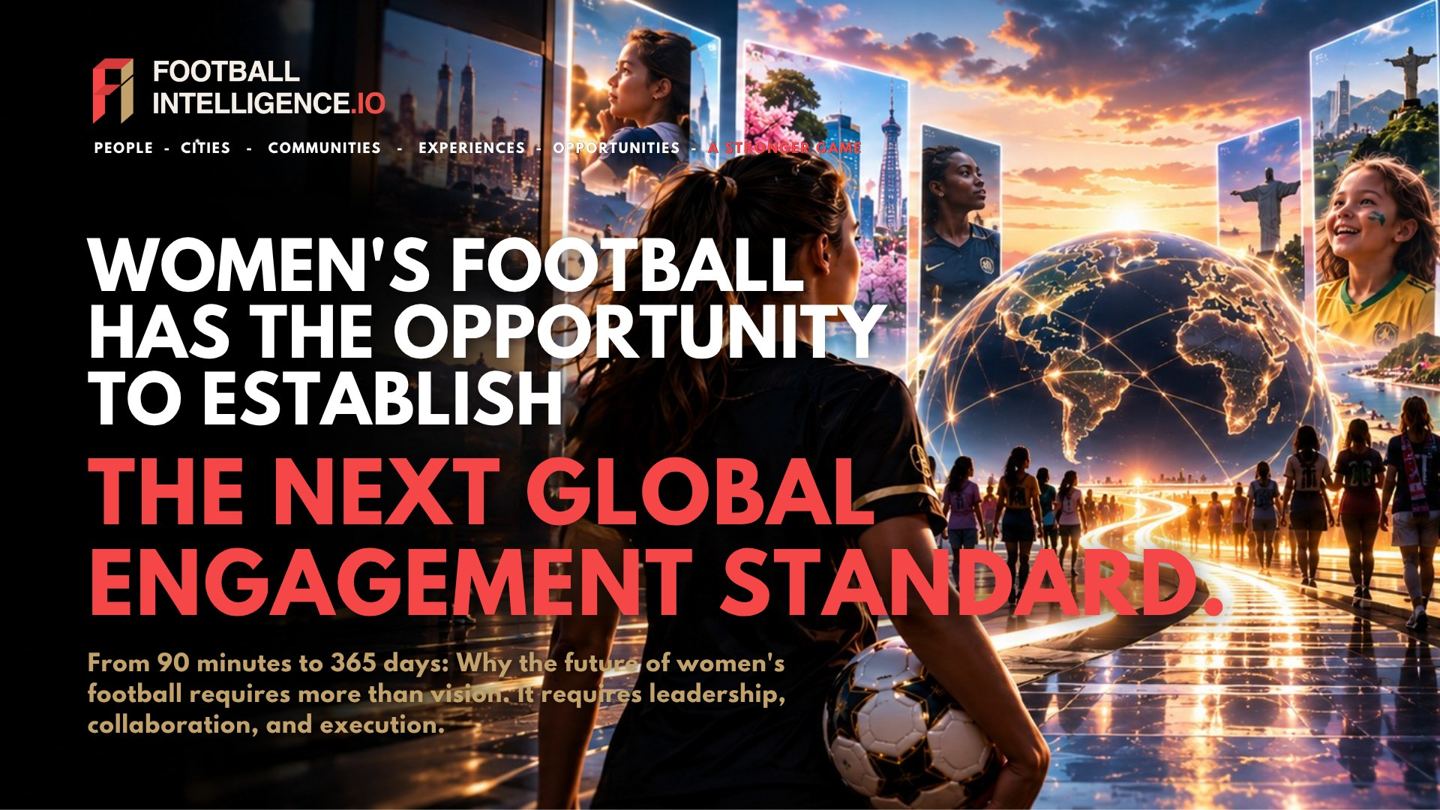
It will be defined by what we're prepared to do with it.
Over the past six articles, I've explored an opportunity I believe deserves greater attention across world football.
An opportunity that extends beyond audience growth.
Beyond sponsorship.
Beyond broadcasting rights.
Beyond digital platforms.
And even beyond the extraordinary momentum surrounding the FIFA Women's World Cup Brazil 2027.
At the heart of this series is a relatively simple observation.
Football has become exceptionally good at attracting people's attention. But we have not yet fully realised the opportunity to become meaningfully connected to their everyday lives.
That distinction may sound philosophical.
It isn't.
It has implications for how football organisations develop relationships, structure commercial partnerships, invest in technology and create lasting value.
And I believe women's football is uniquely positioned to lead a different approach.
Not because it needs to abandon the lessons of the men's game.
But because it has an opportunity to learn from those lessons without inheriting every structural limitation.
The technology has evolved.
Supporter expectations have changed.
Commercial possibilities have expanded.
And the global conversation around women's football has reached a significant moment.
The question is no longer simply how big women's football can become.
The more important question is what kind of industry we're prepared to build.
When I began this series, I wanted to challenge the assumptions shaping the next generation of football engagement.
Not from the perspective of someone looking at football exclusively as a commercial property.
But from the perspective of someone who has experienced the game professionally and subsequently spent approximately two decades exploring digital innovation, connected experiences and commercial strategy.
Each article approached the opportunity from a different direction.
Part 1 — Women's Football Shouldn't Inherit the Past. It Should Define the Future.
The women's game has an opportunity to establish its own commercial and digital foundations rather than simply replicate structures developed in another era.
Part 2 — Brazil 2027: 32 Days of Football. The Opportunity for 365 Days of Engagement.
A global tournament creates extraordinary attention. The opportunity is to develop meaningful relationships that continue after the final whistle.
Part 3 — Stop Marketing to Fans. Start Understanding Their Lives.
The next evolution of engagement begins with understanding people, their identities, their communities and the place football occupies in their lives.
Part 4 — The Next Commercial Revolution in Women's Football Won't Be Confined to the Stadium.
Football creates value across a much broader ecosystem than its traditional revenue categories necessarily capture.
Part 5 — Don't Build Another Platform. Build an Ecosystem That Connects.
Many of the capabilities required already exist. The challenge is connecting them intelligently around a coherent strategy.
Part 6 — The Five Questions Every Women's Football Leader Should Be Asking.
The next era requires leadership willing to question existing assumptions about relationships, commercial value, technology and long-term growth.
These are not six separate conversations.
They are six dimensions of the same opportunity.
How do we move from fragmented experiences and transactions towards a more connected football ecosystem built around meaningful, lasting relationships?
And perhaps more importantly:
Who is prepared to lead that transformation?
Over the past two decades, technology has transformed almost every aspect of how people interact with organisations.
Communication.
Commerce.
Entertainment.
Travel.
Media.
Community.
And increasingly, the relationship between physical experiences and digital environments.
Football has participated in that evolution.
Today, clubs, leagues, federations and tournament organisers have access to sophisticated capabilities across broadcasting, mobile technology, analytics, artificial intelligence, digital commerce and supporter engagement.
Yet the existence of those capabilities does not automatically create a connected experience.
An organisation can invest in advanced technology across multiple departments while still struggling to develop a coherent relationship with the people it serves.
And that is where I believe the industry needs to shift its thinking.
The objective shouldn't be to build more technology simply because new capabilities become available.
It should be to understand how technology, human behaviour and commercial strategy can work together to create meaningful value.
That requires more than procurement.
It requires leadership.
It requires organisational alignment.
It requires an understanding of the relationships football is trying to develop.
And it requires a practical approach to connecting capabilities that were not necessarily designed to operate together.
The opportunity is not to replace everything that exists.
It's to recognise the investments, relationships and capabilities already present—and consider how they might contribute to something greater.
Throughout this series, I've returned to one principle.
Stop asking fans to enter your world. Start finding your place in theirs.
That principle has influenced much of my thinking about digital engagement and commercial strategy.
It also reflects an important lesson from cognitive anthropology.
People don't organise their lives around the internal structures of brands or sporting organisations.
They make decisions through personal meaning, identity, relationships, cultural context and everyday experiences.
Football is particularly powerful because it already occupies an emotional position in people's lives.
It connects generations.
It creates community.
It inspires ambition.
It gives people a sense of belonging.
And in some circumstances, it becomes part of how people define themselves.
But that emotional significance should never be mistaken for permission to demand more attention.
The fact that someone loves football doesn't mean they want constant communication from a club.
It doesn't mean every experience should become commercial.
And it certainly doesn't mean every interaction should become another opportunity to collect data.
Meaningful engagement requires relevance.
Sometimes that relevance is a match.
Sometimes it's a player.
Sometimes it's a community experience.
Sometimes it's a family moment.
And sometimes it's simply making an existing part of someone's life easier, more enjoyable or more meaningful.
The next global engagement standard should not be measured by how often football reaches people.
It should also be measured by whether those interactions make football more valuable to them.
That is a very different foundation for a digital and commercial strategy.
The FIFA Women's World Cup Brazil 2027 will take place from 24 June to 25 July, featuring 32 national teams, 64 matches and eight host cities.
It will be the first Women's World Cup staged in South America.
And it will create one of the most compelling opportunities in global women's sport.
The tournament will bring together supporters from different nations, cultures, communities and generations.
It will create extraordinary sporting moments.
It will inspire young players.
It will create opportunities for commercial partners.
And it will introduce new audiences to women's football.
But the longer-term opportunity deserves equal consideration.
What happens to those relationships when the competition ends?
What happens to the child who discovers a player who changes how they think about their own future?
What happens to the family that develops a new relationship with the sport?
What happens to the international supporter who becomes interested in a domestic women's league?
What happens to the commercial relationships and community initiatives developed around the event?
And what happens to the connection between tournament audiences and the broader football ecosystem?
These questions aren't intended to suggest that FIFA, national federations or commercial partners have overlooked tournament legacy.
Substantial work already exists across women's football development, fan engagement, participation and commercial growth.
The opportunity is to explore whether those efforts can become more connected, more measurable and more enduring.
What if the long-term value of a global tournament were considered alongside the extraordinary success of the event itself?
Not simply the audience reached.
But the relationships strengthened.
The participation encouraged.
The relevance created.
And the value that continues beyond the competition.
This is what I mean by moving from 90 minutes to 365 days.
Not more content every day.
Not constant marketing.
But a more coherent understanding of how football can remain meaningful throughout people's lives.
Football's traditional commercial model is built around powerful and well-established revenue streams.
Broadcast rights.
Sponsorship.
Ticketing.
Merchandise.
Hospitality.
Licensing.
These will remain fundamental.
But as I argued in Part 4, the relationships created through football extend far beyond those categories.
A football experience can involve transport, hospitality, tourism, entertainment, local businesses, families and communities.
A global tournament can connect cities, national federations, domestic leagues, commercial partners and supporters.
An individual player can inspire relationships that extend across national borders and generations.
The potential value exists across a much broader environment than any single organisation necessarily controls.
But that opportunity should not become an excuse to commercialise every moment of a supporter's life.
The strongest commercial models are built around genuine value.
Instead of asking how to extract more revenue from football supporters, we should begin by asking how football can create more value for them.
That shift has implications for sponsorship strategy.
For partnerships.
For digital engagement.
For how organisations measure success.
And for how different stakeholders collaborate.
It also creates a more ambitious question.
Can women's football help establish a commercial model in which relevance, relationships and meaningful experiences become central drivers of sustainable growth?
I believe it can.
But doing so requires moving beyond isolated departmental initiatives towards a more coordinated strategic approach.
This is where the conversation becomes particularly important to me.
For approximately 20 years, I've worked across digital innovation, connected experiences, brand engagement and commercial strategy.
Before that, I spent 15 years playing professional football.
Those two chapters have shaped how I approach the opportunity in front of women's football.
My playing career gave me firsthand experience of the game's culture, its emotional significance and the relationships that make football extraordinary.
My work in digital innovation introduced another perspective.
How organisations develop technology.
How digital environments influence behaviour.
How brands build commercial relationships.
How different capabilities can contribute to a larger strategic objective.
And why technically impressive solutions don't necessarily produce meaningful commercial or human outcomes.
I've seen the difference between technology that demonstrates what's possible and strategy designed to create lasting value.
That distinction matters.
Because I don't believe football's next generation of engagement requires us to invent an entirely new generation of technology.
Many of the capabilities already exist.
The more consequential challenge is understanding what should connect, why those connections matter and how to structure an approach that can deliver meaningful outcomes.
That requires experience across several disciplines.
Technology alone is insufficient.
Marketing alone is insufficient.
Commercial strategy alone is insufficient.
And even a deep understanding of football does not automatically provide the complete answer.
The opportunity exists at the intersection of these worlds.
It's an intersection where I've spent much of my professional career.
And it's why I believe the conversation can move beyond imagining possibilities towards evaluating a credible path to execution.
I see it as a strategic opportunity.
One that starts with the people football is trying to engage.
Considers the capabilities organisations have already developed.
Recognises the importance of established technology and commercial partners.
And explores how those elements can contribute to a connected, measurable approach.
The key questions are not simply technical.
How should the opportunity be structured?
Which relationships create meaningful value?
How can stakeholders participate while preserving their legitimate commercial interests?
What capabilities already exist?
Where are the gaps?
How should success be measured?
And how can an ambitious vision be translated into an approach that is operationally and commercially realistic?
Those are the questions that determine whether an idea becomes another presentation or something capable of making a difference.
I've developed a clear strategic perspective on how this opportunity could be approached.
Not as a collection of disconnected digital experiences.
But as a coordinated engagement model that considers human behaviour, technology, commercial relationships and organisational objectives together.
The details of that approach require more than a public article.
They require a serious discussion about scope, governance, partnerships, commercial viability and delivery.
But I believe the industry is closer to making meaningful progress than it may initially appear.
The distance between what football currently delivers and what it could deliver may be less about technological limitations and more about the strategy required to connect what's already possible.
That is where the opportunity becomes particularly compelling.
One of the risks when discussing global transformation is assuming that consistency requires uniformity.
It doesn't.
Different football organisations have different responsibilities.
A national federation operates differently from a professional club.
A domestic league faces different challenges from a global tournament organiser.
A commercial partner has different objectives from a community football programme.
And supporters in Brazil, England, the United States or elsewhere may have very different relationships with the sport.
Any credible global approach must respect those differences.
The objective should not be to force every stakeholder into an identical model.
Nor should it require organisations to surrender ownership of their supporters, systems or commercial relationships.
Instead, the opportunity is to establish principles that support connectivity while recognising organisational independence and local relevance.
A global engagement standard should make collaboration more valuable without making every participant the same.
It should encourage interoperability rather than unnecessary replacement.
It should support responsible data practices.
It should recognise the value of existing investments.
And it should allow different organisations to contribute to a broader ecosystem while maintaining their own identities and objectives.
These aren't minor implementation details.
They are central to whether a connected strategy can achieve meaningful adoption.
And they illustrate why leadership and execution must be considered together from the beginning.
If football's ambition is to create more meaningful, longer-lasting supporter relationships, its measures of success should reflect that objective.
Audience reach will remain important.
So will attendance.
Commercial revenue.
Media value.
Sponsorship performance.
And digital participation.
But these indicators don't necessarily tell the whole story.
If a major tournament introduces a supporter to women's football, what happens next?
If a club creates a new community initiative, does it strengthen participation or long-term affiliation?
If a brand partnership delivers an experience supporters genuinely value, how does that influence the relationship?
And if technology creates a more connected environment, does it improve the experience or simply introduce another layer of complexity?
The answers require careful measurement.
Not every valuable relationship can be reduced to a single number.
And not every engagement should be treated as a commercial transaction.
But organisations can establish more meaningful ways to assess continuity, relevance, participation, supporter satisfaction and long-term value.
We should stop confusing the volume of engagement activity with the quality of the relationship it produces.
That's a leadership decision.
And it should influence how organisations define their priorities before they invest in the next generation of technology.
It's a more serious conversation about what can realistically be delivered.
I have enormous respect for the organisations and people already advancing women's football.
The investment.
The commitment.
The expertise.
The partnerships.
And the work being undertaken to develop the game globally.
The opportunity I'm describing is not intended to replace those efforts.
It's about exploring how they can become more connected and effective.
I believe the next meaningful step requires leadership teams prepared to examine the opportunity across traditional departmental boundaries.
Commercial strategy.
Fan engagement.
Technology.
Communications.
Partnerships.
Community development.
And executive decision-making.
It requires aligning the right capabilities and establishing objectives that can be measured.
It requires understanding what exists, what can be connected and what genuinely needs to change.
And it requires a willingness to develop an approach that is both ambitious and practical.
I see a credible pathway from the principles explored in this series towards a more connected engagement model.
One that deserves examination with organisations positioned to operate at scale.
Not because every answer has already been established.
But because the experience, capabilities and strategic foundations needed to begin that work are increasingly within reach.
This is where I believe the conversation should move next.
From possibility to practical evaluation.
From disconnected initiatives to coordinated strategy.
And from vision towards execution.
Women's football is at a remarkable point in its development.
Global attention is growing.
Commercial opportunities are expanding.
Technology continues to evolve.
And Brazil 2027 provides a compelling international moment.
But a tournament alone cannot establish a global engagement standard.
Neither can a single technology provider.
Or a club.
Or a commercial partner.
The opportunity requires cooperation across organisations that bring different capabilities, relationships and responsibilities.
FIFA and international governing bodies.
National federations.
Domestic leagues.
Professional clubs.
Commercial partners.
Technology companies.
Host cities.
And the broader football community.
Each has a role to play.
The question is whether the industry can develop a sufficiently connected vision to make those contributions more meaningful together.
I believe women's football has an opportunity to establish an approach that could ultimately influence the wider global game.
Not by becoming a smaller version of an established commercial model.
But by helping demonstrate what a more connected, human-centred and commercially sustainable model can become.
And I believe the time to explore that opportunity is now.
When I started this seven-part series, I wanted to challenge conventional thinking about the future of women's football.
But I also wanted to do something more.
I wanted to begin a serious conversation about an opportunity that I believe can move beyond theory.
An opportunity informed by my experience inside professional football and approximately two decades working across digital innovation, commercial strategy and connected experiences.
I've spent my career looking at how technology, organisations and human behaviour can come together to create new value.
And I believe women's football presents one of the most compelling environments in which to apply that thinking.
The vision matters.
The technology is increasingly available.
The commercial opportunity is significant.
And I see a practical pathway towards bringing those elements together.
But meaningful progress will require leadership, collaboration and disciplined execution.
I'm interested in working with the organisations and decision-makers prepared to take that next step.
Not simply to discuss what football engagement might look like in the future.
But to explore how a different approach could be structured, tested, measured and ultimately delivered.
Through FOOTBALLINTELLIGENCE.io, I welcome strategic conversations with FIFA, national federations, clubs, leagues, ownership groups, technology organisations and commercial partners who share that ambition.
Because the next generation of football engagement won't be defined by who creates the most technology.
Or who generates the greatest number of impressions.
Or even who attracts the largest audience.
It will be defined by who best understands the relationship between football and people's lives—and has the leadership to turn that understanding into lasting value.
Women's football has an extraordinary opportunity to establish that standard.
Brazil 2027 presents an important moment to demonstrate what's possible.
The question is no longer simply what the future of football engagement could look like.
The question is who is prepared to lead it.
I'm interested in helping build it.