
Football is a relationship, not a 90-minute product.
The match is a powerful shared moment. The opportunity is to earn a meaningful place in supporters’ lives before it, after it and between fixtures.
Christopher Roselli’s public beliefs on fan engagement, emotional connection and the opportunity to turn 90 minutes into 365 days of relevance.
The match is a powerful shared moment. The opportunity is to earn a meaningful place in supporters’ lives before it, after it and between fixtures.
A supporter has a family, a culture, routines, aspirations and responsibilities. Start with that life, rather than asking everyone to fit a club’s channels or calendar.
Purchases, clicks and attendance record activity. Explore the identity, belonging, inspiration and practical circumstances behind those actions before deciding what they mean.
A club badge can carry generations of meaning, while a player or experience can open a new connection. Treat those routes into football with curiosity rather than assuming one model of loyalty.
A young person should have opportunities to play, watch and belong. Examine scheduling, travel, accessibility and family commitments alongside awareness and price.
Men’s and women’s football can share a badge while offering distinct experiences. Sponsorship becomes more relevant when it responds to people’s motivations rather than treating visibility as the whole proposition.
Supporters move between stadiums, communities, content and everyday life. Give technology a clear role in making that experience coherent, useful and accessible.
Belonging is not permission to exploit attention or personal data. Offer a clear value exchange and respect each person’s choice about participation.
Quiet digital activity does not prove weak attachment. Build worthwhile opportunities to return and measure what people value, not simply how often they can be prompted to click.
Technology can enable an experience. People decide its purpose, take responsibility for delivery and learn whether it strengthens relationships. That is the work behind turning 90 minutes into 365 days of engagement.
Women's Football series / Part 06 of 07
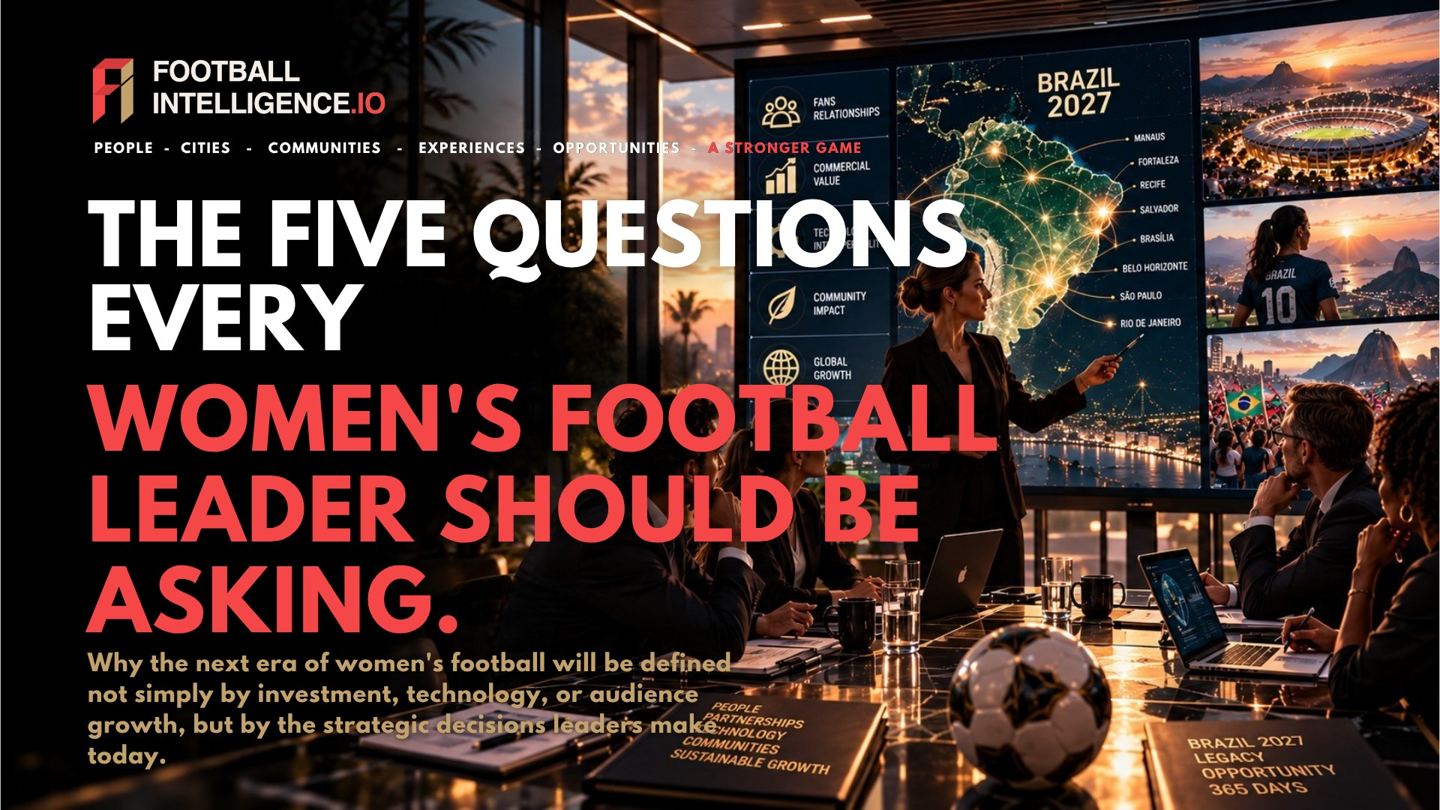
Why the next era of women's football will be defined not simply by investment, technology or audience growth, but by the strategic decisions leaders make today.
By Christopher Roselli
Founder | FootballIntelligence.IO
Former Professional Footballer | Digital Innovation, Football Strategy & Commercial Transformation
12-minute read
Women's football is entering one of the most consequential periods in its history.
Investment is increasing.
Commercial interest is expanding.
New audiences are discovering the game.
International competitions are creating extraordinary visibility.
And the opportunities surrounding the FIFA Women's World Cup Brazil 2027 are bringing renewed attention to the sport's global future.
The momentum is undeniable.
But after 15 years playing professional football and approximately 20 years working across digital innovation, human behaviour, engagement and commercial strategy, I keep coming back to a question that I believe deserves more attention.
Are we making decisions that will define the future of women's football, or simply decisions that will help it grow within the structures we already understand?
There's a fundamental difference.
Growth can happen within an existing model.
Transformation requires questioning the model itself.
And I believe women's football has reached a moment where that distinction matters enormously.
Over the first five articles of this series, I've challenged the industry to think beyond inherited infrastructure, short-term tournament engagement, traditional fan marketing, stadium-based commercial models and disconnected technology.
Now I want to bring those conversations together.
Not through another prediction about the future.
But through five questions I believe should be on the agenda of every leadership team shaping the next generation of women's football.
Because the quality of the future we build will depend on the quality of the questions we're prepared to ask today.
For decades, football has measured growth through familiar indicators.
Attendance.
Viewership.
Social media followers.
Digital impressions.
Sponsorship exposure.
Commercial revenue.
All valuable.
All necessary.
But none, individually, tells us whether a supporter has developed a meaningful relationship with the game.
An individual may watch a World Cup final and never engage with women's football again.
Another may attend a domestic match with their daughter and begin a lifelong relationship with a club.
Both interactions contribute to audience metrics.
But their long-term significance is very different.
And that's where I believe leadership needs to look more carefully.
Are we measuring the attention football receives, or the relationships football creates?
This is more than a marketing question.
It's a strategic question affecting how organisations allocate resources, develop commercial partnerships and evaluate long-term growth.
An organisation focused exclusively on audience expansion may prioritise reach.
An organisation focused on relationships must also consider relevance, continuity, trust and meaningful participation.
That requires a broader understanding of supporter behaviour.
One that recognises the principles of cognitive anthropology and the role football plays in people's identities, relationships, communities and everyday lives.
Supporters aren't simply consumers waiting for the next piece of content.
They're people whose connection to football exists alongside everything else happening in their lives.
And those connections are not all the same.
A young player discovering the game may have very different motivations from a lifelong supporter, an international fan or a family attending its first match.
The opportunity isn't necessarily to communicate more frequently with all of them.
It's to understand what makes the relationship meaningful in the first place.
The boardroom question:
If our audience doubled tomorrow, would we have a strategy capable of turning that attention into meaningful relationships that continue to create value over time?
If the answer is unclear, increasing audience size alone may not solve the underlying challenge.
The professionalisation of women's football is essential.
Players deserve world-class environments.
Clubs require sustainable financial structures.
Leagues need competitive integrity.
Federations must invest in development pathways.
And commercial partners play a vital role in supporting the industry's future.
But professionalisation and replication are not the same thing.
The men's game has developed an extraordinary commercial model over generations.
There is a great deal to learn from its successes.
But there are also lessons in the limitations created by legacy infrastructure, fragmented technology and commercial structures established in a very different era.
Women's football doesn't need to reject that history.
It can use the knowledge to make better decisions.
Why should an emerging generation of football infrastructure inherit every assumption of the previous one?
Consider how supporters discover and follow women's football.
Some enter through national teams.
Others through individual players.
Some through domestic clubs.
Others through family participation, local communities or international competitions.
Those relationships may overlap, evolve and exist simultaneously.
Yet many traditional sporting business models are built around individual properties attempting to control their own audience and maximise their own transactions.
There's nothing inherently wrong with organisations protecting and developing their commercial assets.
But the broader strategic opportunity may require thinking beyond any single property.
It may involve new forms of collaboration.
New approaches to commercial relevance.
And a more complete understanding of how the football ecosystem creates value.
UEFA's Unstoppable strategy commits €1 billion in competition revenue and investment to women's football through 2030, with clear ambitions for participation, professionalisation and sustainability.
That investment illustrates the scale of the industry's ambition.
The strategic question is how this momentum can support models that remain sustainable, adaptable and relevant over time.
The boardroom question:
If we were designing women's football's commercial and digital foundations today, without the limitations of inherited structures, would we build them exactly as they exist?
Or would we make different choices?
Football has access to an extraordinary range of technology.
Digital platforms.
Mobile applications.
Data analytics.
Artificial intelligence.
Customer relationship management.
Commerce.
Broadcasting and streaming.
Connected venues.
And increasingly sophisticated engagement systems.
But I've spent enough time working in digital innovation to recognise a recurring pattern.
Organisations can become very good at acquiring technology without developing an equally clear strategy for how it contributes to the overall business.
One department introduces a solution.
Another department builds its own platform.
A commercial partner brings additional technology.
A new initiative creates another digital environment.
Each may deliver value.
But over time, organisations can find themselves managing a collection of capabilities that don't necessarily work together around a coherent strategic objective.
More technology doesn't automatically mean more intelligence.
And artificial intelligence doesn't eliminate that distinction.
AI may help organisations analyse information, automate processes and personalise experiences.
But applying AI to disconnected systems and unclear organisational priorities can simply make the existing fragmentation more sophisticated.
This is why I believe the next stage of technology investment must begin with leadership.
Before commissioning another application, organisations should define the relationships they want to strengthen.
The experiences they want to improve.
The decisions they need to make more intelligently.
And the commercial value those capabilities should support.
That doesn't mean every organisation needs to share all its information.
Responsible governance, privacy, data ownership and legitimate commercial boundaries remain essential.
Nor does it mean the future must be built around one universal technology provider.
Quite the opposite.
It means identifying where interoperability and strategic coordination can create value while preserving appropriate independence and control.
Technology should support the strategy. It should not become the strategy.
The boardroom question:
If we removed the names of every technology provider from our organisation's digital roadmap, could we still clearly explain what we're trying to achieve for the supporter?
If not, perhaps we're evaluating technology investments before defining the experience they're meant to enable.
Sponsorship has been one of the defining commercial forces in modern football.
The association between brands and sporting properties has helped finance competitions, clubs and international tournaments.
And commercial visibility will continue to play an important role.
But I believe the next generation of partnership strategy must consider a broader proposition.
What value does the relationship create for the people the partnership is intended to reach?
It's a question that becomes especially interesting in women's football.
A brand can invest in signage.
It can sponsor a digital campaign.
It can associate itself with a competition or athlete.
These approaches can produce measurable commercial outcomes.
But are we sufficiently exploring the role commercial partners can play in creating meaningful supporter experiences?
Experiences that extend beyond matchday.
That connect with community interests.
That improve accessibility.
That encourage participation.
That create reasons for people to value the relationship.
A family attending a football match doesn't experience its journey through a series of commercial departments.
It experiences one connected day.
Travel.
Food.
The match.
Local businesses.
Shared memories.
Perhaps a new sporting ambition for a child.
There are commercial opportunities surrounding these experiences.
But the strongest opportunities may emerge when organisations start by understanding what people actually value.
Not by identifying another place to insert an advertisement.
The objective shouldn't simply be to extract more commercial value from supporters.
It should be to create more value for supporters and allow sustainable commercial relationships to develop around that value.
That's a different mindset.
One that can influence how rights are structured, how partnerships are evaluated and how long-term outcomes are measured.
The boardroom question:
If we evaluated our commercial partnerships by the meaningful value they helped create for supporters, would our sponsorship strategy look different?
Would we attract different partners?
Would we create different experiences?
Would we measure success differently?
Those are questions worth exploring.
This may be the most important question of the five.
The FIFA Women's World Cup Brazil 2027 will take place from 24 June to 25 July.
Thirty-two national teams.
Sixty-four matches.
Eight host cities.
And the first Women's World Cup hosted in South America.
A remarkable opportunity for world football.
But global tournaments create a particular strategic challenge.
The event captures enormous attention.
Supporters become emotionally invested.
Media coverage expands.
Brands activate.
Cities welcome visitors.
Players become international figures.
And interest in the sport accelerates.
Then the tournament ends.
Of course, football continues.
Domestic leagues resume.
Clubs compete.
Federations develop their programmes.
But what happens to the relationships created during those extraordinary weeks?
What becomes of the child who discovers women's football for the first time?
What happens to the family attending its first international match?
The supporter who becomes inspired by a player?
The international visitor who develops a connection with a host city?
The commercial partner that successfully engages an emerging community?
Are those relationships capable of continuing meaningfully beyond the competition?
Or do we return to planning the next campaign?
This is the distinction I've been exploring throughout the series.
From 90 minutes to 365 days.
It isn't simply a slogan about extending digital engagement.
It's a challenge to reconsider how football can establish a place within people's lives beyond the occasions when they're watching matches.
And Brazil 2027 provides an extraordinary opportunity to examine that ambition at global scale.
That doesn't require suggesting FIFA or its partners lack existing engagement strategies.
Significant work is already being undertaken across women's football development, digital engagement, commercial partnerships and tournament legacy.
The opportunity is to explore how these efforts might become even more connected and enduring.
How different stakeholders can contribute to a common long-term vision.
How local relevance can complement global reach.
How participation and supporter relationships can continue developing.
And how commercial partners can create meaningful value beyond the tournament itself.
The boardroom question:
When Brazil 2027 concludes on 25 July, what relationships will we have strengthened that remain meaningful in July 2028?
And will we have a credible way to understand the difference?
They're five dimensions of the same strategic challenge.
Audience growth without meaningful relationships can create temporary attention.
Commercial development without supporter understanding can produce transactions without lasting relevance.
Technology without strategic alignment can create complexity.
Sponsorship without genuine value can become another exercise in visibility.
And major tournaments without long-term continuity risk leaving opportunities unrealised.
But when these elements are considered together, a different perspective emerges.
One that views engagement as a core organisational capability rather than a marketing activity.
One that recognises supporters as people rather than simply data points.
One that considers the relationship between technology, commercial development, communities and long-term growth.
The future of women's football should not be evaluated only by how big the industry becomes.
It should also be evaluated by how intelligently that growth is designed.
This is not an argument for ignoring short-term financial realities.
Women's football needs investment, revenue and commercial discipline.
Many clubs face immediate operational pressures that cannot be resolved through ambitious long-term thinking alone.
But those realities make strategy more important, not less.
Because capital is finite.
Technology investments have consequences.
Commercial structures influence future flexibility.
And today's decisions can either create opportunities or introduce limitations for the next generation.
Too often, engagement is discussed as a marketing responsibility.
Technology is treated as an IT decision.
Sponsorship becomes a commercial department's concern.
And community development operates through its own programmes.
Each area has experienced professionals working towards legitimate objectives.
But if the next stage of growth requires a more connected approach, the responsibility cannot sit exclusively within any one department.
It becomes a leadership challenge.
A question of organisational design.
Strategic alignment.
Commercial governance.
Partnership philosophy.
And long-term vision.
Who's responsible for ensuring the organisation is developing a coherent relationship with its supporters across every relevant touchpoint?
Not merely collecting information.
Not simply increasing communications.
But ensuring that the collective experience reflects an understanding of the people the organisation is trying to serve.
That responsibility ultimately requires executive attention.
Because the opportunity crosses too many organisational boundaries to be solved through a single marketing campaign, technology purchase or departmental initiative.
And it demands a serious conversation about implementation.
Not because every organisation should adopt an identical model.
But because a strategy only becomes valuable when it can be translated into measurable outcomes.
My perspective on this challenge comes from two different parts of my professional life.
Fifteen years playing football professionally gave me a firsthand understanding of the game, its culture and the emotional relationships that make it extraordinary.
The following two decades working in digital innovation, connected experiences, brand engagement and commercial strategy helped me understand another dimension.
How organisations use technology.
How people interact with digital environments.
How commercial relationships develop.
And why sophisticated technology can still fail to produce meaningful engagement.
I've worked across industries where the underlying challenge is remarkably similar.
Organisations have audiences.
They have technology.
They have information.
They have commercial relationships.
Yet the potential value of connecting these elements around people's actual lives often remains unrealised.
I believe women's football presents an extraordinary opportunity to approach that challenge differently.
Not simply through more technology.
Or another platform.
Or another marketing initiative.
But through a more coherent strategic approach that connects human understanding with commercial and digital capability.
The specific execution of that opportunity deserves its own discussion.
It requires decisions about strategy, partners, accountability, governance and measurable outcomes.
But the starting point is clear.
Before we decide what to build next, we should agree on what future we're actually trying to create.
The momentum behind women's football is extraordinary.
But momentum alone is not a strategy.
Investment creates opportunity.
Technology creates capability.
Audience growth creates potential.
And major tournaments create attention.
Leadership determines what becomes of them.
As we approach Brazil 2027, I believe this is the right moment for governing bodies, federations, leagues, clubs, investors and commercial partners to expand the conversation.
Beyond the next campaign.
Beyond the next sponsorship deal.
Beyond the next application.
And even beyond the next major tournament.
Towards a more fundamental question.
What kind of relationship do we want women's football to have with the next generation of supporters, and what are we prepared to change to make that possible?
Because if we ask that question seriously, the implications extend well beyond engagement.
They reach into commercial strategy.
Technology investment.
Organisational leadership.
Community development.
And the long-term structure of the industry itself.
The next great competitive advantage in women's football may not belong to the organisation that spends the most.
It may belong to the organisation that asks better questions—and has the courage to act on the answers.
Throughout this series, I've challenged the industry to reconsider how it approaches the future of women's football.
My intention isn't to dismiss the extraordinary work already taking place.
It's to ask whether the next generation of opportunity requires a different level of strategic thinking.
I would welcome perspectives from leaders across FIFA, UEFA, World Football Summit, the Women's Super League, the National Women's Soccer League, national federations, clubs, commercial organisations and ownership groups.
Not simply about the scale of the opportunity.
But about the decisions required to realise it.
Through FOOTBALLINTELLIGENCE.io, I'm interested in working with leadership teams exploring new approaches to engagement, commercial transformation and connected digital strategy.
If these five questions are already part of your organisation's discussions, I'd be interested in the answers.
And if they aren't, perhaps that's where the conversation should begin.
Because the future of women's football will not be defined by the technology we introduce or the audiences we attract alone.
It will be defined by how intelligently we connect those opportunities into something that creates lasting value.