
Football is a relationship, not a 90-minute product.
The match is a powerful shared moment. The opportunity is to earn a meaningful place in supporters’ lives before it, after it and between fixtures.
Christopher Roselli’s public beliefs on fan engagement, emotional connection and the opportunity to turn 90 minutes into 365 days of relevance.
The match is a powerful shared moment. The opportunity is to earn a meaningful place in supporters’ lives before it, after it and between fixtures.
A supporter has a family, a culture, routines, aspirations and responsibilities. Start with that life, rather than asking everyone to fit a club’s channels or calendar.
Purchases, clicks and attendance record activity. Explore the identity, belonging, inspiration and practical circumstances behind those actions before deciding what they mean.
A club badge can carry generations of meaning, while a player or experience can open a new connection. Treat those routes into football with curiosity rather than assuming one model of loyalty.
A young person should have opportunities to play, watch and belong. Examine scheduling, travel, accessibility and family commitments alongside awareness and price.
Men’s and women’s football can share a badge while offering distinct experiences. Sponsorship becomes more relevant when it responds to people’s motivations rather than treating visibility as the whole proposition.
Supporters move between stadiums, communities, content and everyday life. Give technology a clear role in making that experience coherent, useful and accessible.
Belonging is not permission to exploit attention or personal data. Offer a clear value exchange and respect each person’s choice about participation.
Quiet digital activity does not prove weak attachment. Build worthwhile opportunities to return and measure what people value, not simply how often they can be prompted to click.
Technology can enable an experience. People decide its purpose, take responsibility for delivery and learn whether it strengthens relationships. That is the work behind turning 90 minutes into 365 days of engagement.
Women's Football series / Part 05 of 07
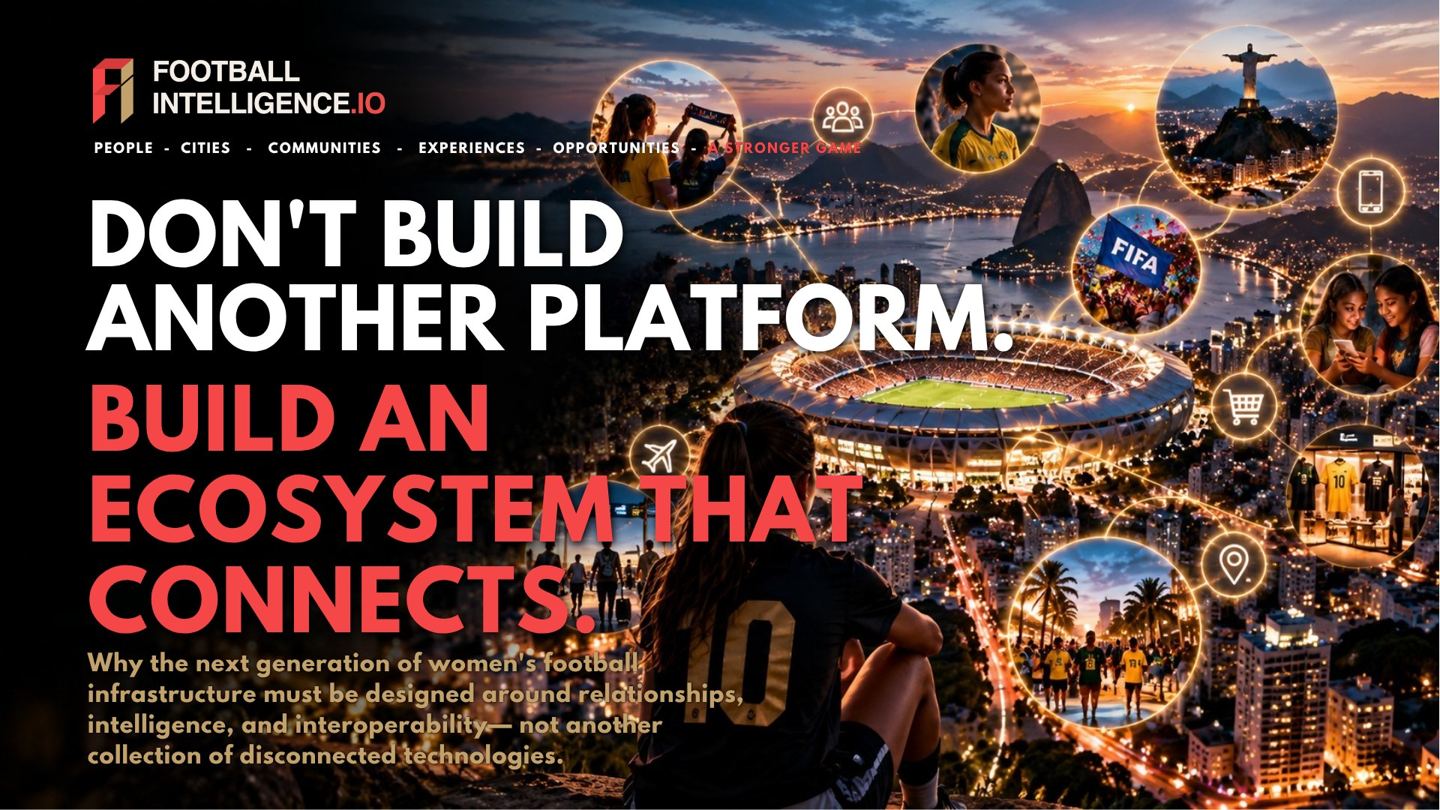
Why the next generation of women's football infrastructure must be designed around relationships, intelligence and interoperability—not another collection of disconnected technologies.
By Christopher Roselli
Founder | FootballIntelligence.IO
Former Professional Footballer | Digital Innovation, Football Strategy & Commercial Transformation
9-minute read
It needs a better way to connect what already exists.
Over the past four articles in this series, I've explored why women's football has an extraordinary opportunity to rethink the commercial and engagement models inherited from the men's game.
Why Brazil 2027 could represent far more than 32 days of competition.
Why meaningful engagement begins with understanding people.
And why the next commercial revolution in football may be defined by the value created beyond the stadium.
Now we arrive at a question I believe deserves attention at the highest levels of football leadership.
Are we building the infrastructure required for the next generation of engagement—or simply introducing another generation of disconnected technology?
Because there is an enormous difference.
And the decisions being made today could shape how women's football operates commercially for decades.
Consider how a modern football organisation operates.
Ticketing. Customer relationship management. Broadcasting. Content distribution. Retail and commerce. Sponsorship. Digital memberships. Community programmes. Stadium experiences. Data analytics.
Each function has evolved.
Each has its own objectives.
Each may operate through different technology providers, business processes and commercial arrangements.
Some of those systems are highly sophisticated.
But sophistication within an individual platform doesn't automatically create intelligence across an organisation.
An organisation can have world-class technology in every department and still struggle to understand the complete relationship it has with a supporter.
That's the distinction.
The supporter doesn't experience football as a series of departments.
They experience it as part of their life.
They don't think in terms of CRM, ticketing, partnership activation or digital infrastructure.
They think about the club they love.
The player who inspires them.
The match they're attending.
The community they belong to.
The experiences they remember.
And the opportunities football creates.
If supporters experience football as one interconnected relationship, why do we continue developing so much of the infrastructure around disconnected organisational functions?
That question has informed much of my work across digital innovation and commercial strategy.
And I believe it's becoming increasingly important to the future of women's football.
One of the advantages of working in digital innovation for approximately 20 years is seeing how technological decisions evolve over time.
I've watched organisations invest heavily in systems that solve immediate business challenges but create longer-term limitations.
A new application solves one problem.
A new platform addresses another.
A separate commercial integration introduces additional capabilities.
Over time, organisations can find themselves managing an increasingly complex environment of disconnected information, systems and relationships.
Then the next investment cycle begins.
This time, the challenge is connecting everything that was previously built.
That's not necessarily evidence of poor decision-making.
Technology changes. Business models evolve. Organisations grow.
But women's football has the opportunity to learn from these patterns.
Why recreate the fragmentation that established organisations are now spending significant resources trying to overcome?
This isn't an argument against technology providers.
Quite the opposite.
Many of the capabilities needed for the future already exist.
The opportunity is to think more intelligently about how they contribute to a broader strategic objective.
About how information becomes useful.
How experiences remain connected.
How commercial relationships develop.
And how different elements of a football organisation can work together without requiring every function to operate inside a single proprietary environment.
The next generation of infrastructure shouldn't be defined by how much technology an organisation owns.
It should be defined by how effectively that technology creates meaningful value.
FIFA's Setting the Pace women's football benchmarking research examines data and digital maturity across women's football leagues.
Its findings highlight important opportunities to strengthen digital capabilities, supporter understanding and commercial development across the game.
This matters because digital presence is not the same as digital maturity.
And digital maturity is not simply about having more systems.
It's about whether those capabilities help an organisation understand its supporters, improve experiences and make more informed commercial decisions.
For women's football, this creates an important opportunity.
The challenge isn't necessarily to catch up by purchasing every technology available to established men's clubs.
It's to make better strategic decisions about what should be connected, why those connections matter and how they create value.
That is a different starting point.
And potentially a far more sustainable one.
Artificial intelligence is rapidly expanding what organisations can analyse, understand and deliver.
Personalised communication. Predictive insights. Intelligent recommendations. Automated workflows. Contextual experiences. More sophisticated commercial decision-making.
These capabilities are creating extraordinary possibilities.
But AI cannot compensate for an organisation that has never defined what it wants to achieve.
Nor does intelligence automatically emerge simply because more information is collected.
AI applied to disconnected thinking risks creating more sophisticated fragmentation.
If an organisation doesn't understand how its commercial, digital and community activities relate to one another, introducing artificial intelligence doesn't automatically solve that challenge.
The technology may become more advanced.
But the underlying strategic limitations remain.
And this is why I believe the discussion must begin at a higher level.
Before asking what AI can deliver, we should ask what relationships the organisation wants to strengthen.
What decisions it needs to improve.
What experiences would create genuine value.
And what organisational capabilities are required to support them.
Technology is an enabler. Strategic intelligence comes from understanding what the organisation is trying to accomplish—and how its different capabilities contribute to that outcome.
In previous articles, I've argued that professionalisation should not be confused with replication.
Women's football deserves world-class infrastructure.
The best facilities. Outstanding player development. Sophisticated medical and performance support. Strong commercial leadership. Sustainable investment.
But there is no requirement to inherit every digital and commercial structure established in a different technological era.
Women's football can make more deliberate decisions about its operating foundations.
It can prioritise interoperability.
It can consider the relationship between local communities and global audiences.
It can evaluate how commercial partnerships contribute to the broader supporter experience.
It can establish responsible approaches to data and digital identity.
And it can design around long-term adaptability rather than short-term technological trends.
That last point is particularly important.
The next generation of women's football infrastructure should be built to evolve.
Because the technology we use in 2030 will not be identical to the technology available today.
Supporter expectations will change.
Commercial models will change.
New partners will emerge.
And new ways of experiencing football will continue to develop.
An intelligent strategy recognises that change is inevitable.
The objective is not to predict every future technology.
It's to avoid building an organisation that becomes trapped by today's choices.
The FIFA Women's World Cup Brazil 2027 will bring together 32 national teams across eight host cities.
It will create an extraordinary international audience and an extensive ecosystem of sporting, cultural and commercial experiences.
But it also raises an important strategic question.
How do different elements of that ecosystem contribute to a coherent relationship with the supporter?
A global tournament involves multiple stakeholders.
International governing bodies. National federations. Host cities. Commercial partners. Technology providers. Broadcasters. Domestic football organisations.
And millions of people interacting with the event in different ways.
Each stakeholder has legitimate responsibilities, commercial objectives and operational systems.
The challenge isn't to place every organisation inside a single platform.
Nor should it be to centralise every piece of information or remove established ownership and governance arrangements.
The challenge is to consider how the overall experience can become more connected, relevant and enduring.
Particularly when the opportunity extends beyond the tournament.
As I've argued throughout this series, the FIFA Women's World Cup should not simply be viewed through the activity it generates during the competition.
Its longer-term value also lies in the relationships it inspires.
And supporting those relationships requires more than disconnected campaigns and isolated digital experiences.
Brazil 2027 provides an opportunity to examine what a more connected engagement philosophy could mean for a global football ecosystem.
One that respects the roles of different stakeholders.
Recognises the importance of local relevance.
Supports commercial value.
And places meaningful supporter relationships at the centre of the conversation.
It's a different strategic approach to how existing and emerging capabilities work together.
This is a distinction I believe the industry needs to understand.
The next generation of football engagement will not be delivered by technology alone.
It will require coordination across organisational boundaries.
Clarity around commercial objectives.
Understanding of human behaviour.
Responsible management of information.
And a shared view of what meaningful engagement actually looks like.
That's why I believe engagement should increasingly be considered at the level of executive strategy.
Not simply within marketing departments.
Not simply within digital teams.
And not exclusively through technology procurement.
Engagement is becoming an organisational capability.
One that connects how football communicates, creates experiences, develops commercial relationships and understands the communities it serves.
And if that capability is designed correctly, its value can extend far beyond any individual application or platform.
I've spent much of the past two decades exploring the relationship between digital environments, brand engagement, communication, connected experiences and commercial value.
Across different industries, the same challenge frequently appears.
Organisations possess valuable capabilities.
They possess relationships.
They possess information.
They possess commercial opportunities.
But those elements often operate independently.
And the potential value of connecting them remains unrealised.
That experience has shaped my thinking about what the next generation of football engagement requires.
I believe many of the capabilities needed to approach this challenge differently already exist.
The more important question is how they're brought together.
How the strategy is structured.
How the right partners participate.
How organisational interests are aligned.
And how meaningful outcomes can be delivered and measured.
These aren't questions that can be answered through another application or a single technological investment.
They require a broader strategic perspective.
And, critically, a credible approach to execution.
I believe there is a practical opportunity here.
One that deserves serious exploration with organisations prepared to challenge conventional assumptions.
The question isn't whether the technology exists to connect these experiences.
It's whether the industry is prepared to develop the strategy required to make those connections meaningful.
It will belong to the organisations that create the most value from the capabilities and relationships available to them.
That value may take many forms.
More meaningful supporter relationships. Better organisational decisions. More relevant commercial partnerships. Improved community participation. Greater continuity across football experiences. Stronger opportunities for sustainable growth.
None of these outcomes is guaranteed simply by making systems interoperable.
They require leadership, thoughtful design and disciplined execution.
But they illustrate why I believe the next generation of women's football infrastructure should be approached differently.
Women's football has an opportunity to establish an operating philosophy built for modern expectations rather than inherited limitations.
To combine the lessons of football's past with the capabilities of its future.
And to demonstrate how technology can become genuinely valuable when it's connected to a clear human and commercial purpose.
DON'T BUILD ANOTHER PLATFORM SIMPLY BECAUSE YOU CAN.
BUILD AN ECOSYSTEM THAT CONNECTS BECAUSE YOU UNDERSTAND WHY IT MATTERS.
Across this series, I've been exploring why women's football is uniquely positioned to influence the next evolution of global fan engagement.
From the opportunity to rethink traditional commercial structures.
To the significance of Brazil 2027.
To the importance of understanding human behaviour.
And the wider commercial value football creates beyond the stadium.
I believe these conversations point towards a more fundamental opportunity.
The need for a connected strategic approach to football engagement.
One that aligns technology, communication, commercial relationships and supporter experiences around a coherent long-term vision.
I'd welcome perspectives from leaders across @FIFA, @World Football Summit, @UEFA, @Women's Super League and @National Women's Soccer League, alongside clubs, national federations, investors, technology partners and commercial executives shaping the future of women's football.
Through FOOTBALLINTELLIGENCE.io, I'm interested in advancing strategic conversations with organisations considering the future of their engagement and commercial infrastructure.
Not simply to discuss the opportunity.
But to explore how meaningful, measurable outcomes can be delivered.
THE NEXT GENERATION OF FOOTBALL WON'T BE DEFINED BY HOW MANY PLATFORMS WE BUILD.
IT WILL BE DEFINED BY HOW INTELLIGENTLY WE CONNECT THE PEOPLE, ORGANISATIONS AND EXPERIENCES THAT MAKE THE GAME VALUABLE.
And women's football has an opportunity to help establish that standard.