
Football is a relationship, not a 90-minute product.
The match is a powerful shared moment. The opportunity is to earn a meaningful place in supporters’ lives before it, after it and between fixtures.
Christopher Roselli’s public beliefs on fan engagement, emotional connection and the opportunity to turn 90 minutes into 365 days of relevance.
The match is a powerful shared moment. The opportunity is to earn a meaningful place in supporters’ lives before it, after it and between fixtures.
A supporter has a family, a culture, routines, aspirations and responsibilities. Start with that life, rather than asking everyone to fit a club’s channels or calendar.
Purchases, clicks and attendance record activity. Explore the identity, belonging, inspiration and practical circumstances behind those actions before deciding what they mean.
A club badge can carry generations of meaning, while a player or experience can open a new connection. Treat those routes into football with curiosity rather than assuming one model of loyalty.
A young person should have opportunities to play, watch and belong. Examine scheduling, travel, accessibility and family commitments alongside awareness and price.
Men’s and women’s football can share a badge while offering distinct experiences. Sponsorship becomes more relevant when it responds to people’s motivations rather than treating visibility as the whole proposition.
Supporters move between stadiums, communities, content and everyday life. Give technology a clear role in making that experience coherent, useful and accessible.
Belonging is not permission to exploit attention or personal data. Offer a clear value exchange and respect each person’s choice about participation.
Quiet digital activity does not prove weak attachment. Build worthwhile opportunities to return and measure what people value, not simply how often they can be prompted to click.
Technology can enable an experience. People decide its purpose, take responsibility for delivery and learn whether it strengthens relationships. That is the work behind turning 90 minutes into 365 days of engagement.
Women's Football series / Part 04 of 07
Why the future of football's commercial value will be defined by the relationships it creates, not simply the audiences it reaches.
By Christopher Roselli
Founder | FootballIntelligence.IO
Former Professional Footballer | Digital Innovation, Football Strategy & Commercial Transformation
10-minute read
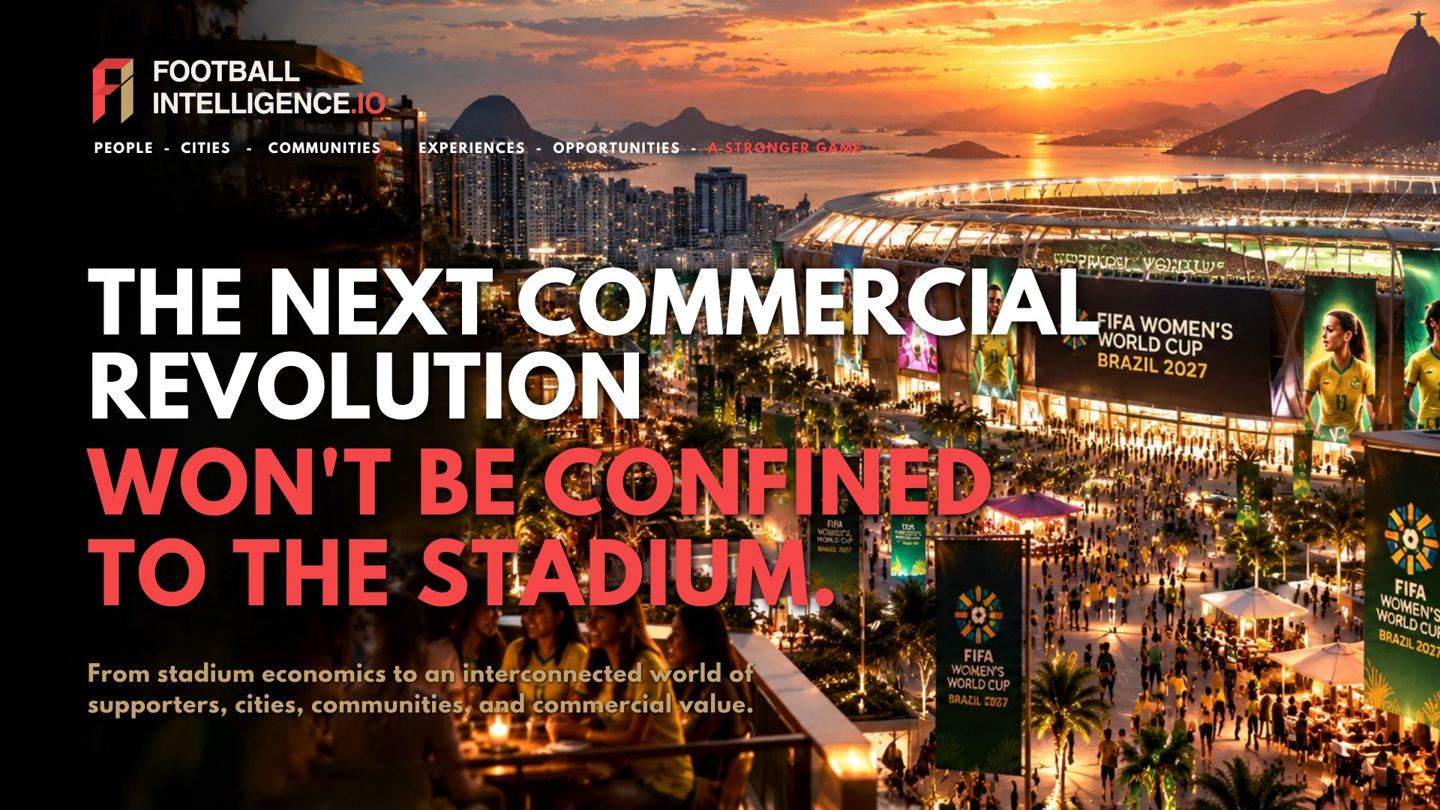
For decades, football's commercial success has been measured through familiar categories.
Broadcasting rights.
Sponsorship agreements.
Ticketing.
Hospitality.
Merchandise.
Media exposure.
These revenue streams have helped transform football into one of the world's most influential sporting industries.
And they will remain essential.
But after approximately 20 years working at the intersection of digital innovation, brand engagement, communication and commercial strategy, I've become increasingly convinced of something.
The commercial value of football extends considerably further than the transactions taking place within its existing business model.
Think about the relationships football creates.
The families that travel together.
The communities that gather around clubs.
The cities that welcome international visitors.
The friendships formed through shared experiences.
The children inspired to participate.
The businesses that benefit from sporting activity.
The commercial partners that connect with supporters through the game.
These relationships are not secondary to football's value.
They are part of what makes the industry valuable in the first place.
Yet much of the commercial model remains organised around the organisation rather than the full ecosystem of people and experiences surrounding it.
And that is where I believe the next significant opportunity exists.
Football has spent decades learning how to commercialise the game.
The next generation must become better at creating value through the relationships the game makes possible.
In the first three articles of this series, I argued that women's football shouldn't simply inherit the infrastructure and assumptions of the men's game.
I explored why Brazil 2027 represents an opportunity to think beyond a month-long tournament.
And I challenged the industry to stop confusing marketing activity with meaningful supporter engagement.
Now we arrive at the commercial question.
What happens when an organisation begins treating relevance and relationships as the foundation of its commercial strategy?
I believe the implications are substantial.
Women's football is developing at an important moment.
Investment is increasing.
New audiences are discovering the game.
Commercial partners are recognising its potential.
And modern technology provides opportunities to connect experiences that were historically fragmented.
But I don't believe the greatest ambition should be to replicate the existing revenue structure of men's football on a smaller scale.
The greater opportunity is to develop a commercial model that is more connected, more relevant and better aligned with how supporters actually experience football.
Not by rejecting traditional revenue streams.
But by exploring opportunities beyond their current boundaries.
The objective shouldn't simply be to generate more revenue from supporters.
It should be to create more value for supporters—and develop sustainable commercial opportunities around that value.
That is a very different philosophy.
In January 2026, Deloitte reported that the 15 highest-revenue women's football clubs generated a combined €158 million during the 2024/25 season.
An increase of 35% compared with the previous edition's top 15.
Arsenal Women topped the ranking with €25.6 million in revenue, followed by Chelsea Women and FC Barcelona Femení.
These figures illustrate the progress taking place.
But there is something particularly interesting beneath them.
Deloitte highlighted Arsenal Women's investment in understanding its audiences, alongside innovative approaches to attendance and ticketing.
The club achieved attendances exceeding 35,000 on five occasions during the season.
These results demonstrate that understanding supporter behaviour can contribute to commercial performance.
But I believe they also raise a larger question.
What additional value could be created if this level of understanding extended beyond ticketing, content and matchday experiences?
What if football organisations thought more broadly about the relationship between supporters, communities, places and commercial partners?
What if that thinking was incorporated into the commercial structure from the beginning?
Women's football has an opportunity to explore these questions while its next generation of infrastructure and business models are still being developed.
And that is a strategic advantage worth recognising.
Consider a family attending a women's football match.
The commercial activity surrounding that experience may begin long before they arrive.
Transportation.
Food and drink.
Retail.
Accommodation.
Entertainment.
Local attractions.
And perhaps activities associated with the club or wider football community.
But the significance of the experience extends further.
A child may discover a player who inspires them.
A family may establish a new tradition.
A supporter may become more connected to a community.
A visitor may develop an ongoing relationship with the city.
And a commercial partner may have an opportunity to contribute something genuinely useful.
These are all potential sources of value.
Yet they are frequently considered through separate commercial, digital or organisational structures.
Why do we continue thinking about connected human experiences through disconnected commercial categories?
That question has shaped much of my work.
And I believe it is becoming increasingly relevant to the future of women's football.
Because the opportunity is not simply to sell more products or introduce additional sponsorship inventory.
It's to consider how football can contribute to meaningful experiences within people's everyday lives.
And how organisations and commercial partners can participate in creating that value.
Not every interaction needs to produce a transaction.
Not every experience requires a sponsor.
And not every supporter relationship should become another data collection opportunity.
But when genuine relevance exists, commercial opportunity can follow.
The strongest commercial relationships are often the ones in which value is experienced before a transaction is requested.
For generations, sponsorship has been built around a relatively familiar proposition.
A brand invests in a sporting property.
In return, it receives access, association, visibility and commercial rights.
Those rights can be valuable.
And the approach has played an enormous role in the growth of international sport.
But I believe the next generation of sponsorship will increasingly be defined by another question.
What meaningful value does the partnership create for the people it is designed to reach?
This is particularly important in women's football.
Commercial partners have an opportunity to support the development of an industry while building genuine relationships with emerging and established supporter communities.
But there is a difference between participating in that development and simply advertising alongside it.
Imagine evaluating a partnership not only through impressions or brand exposure.
But through the experiences it helps create.
The accessibility it improves.
The opportunities it supports.
The community relationships it strengthens.
And the reasons it gives people to value the association.
That doesn't eliminate the importance of commercial return.
It creates a broader understanding of how that return can be generated.
Sponsorship shouldn't simply place a brand in front of an audience.
It should identify where a brand can earn a meaningful place in the lives of that audience.
I believe this principle will become increasingly important as women's football expands.
And the organisations that understand it will be better positioned to develop commercial partnerships based on more than visibility alone.
The FIFA Women's World Cup Brazil 2027 will bring together 32 nations across eight host cities.
It will create extraordinary global attention.
But as I argued in Part 2 of this series, the real opportunity isn't simply what happens during the tournament.
It's what those experiences make possible afterwards.
Consider the range of relationships a World Cup creates.
International supporters.
National federations.
Host cities.
Commercial partners.
Domestic football communities.
Players and their followers.
Families and emerging generations of fans.
Each has its own role within the broader football ecosystem.
And each has a relationship with the event that may develop differently over time.
What if we evaluated a World Cup not only as a global sporting event, but also as a catalyst for longer-term relationships across the football ecosystem?
What if the value generated through those relationships continued to benefit women's football beyond the competition itself?
What if commercial partners were able to create meaningful relevance across the wider supporter journey?
And what if the benefits of hosting a tournament could extend more deliberately into communities, domestic competitions and future participation?
These are the types of questions I believe deserve serious consideration.
Not simply by marketing teams.
But by the organisations responsible for the commercial and strategic future of the game.
Because the opportunity is bigger than a single tournament.
Brazil 2027 could provide an important opportunity to demonstrate how a global sporting event contributes to a longer-term engagement economy.
That possibility deserves to be explored without assuming that more technology or more commercial activity will automatically produce better outcomes.
It begins with strategy.
In many sporting organisations, fan engagement is discussed within marketing and digital departments.
Sponsorship is managed through commercial teams.
Community development operates through separate programmes.
Ticketing, hospitality, retail and partnerships have their own objectives.
And technology supports an assortment of platforms and systems.
Each department can perform well independently.
But that doesn't necessarily mean the organisation is creating the greatest possible value from the relationships connecting them.
This is not simply a question of departmental efficiency.
It's a question of strategic alignment.
If the supporter experiences football as one interconnected part of their life, why do we continue designing the business around disconnected organisational structures?
I believe the future requires a more integrated perspective.
One in which commercial strategy and engagement are developed together.
Where supporter understanding informs meaningful experiences.
Where partnerships create genuine value.
Where organisations can measure relationship quality alongside commercial performance.
And where technology supports a coherent vision rather than defining it.
That doesn't mean every function must operate on one platform.
Or that every supporter interaction should become commercial.
It means the organisation should understand how its different activities contribute to the same relationship.
Because the relationship belongs to the supporter. Not to the department managing the interaction.
It will come from becoming more relevant to them.
Audience growth remains important.
Media rights remain important.
Stadium attendance remains important.
But increasing scale is not the only route to increasing value.
A club that understands its supporters more deeply may identify opportunities unavailable to an organisation relying entirely on audience size.
A federation that develops stronger relationships between international tournaments may create more consistent participation.
A commercial partner that provides meaningful value may build a stronger association than one relying exclusively on visibility.
And a host city that develops lasting connections with visitors may benefit beyond the event itself.
These are possibilities that require thoughtful design, commercial discipline and measurable outcomes.
They are not automatic consequences of introducing new technology.
But they illustrate why I believe the commercial opportunity surrounding women's football should be considered through a broader strategic lens.
The next stage of growth won't simply be about how much attention women's football can attract.
It will also be about how much lasting value it can create from the relationships that attention makes possible.
Over the past two decades, I've spent considerable time exploring how digital innovation, human behaviour, brand engagement and commercial relationships can become more meaningfully interconnected.
That experience has shaped a specific perspective on the opportunities emerging across world football.
And I believe women's football is particularly well positioned to benefit from a different approach.
Not because the existing commercial model has no value.
It clearly does.
But because the next generation of women's football infrastructure can be designed with a more complete understanding of the relationship between people, organisations, technology and commerce.
I see an opportunity to approach this challenge strategically rather than through a collection of disconnected initiatives.
One that can be relevant to clubs, national federations, leagues, major tournaments and commercial partners.
And one that recognises the importance of connecting commercial value with meaningful experiences.
The specifics of how that opportunity is delivered require a much more considered conversation than a public article can provide.
But the underlying principle is straightforward.
We need to stop asking only how football can generate more commercial value from its supporters.
We should also be asking how football can create more value within their lives.
That distinction could influence the next generation of the industry's business model.
The future of women's football represents a significant strategic opportunity.
For FIFA.
For national federations.
For clubs and leagues.
For ownership groups and investors.
For global sponsors.
And for the organisations shaping the FIFA Women's World Cup Brazil 2027.
The question is not simply how to increase attendance, sponsorship revenue or digital engagement.
Those are important objectives.
But I believe we need to consider something more fundamental.
How do we create a more connected commercial ecosystem in which meaningful supporter relationships become a foundation for sustainable growth?
This is the intersection of football, digital innovation, human behaviour and commercial strategy where I've spent much of my career.
And it is an area where I believe we now have an extraordinary opportunity to move from established thinking towards a different approach.
Not simply to discuss the future.
But to explore how it could be delivered.
Through FOOTBALLINTELLIGENCE.io, I welcome strategic conversations with leaders across world football who are considering the next generation of engagement and commercial transformation.
The next commercial revolution in women's football won't necessarily be defined by what happens inside the stadium.
It may be defined by the value football creates in the world beyond it.
And I believe that opportunity is considerably larger than we're currently recognising.