
Football is a relationship, not a 90-minute product.
The match is a powerful shared moment. The opportunity is to earn a meaningful place in supporters’ lives before it, after it and between fixtures.
Christopher Roselli’s public beliefs on fan engagement, emotional connection and the opportunity to turn 90 minutes into 365 days of relevance.
The match is a powerful shared moment. The opportunity is to earn a meaningful place in supporters’ lives before it, after it and between fixtures.
A supporter has a family, a culture, routines, aspirations and responsibilities. Start with that life, rather than asking everyone to fit a club’s channels or calendar.
Purchases, clicks and attendance record activity. Explore the identity, belonging, inspiration and practical circumstances behind those actions before deciding what they mean.
A club badge can carry generations of meaning, while a player or experience can open a new connection. Treat those routes into football with curiosity rather than assuming one model of loyalty.
A young person should have opportunities to play, watch and belong. Examine scheduling, travel, accessibility and family commitments alongside awareness and price.
Men’s and women’s football can share a badge while offering distinct experiences. Sponsorship becomes more relevant when it responds to people’s motivations rather than treating visibility as the whole proposition.
Supporters move between stadiums, communities, content and everyday life. Give technology a clear role in making that experience coherent, useful and accessible.
Belonging is not permission to exploit attention or personal data. Offer a clear value exchange and respect each person’s choice about participation.
Quiet digital activity does not prove weak attachment. Build worthwhile opportunities to return and measure what people value, not simply how often they can be prompted to click.
Technology can enable an experience. People decide its purpose, take responsibility for delivery and learn whether it strengthens relationships. That is the work behind turning 90 minutes into 365 days of engagement.
Women's Football series / Part 01 of 07
Why the next great evolution in football won't necessarily come from the industry's most established structures — and why Brazil 2027 presents an extraordinary opportunity to think differently.
By Christopher Roselli
Founder | FootballIntelligence.IO
Former Professional Footballer | Digital Innovation, Football Strategy & Commercial Transformation
9-minute read
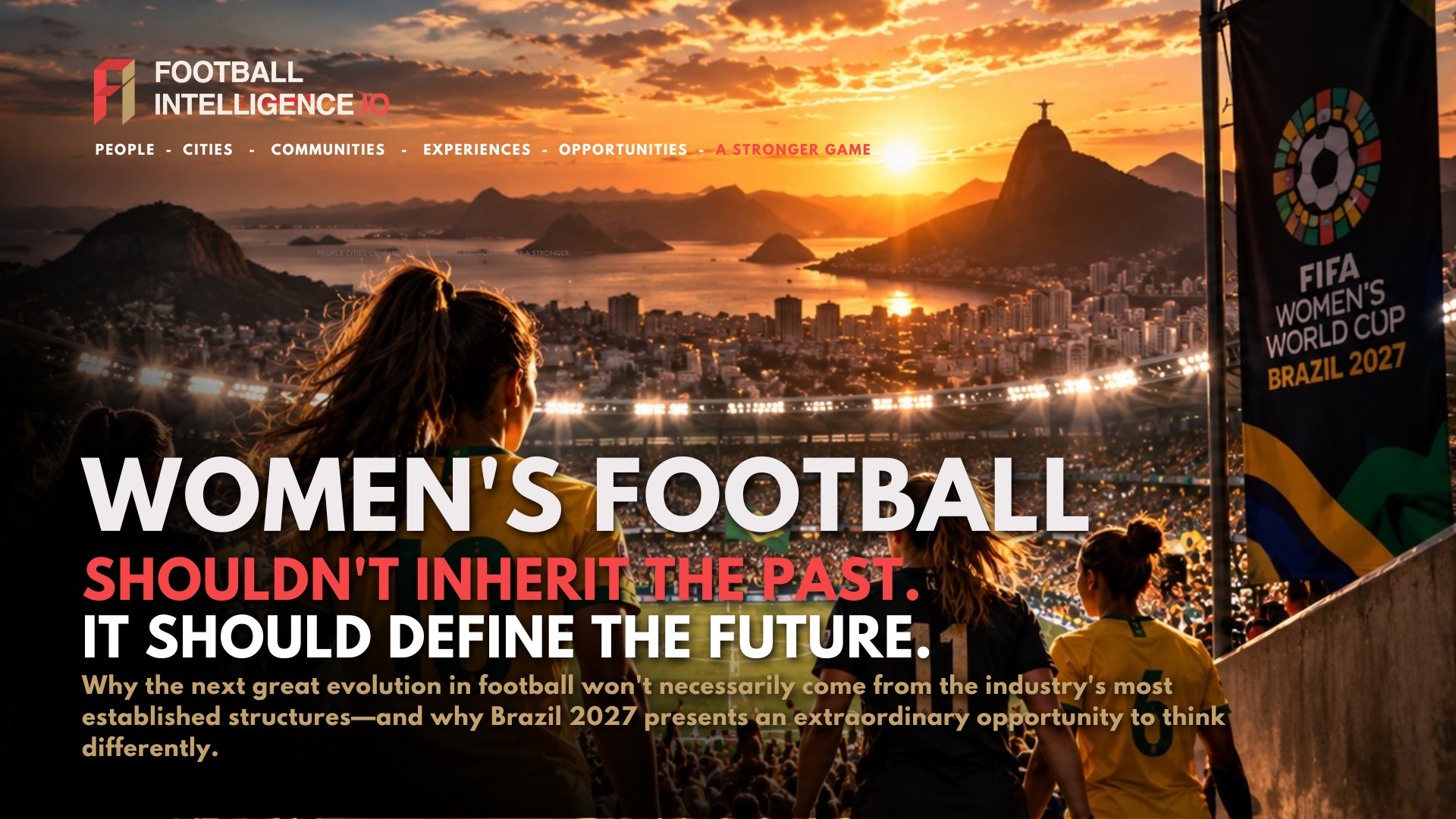
It's to create what the men's game would build if it could start again today.
I've spent approximately 15 years playing professional football and another 20 years working at the intersection of digital innovation, brand engagement, communication and commercial strategy.
And I believe we're approaching one of the most significant opportunities in the evolution of world football.
Women's football is at a defining moment.
Investment is accelerating. Commercial interest is expanding. New audiences are discovering the game. International competitions are creating unprecedented opportunities for visibility and participation.
But here's the question I believe we should be asking.
Are we building women's football for the future, or simply reproducing the structures of the past?
Because there's a fundamental difference.
One approach takes an established model and attempts to scale it.
The other recognises the lessons of that model, identifies its limitations and designs something better.
And after two decades working in digital innovation and engagement strategy, I believe that distinction could become one of the most important strategic decisions facing women's football.
The opportunity isn't simply to build a bigger industry. It's to build a more connected, commercially intelligent and meaningful one.
I recently had a conversation with Patrick Nally, one of the pioneers of modern sports marketing.
Through West Nally, Patrick helped shape FIFA's commercial evolution during the 1970s, including its landmark relationship with Coca-Cola and the development of international sponsorship models surrounding the 1978 FIFA World Cup.
His work helped establish principles that would influence the commercial architecture of global sport for generations.
It's a fascinating reminder of something important.
What appears to be the natural structure of an industry today was often a radical new idea yesterday.
In 1991, the inaugural FIFA Women's World Cup took place in China with just 12 participating teams.
By 2023, the tournament had expanded to 32 nations, with Australia and New Zealand hosting a landmark competition that elevated women's football to new levels of international visibility.
And now we look ahead to Brazil 2027.
The tenth edition.
Thirty-two national teams.
Eight host cities.
The first Women's World Cup hosted in South America.
Think about that progression.
In little more than three decades, women's football has developed an international platform that took other sporting properties generations to establish.
Yet I believe the most important part of its story is still ahead.
The commercial revolution of the previous generation was about packaging, distributing and monetising sport.
The next revolution should be about connecting sport more meaningfully to the everyday lives of the people who love it.
And women's football has an opportunity to help lead it.
Let me be clear.
The men's game has built an extraordinary global industry.
Iconic clubs. Generations of loyalty. Global commercial partnerships. Broadcasting ecosystems. World-class sporting infrastructure.
Its achievements should be recognised.
And women's football should absolutely benefit from that experience.
But professionalisation does not require imitation.
Many of the commercial and operational structures that shaped modern men's football evolved before today's digital capabilities existed.
Before mobile technology became central to everyday life.
Before artificial intelligence.
Before connected digital identities.
Before organisations could create personalised experiences across physical and digital environments.
Before the lines between community, content, commerce and communication began to disappear.
The result is that many established organisations now operate through fragmented platforms, disconnected data and commercial systems developed at different points in their history.
Enormous resources are being invested in bringing those environments together.
Why would we intentionally recreate that fragmentation in an industry with an opportunity to design differently from the beginning?
Women's football should have world-class facilities, medical services, player development, commercial leadership and sporting infrastructure.
Without compromise.
But when it comes to engagement, digital strategy, commercial ecosystems and the relationship between organisations and supporters, I believe we should challenge inherited assumptions.
We shouldn't automatically accept yesterday's architecture as tomorrow's blueprint.
Women's football doesn't need to spend the next 30 years learning lessons men's football has already spent decades discovering.
It has an opportunity to leap ahead.
One principle that has shaped my work comes from the field of cognitive anthropology — understanding how people construct meaning, develop emotional connections, form identities and make decisions within their everyday lives.
Applied to football, it raises a fundamental question.
Why do we continue designing engagement around what organisations want supporters to do, instead of understanding how football already fits into the lives of the people who love it?
We build an application and ask people to download it.
We create a loyalty programme and ask them to participate.
We develop content and ask them to consume it.
We introduce commercial partnerships and ask them to respond.
And then we measure engagement through activity.
But meaningful engagement isn't simply a measurement of activity.
It's the quality of the relationship.
The relevance of the experience.
The value created.
The emotional connection strengthened.
And the reason someone chooses to return.
Women's football has an extraordinary opportunity to establish a different foundation.
Not engagement designed around the organisation.
Engagement designed around people.
Their families.
Their communities.
Their identities.
Their aspirations.
Their interests.
Their experiences.
And the role football plays within their everyday lives.
This is where I believe the opportunity becomes much bigger than the sport itself.
Because we're not simply building an audience.
We're building relationships that can extend across generations.
The FIFA Women's World Cup Brazil 2027 will take place from June 24 to July 25, featuring 64 matches across eight host cities.
It will be a defining event for women's football in South America.
But I believe the strategic opportunity extends considerably further.
Think about the relationship between a global tournament and its supporters.
An international fan discovers a national team.
A family attends its first women's football match.
A young girl becomes inspired by a player.
A commercial partner participates in the growth of the game.
A visitor travels to Brazil.
A host city welcomes supporters from around the world.
Each interaction creates a connection.
But what happens when the tournament ends?
Where does that relationship go?
Who maintains it?
Who creates the next relevant experience?
And how does the value of that relationship continue to benefit women's football, its communities and its commercial ecosystem?
The World Cup should not be the end of the engagement journey. It should be one of its most powerful beginnings.
Now imagine approaching the tournament not simply as a sequence of matches and commercial activations, but as an opportunity to develop a more connected relationship between supporters, federations, cities, clubs and partners.
A relationship that begins before the tournament.
Develops throughout the experience.
And continues long after the final whistle.
This is the type of opportunity I believe deserves to be explored at the highest levels of football leadership.
Not simply as another digital initiative.
But as an interconnected strategic approach to long-term engagement and commercial value.
For years, I've been exploring how organisations can move beyond traditional marketing and develop more meaningful relationships with people.
How physical and digital experiences can connect.
How technology can create relevance rather than simply capture attention.
How commercial partnerships can provide genuine value.
And how organisations can create sustainable relationships that extend beyond individual transactions.
Through that work, I've developed a particular perspective on the infrastructure and strategic thinking required to connect these opportunities.
And I believe women's football represents one of the most compelling environments in which to apply it.
This isn't simply a question of which technology to introduce.
It's about how the entire engagement model is designed.
How different environments connect.
How relationships continue.
How value flows between participants.
And how commercial opportunities emerge naturally from experiences that people genuinely want.
I see significant potential for a more connected approach.
One that can be relevant to an international tournament, a national federation, a domestic league or an individual football club.
One that recognises the importance of local identity while supporting global reach.
And one that is capable of evolving as technology, commercial relationships and supporter expectations change.
The opportunity is clear.
The capabilities increasingly exist.
What matters now is bringing the right strategy, infrastructure and partners together to deliver it.
I've spent much of my life in football.
First as a professional player.
Then working across digital innovation, commercial strategy and the technologies shaping the way organisations connect with people.
And one thing has become increasingly clear to me.
We don't create meaningful progress simply by making established systems bigger.
We create progress by recognising when a different approach is possible.
Women's football is growing at a moment when the technology, intelligence and commercial capabilities required to design a more connected industry are increasingly accessible.
We should take advantage of that.
Learn from men's football.
Use its strengths.
Respect its history.
But don't be constrained by its limitations.
Build relationships before building platforms.
Build relevance before demanding attention.
Build communities rather than simply collecting audiences.
And create commercial models that strengthen the relationship between football and the people who give it meaning.
Women's football doesn't need to catch up to the old model.
It has the opportunity to establish the next one.
The decisions being made today will influence how women's football grows for decades.
For FIFA, national federations, club ownership groups, leagues, commercial partners and the organisations preparing for Brazil 2027, I believe there's an extraordinary opportunity to approach this next phase differently.
Not simply to increase engagement.
But to reconsider what engagement should actually mean.
Not simply to attract audiences.
But to build lasting relationships.
And not simply to introduce technology.
But to develop more connected commercial and engagement ecosystems.
Through FOOTBALLINTELLIGENCE.io, I'm interested in advancing this conversation with leaders who recognise the scale of the opportunity.
I believe there is a practical path towards delivering a different model.
One informed by two decades of experience at the intersection of football, digital innovation, brand engagement and communication strategy.
One that deserves a serious conversation.
The future of women's football should not be defined by how closely it replicates the men's game.
It should be defined by how intelligently it takes the entire industry forward.
And Brazil 2027 could be an important moment to demonstrate what's possible.
Don't replicate the past. Design the future.