
Football is a relationship, not a 90-minute product.
The match is a powerful shared moment. The opportunity is to earn a meaningful place in supporters’ lives before it, after it and between fixtures.
Christopher Roselli’s public beliefs on fan engagement, emotional connection and the opportunity to turn 90 minutes into 365 days of relevance.
The match is a powerful shared moment. The opportunity is to earn a meaningful place in supporters’ lives before it, after it and between fixtures.
A supporter has a family, a culture, routines, aspirations and responsibilities. Start with that life, rather than asking everyone to fit a club’s channels or calendar.
Purchases, clicks and attendance record activity. Explore the identity, belonging, inspiration and practical circumstances behind those actions before deciding what they mean.
A club badge can carry generations of meaning, while a player or experience can open a new connection. Treat those routes into football with curiosity rather than assuming one model of loyalty.
A young person should have opportunities to play, watch and belong. Examine scheduling, travel, accessibility and family commitments alongside awareness and price.
Men’s and women’s football can share a badge while offering distinct experiences. Sponsorship becomes more relevant when it responds to people’s motivations rather than treating visibility as the whole proposition.
Supporters move between stadiums, communities, content and everyday life. Give technology a clear role in making that experience coherent, useful and accessible.
Belonging is not permission to exploit attention or personal data. Offer a clear value exchange and respect each person’s choice about participation.
Quiet digital activity does not prove weak attachment. Build worthwhile opportunities to return and measure what people value, not simply how often they can be prompted to click.
Technology can enable an experience. People decide its purpose, take responsibility for delivery and learn whether it strengthens relationships. That is the work behind turning 90 minutes into 365 days of engagement.
Women's Football series / Part 03 of 07
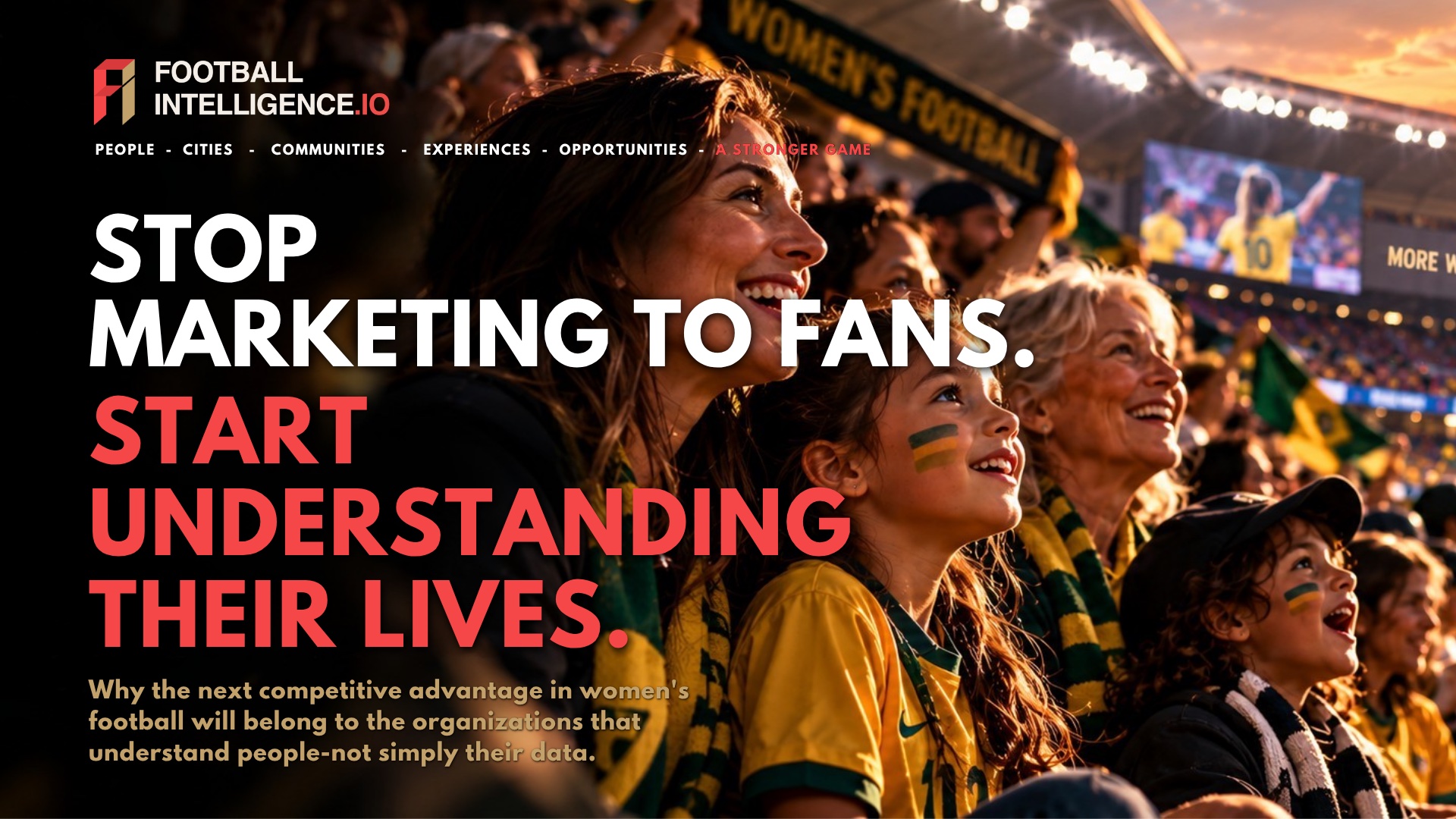
Why the next competitive advantage in women's football will belong to the organisations that understand people—not simply their data.
By Christopher Roselli
Founder | FootballIntelligence.IO
Former Professional Footballer | Digital Innovation, Football Strategy & Commercial Transformation
10-minute read
In my first two articles in this series, I challenged the idea that women's football should simply inherit the commercial and digital infrastructure established by the men's game.
I also explored why the FIFA Women's World Cup Brazil 2027 presents an extraordinary opportunity to rethink what meaningful engagement could look like beyond the tournament itself.
But there's a more fundamental question beneath both arguments.
Do we actually understand the people we're trying to engage?
Not simply their demographics.
Not their social media behaviour.
Not how many tickets they've purchased.
Or how frequently they've interacted with a digital platform.
I'm talking about understanding people as human beings.
Their identities.
Their motivations.
Their emotional connections.
Their families.
Their communities.
And the role football plays within their everyday lives.
Because I believe one of the biggest limitations in conventional fan engagement is that we continue designing strategies around what organisations want people to do.
Rather than understanding why people choose to build relationships with football in the first place.
That's not simply a marketing problem. It's a strategic problem.
And it's one that women's football has an exceptional opportunity to address.
Before spending approximately two decades working across digital innovation, brand engagement, communication and commercial strategy, I spent 15 years playing professional football.
That combination has shaped how I think about the relationship between sport and people.
I've experienced the extraordinary emotional connection football creates.
And I've spent much of my professional career examining how organisations attempt to understand, communicate with and develop commercial relationships around those connections.
One principle that has significantly influenced my work comes from the field of cognitive anthropology.
Understanding how people construct meaning, form identities, develop emotional relationships and interpret the world through their everyday experiences.
Applied to brand engagement, the implications are profound.
The most successful brands don't expect people to reorganise their lives around the brand. They find meaningful ways to become relevant within people's existing lives.
This is a distinction I believe world football needs to examine far more seriously.
Because for too long, we've approached engagement by asking supporters to enter environments we've created.
Download the application.
Join the programme.
Subscribe to the platform.
Watch the content.
Respond to the notification.
Participate in the campaign.
And ultimately, complete the transaction.
There's nothing inherently wrong with these activities.
But they aren't necessarily evidence of a meaningful relationship.
An organisation can have an extraordinary amount of data about someone and still understand remarkably little about what matters to them.
And understanding that difference is where the next evolution of engagement begins.
In September 2026, Populous and YouGov Sport published research examining what supporters actually value from women's football matchday experiences in the United Kingdom.
The study surveyed 2,000 existing and potential women's football attendees.
Its findings raise an important question about how the industry prioritises engagement investment.
Among existing attendees, only 15% reported attending women's football matches at least monthly.
And when respondents considered what makes matchday experiences enjoyable, practical factors such as comfort, accessibility, food and drink, and welcoming environments featured prominently.
The research identified a gap between growing interest in the women's game and regular attendance at domestic clubs.
Think about what that tells us.
Interest exists.
The opportunity exists.
But simply making more people aware of women's football doesn't necessarily mean they'll develop regular, lasting relationships with it.
The problem may not be that supporters need more reasons to consume football.
It may be that organisations need a better understanding of what makes participation meaningful, convenient and valuable in their lives.
This is a fundamentally different strategic starting point.
And it has implications that extend far beyond stadium design.
Modern football organisations have access to increasingly sophisticated information.
Audience demographics.
Ticketing behaviour.
Content consumption.
Digital interactions.
Merchandise purchases.
Campaign performance.
Social media activity.
All valuable.
But these measurements primarily describe observable behaviour.
They don't necessarily explain its meaning.
Consider two people attending the same women's football match.
One is a lifelong football supporter who follows the sport closely.
The other is a parent attending with their daughter for the first time.
Both purchased a ticket.
Both attended the same fixture.
Both may have interacted with the same digital content.
From a conventional transaction-based perspective, they may look remarkably similar.
But the significance of that experience in their respective lives could be entirely different.
For one, it's another chapter in a lifelong sporting relationship.
For the other, it could be the beginning of something that influences their family for generations.
If we don't understand those differences, how can we expect to create engagement that is genuinely relevant to either person?
The opportunity isn't simply to collect more information.
It's to develop a more intelligent understanding of why relationships begin, what makes them meaningful and how organisations can support them.
And crucially, that understanding should be built around supporter choice, trust and responsible data practices.
Not intrusive surveillance or endless attempts to capture attention.
One of the mistakes established industries frequently make is assuming that growth means attracting more people into an existing model.
But what if the model itself needs to evolve?
Women's football is developing across markets with very different histories, cultures, infrastructure and supporter expectations.
The experience of a supporter in England may be entirely different from someone in Brazil.
A family discovering the game through a Women's World Cup may have different motivations from an established domestic club supporter.
An international fan following a particular player may develop their connection differently from someone whose relationship began through a local community.
These aren't simply different demographic segments.
They're different human relationships with football.
And I believe that matters enormously.
Because a one-size-fits-all engagement approach risks overlooking the reasons people choose to participate.
Research published in Soccer & Society examining supporters of Scotland's women's national team highlights how identity, representation, inclusivity and supporter culture shape the relationship between fans and women's football.
These findings reinforce the importance of understanding distinct communities rather than assuming every football audience behaves in the same way.
Women's football has the opportunity to design around these differences rather than force them into inherited commercial assumptions.
To develop relationships that reflect local culture while supporting international growth.
To recognise families, communities and grassroots participation as meaningful dimensions of engagement.
And to build a more relevant relationship between professional football and the people who experience it.
Consider how commercial partnerships have traditionally been evaluated.
Brand visibility.
Audience reach.
Media exposure.
Impressions.
Campaign engagement.
Sales conversions.
These metrics remain important.
But I believe the most significant commercial opportunities ahead will require a broader understanding of value.
What if the starting point for a partnership wasn't simply how many people could be reached?
What if it began with understanding what supporters genuinely want to experience?
What challenges they face?
What interests they share?
And how a commercial partner could contribute something meaningful to their lives?
The difference may sound subtle.
Commercially, it could be substantial.
A partner that creates genuine relevance has an opportunity to build a different quality of relationship from one that simply purchases attention.
And women's football has an opportunity to develop that philosophy as part of its emerging commercial foundations.
The next generation of sponsorship should not simply be about placing brands in front of football supporters.
It should be about identifying where brands can create meaningful value within the lives of those supporters.
That requires a more sophisticated understanding of human behaviour.
And a different way of thinking about commercial engagement.
The FIFA Women's World Cup Brazil 2027 will bring together 32 national teams across eight host cities.
It will create extraordinary moments.
New supporters will discover women's football.
Families will build memories.
Communities will come together.
International visitors will experience Brazil.
Players will inspire future generations.
And commercial partners will participate in one of the world's most significant sporting events.
But here's the question I believe deserves attention now.
How do we understand what these experiences actually mean to the people involved?
And perhaps more importantly:
How can that understanding inform more meaningful relationships beyond the tournament?
A World Cup creates global attention.
But attention doesn't automatically become lasting engagement.
And lasting engagement doesn't emerge simply because a supporter downloads another application or follows another social media account.
It emerges when football continues to provide relevance within their lives.
That's why I believe Brazil 2027 presents an opportunity that extends far beyond the tournament's commercial and digital operations.
Not simply to generate more interactions.
But to examine how global football relationships could become more meaningful, connected and enduring.
The implications extend into national federations, domestic leagues, clubs, communities and future international competitions.
The tournament may last 32 days.
The relationships it inspires could last a lifetime.
But that outcome requires a different level of strategic thinking.
Artificial intelligence is advancing rapidly.
Digital identity is evolving.
Connected experiences are becoming increasingly sophisticated.
Organisations have more opportunities than ever to personalise communication and understand behavioural patterns.
And the infrastructure required to connect physical and digital experiences continues to improve.
These are extraordinary developments.
But I've become increasingly convinced that the real competitive advantage will not come simply from possessing the most advanced technology.
It will come from knowing what to do with it.
Technology should enable human relevance.
Not replace it.
And certainly not become the reason engagement exists.
This is where I believe football needs a more integrated strategic approach.
One that begins with understanding the relationship.
Then considers the capabilities required to support it.
One that connects commercial ambition with meaningful supporter experiences.
And one that measures success not simply through interactions, but through the value created over time.
After two decades working across these disciplines, I've developed a clear perspective on how these opportunities can be brought together.
And I believe the potential applications across women's football are significant.
Not merely for individual clubs.
But across federations, international competitions and the broader commercial ecosystem.
The challenge is no longer simply what technology can do.
It's whether we're prepared to rethink the engagement model that technology is being asked to support.
They'll understand them better.
They'll recognise that people don't experience football in isolation.
They experience it through families.
Friendships.
Communities.
Identity.
Culture.
Aspiration.
And everyday life.
They'll understand the difference between generating an interaction and building a relationship.
Between reaching an audience and becoming relevant to it.
Between collecting information and developing genuine understanding.
And between extracting commercial value and creating value that supporters willingly participate in.
Women's football has an opportunity to establish those principles now.
As its infrastructure develops.
As its commercial partnerships expand.
As its global audiences grow.
And as international competitions such as Brazil 2027 create extraordinary new opportunities to connect with people.
The most important question in fan engagement isn't how we get supporters to spend more time with football.
It's how football can become more meaningfully connected to the time supporters already spend living their lives.
That's where I believe the next generation of engagement begins.
And that's where I believe the most interesting commercial opportunities are waiting to be developed.
Through this series, I've been challenging a fundamental assumption.
That the future of women's football should be built by adapting the commercial and engagement structures of the past.
I believe we have an opportunity to approach it differently.
To begin with human understanding.
To create relationships built around genuine relevance.
And to develop more connected, sustainable commercial engagement models that reflect how people actually experience football.
This is an area I've spent much of my professional career exploring.
And one where I believe a practical, strategically developed approach can make a meaningful difference.
For FIFA, national federations, women's leagues, club leadership, commercial partners and organisations exploring the opportunities surrounding Brazil 2027, I believe this conversation deserves to move beyond traditional marketing thinking.
The opportunity isn't simply to reach the next generation of football supporters.
It's to understand them well enough to build something that matters to them.
And ultimately, to create the conditions for relationships that endure.
Stop marketing to fans. Start understanding their lives.